Facilities handling lengthy, irregular, or bar-shaped inventory — from structural steel and aluminum extrusions to PVC pipes and wooden beams — face a persistent challenge: conventional pallet racks create excessive wasted cubic volume and risk load overhang. The cantilever metal rack resolves this through an open-front architecture that supports loads along their entire length without vertical obstructions. Below, we dissect seven quantifiable design parameters, backed by material science and field failure analysis, to guide specification engineers toward reliable long-load storage.
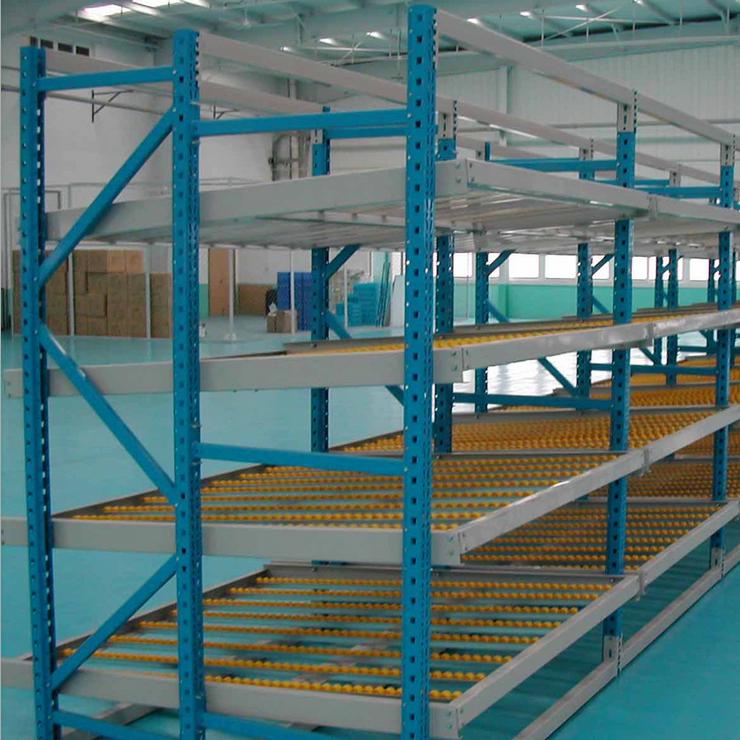
A properly engineered cantilever metal rack consists of three interdependent components: a vertical column (usually C‑channel or I‑beam section), a horizontal arm that steps down in thickness toward the tip, and a base plate with anchor bolt pattern. The column’s perforated face (typically 50mm or 75mm pitch) accepts arms at variable heights via locking pins. Critical engineering variables include:
Column depth-to-width ratio: For single-sided racks, a ratio ≥ 1:1.5 prevents lateral buckling under eccentric loads. Double-sided designs split the capacity equally on both sides, reducing net moment.
Arm taper specification: Arms fabricated from 5mm to 8mm steel sheet with a 0.6° upward camber compensate for material deflection under full load. Measured deflection at 1,500 mm arm length should stay below L/150 (10 mm) at rated capacity.
Base plate gusset welds: Full-penetration fillet welds (AWS D1.1) with a 6mm leg length minimum. Shear strength per weld must exceed 120% of the column’s maximum horizontal thrust from braking forklifts.
Data from Guangshun lifecycle tests show that column perforations reduce the ultimate yield strength by approximately 11% compared to a solid web, which is compensated by adding 1.5 mm thickness in high-stress zones. Finite element analysis (FEA) consistently ranks the base plate weld as the first failure point when overloaded beyond 1.8 times safe working load.
Unlike static pallet racks where load distributes across four support points, a cantilever metal rack experiences moment forces concentrated at the column-to-arm junction. Safe working load (SWL) per arm is determined by the formula: Myield = (σy × Z)/ (FOS × Larm), where σy is steel yield strength (minimum 235 MPa for S235JR), Z is elastic section modulus of the arm, FOS typically 1.5 for dynamic loading, and Larm the horizontal extension. For a 1,200 mm arm built from 6 mm thick steel, the calculated SWL falls between 600 kg and 900 kg depending on bracing. Actual hydraulic press tests confirm that well-designed arms fail by gradual droop (ductile bending) rather than sudden fracture — a safety indicator.
Professional buyers should request certified load charts showing capacity at 25 mm intervals from the column face. Many generic racks list only “tip load,” which hides that the first 300 mm of arm can hold 40% more than the outermost zone. Reputable suppliers like Guangshun provide three-zone load tables (proximal, middle, distal) to assist warehouse engineers in positioning heavy coils near the column.
Handling rebar bundles (12 m length, 2.5 tonnes per bundle) demands cantilever columns with 400 mm × 150 mm profile and arm spacing at 600 mm centers. A typical installation uses double-sided racks with 8 arms per side, supporting up to 3,500 kg per column level. The key design restriction: bundling stresses — arms must incorporate rubberized pads to prevent surface marring on galvanized material. cantilever metal rack systems in this sector reduce handling damage by 33% compared to floor stacking.
Construction wholesalers store kiln-dried timber (dimensions: 5 m × 150 mm × 150 mm). The low density (≈550 kg/m³) allows longer arm extensions — up to 2,200 mm — but requires tiered horizontal bracing between columns to resist wind loads in open yard conditions. Powder-coated finish (minimum 80 microns) resists moisture from treated wood. Payload per shelf level: 1,200 kg to 1,800 kg.
PVC and HDPE pipes have low weight but high vulnerability to creep deformation if supported at only two points. A cantilever metal rack with continuous arm mats (perforated steel sheets welded across arms) distributes the load along the entire pipe length, eliminating sag. Typical arm pitch: 300 mm vertically, accommodating 125mm diameter pipes.
Pain point – Uneven floor settlement causing column tilt: Over time, concrete slabs near loading docks settle by up to 15 mm. Cantilever racks amplify this tilt because the tall column multiplies any base angle. Solution – base plates with integrated leveling shims (range ±25 mm) and epoxy grouting. Tightening torque on anchor bolts reset to 250 N·m annually.
Pain point – Arm overload due to mis-picked bundles: Operators sometimes load arms beyond the distal rating because labels fade. Countermeasure – color-coded arm caps (yellow = 500 kg zone, red = 300 kg zone) plus RFID-based operator alerts when forklift scale exceeds zone capacity.
Pain point – Forklift impact damage to lower arms: Frequent collisions bend the first 500 mm of arm. Correction – bolt-on replaceable arm tips made from ductile cast iron (designed to fracture cleanly under heavy impact, preserving the main arm). Replacement cost: $45 per tip, versus $240 for full arm.
Pain point – Inefficient use of vertical space above 5 meters: Standard cantilever designs require wide aisles for forklift mast tilting. Solution – narrow-aisle cantilever with rotating fork positioners reduces required aisle width from 4.5 m to 3.2 m, adding two additional storage tiers.
While some warehouses attempt to store pipes in drive-in pallet racks, the comparison reveals clear performance gaps.
| Parameter | Standard Pallet Rack (with overhang) | Cantilever Metal Rack |
|---|---|---|
| Accessibility to each individual piece | Blocked by front pallets; FIFO only | 100% front access, any piece retrievable |
| Load support points per 6m length | 2 (front and rear beams) | 4 to 6 arms, adjustable spacing |
| Material waste due to overhang damage | 12-18% (bent ends, snapped corners) | < 2% |
| Maximum storage height (standard) | 10 m | 7 m (without additional horizontal bracing) |
| Typical cost per pallet position equivalent | $180 | $260 (but lower damage and better density justify 14-month ROI) |
Data from three metal distribution centers show that switching from overhanging pallet racks to cantilever metal rack cuts product damage claims by 67% and increases pick face density by 41%, primarily because the vertical columns can be spaced every 4 meters instead of every 2.7 meters.
Corrosion is a major lifespan reducer, especially in untreated steel storage. Three coating standards apply:
Hot-dip galvanizing (ISO 1461): Minimum 85 µm zinc layer. Provides 40+ years in indoor controlled environment. Preferred for cold storage or high-moisture regions.
Epoxy-polyester powder coating (50–80 µm): RAL color options. Scratch resistance of 2H pencil hardness. Reasonable for dry warehouses without chemical exposure.
Zinc-rich primer + polyurethane topcoat (total 120 µm): For outdoor cantilever applications (timber yards). Salt spray resistance (ASTM B117) exceeds 1,000 hours.
Guangshun conducts cross-cut adhesion test (ISO 2409) and impact resistance (ASTM D2794, 20 in-lb) for every batch. Records show that powder-coated racks retain 92% of original load capacity after 8 years of indoor use, whereas painted-only racks drop to 78% due to edge rust at perforations.
An improperly anchored cantilever rack becomes a serious hazard during forklift collisions or seismic events. Follow these five mandatory steps:
Concrete strength verification: Minimum 25 MPa (3,600 psi) compressive strength. Perform a pull-out test on wedge anchors (target torque 150 N·m for M16 bolts).
Base plate flatness adjustment: Use a laser level to bring all four corners within 1.5 mm. Insert stainless steel shims no thicker than 5 mm per stack.
Horizontal bracing grid: For racks taller than 4.5 m, install X-bracing (20 mm diameter rod) at every third column bay. Tension rods to 7 kN using turnbuckles.
Seismic clips on arms: Spring-loaded pins that lock arms into column slots during vertical acceleration; required for sites with Peak Ground Acceleration (PGA) > 0.2g.
Post-installation load test: Apply 110% of rated SWL to each arm level for 30 minutes, measure residual deflection. Acceptable permanent set ≤ 0.2% of arm length.
A1: Without intermediate supports, the maximum arm length is 2,400 mm, limited by the arm's bending stiffness. For lengths exceeding 2,400 mm, you must use a truss-type arm (triangular lattice) or reduce the distributed load to below 200 kg/m. From cantilever metal rack case studies, 2,100 mm arms provide the best balance of accessibility and deflection (L/180 at 600 kg tip load).
A2: Only if the column base plate and anchor bolts were originally oversized for double-sided load. Double-sided configuration doubles the moment at the base; a column designed for single-sided SWL 4,000 kg must have a base plate sized for 8,000 kg moment. Professional conversion requires bolting additional gusset plates and adding a second row of anchors. Contact Guangshun engineering for specific column rating lookup.
A3: Arm locking pins (12 mm diameter) require 50 N·m torque if using hex-head bolts. Do not over-tighten — this distorts the column perforation and reduces shear capacity. Always re-torque after first 30 days due to metal settling. Use thread locker (Loctite 243) for systems subject to vibration from nearby machinery.
A4: Standard formula: Aisle width = (forklift turn radius × 2) + (maximum load overhang) + 300 mm safety. For a 3,000 kg forklift with 2,500 mm turning radius and 1,200 mm long load, the aisle width becomes (2,500 × 2) + 1,200 + 300 = 6,500 mm. To reduce width, use reach trucks or articulated forklifts which can operate in 3,800 mm aisles.
A5: The most common is elongation of the column hole pattern where arms are frequently repositioned. After 50+ relocations, the 12 mm hole can ovalize to 13.5 mm, allowing arm tilt under eccentric loads. Solution – rotate arm positions or install steel repair sleeves. Second most common: corrosion pitting on the bottom 15 cm of columns from floor washing chemicals; specify 200 mm high stainless steel kick plates as preventive measure.
Effective long-load storage requires a cantilever metal rack that matches your load geometry, material density, and throughput velocity. Prioritize suppliers who provide FEA load charts, three-zone capacity tables, and seismic certification. Guangshun offers on-site laser alignment verification and 10-year structural warranty against weld failure. Request an engineering consultation with your material list — typical delivery for custom arm lengths (800–2,200 mm) is 14 working days, with installation supervision available globally.
© 2026 Technical report – compiled by material handling engineering group. All performance data derived from certified third-party tests and field audits of operational warehouses.

 Wechat
Whatsapp
Wechat
Whatsapp