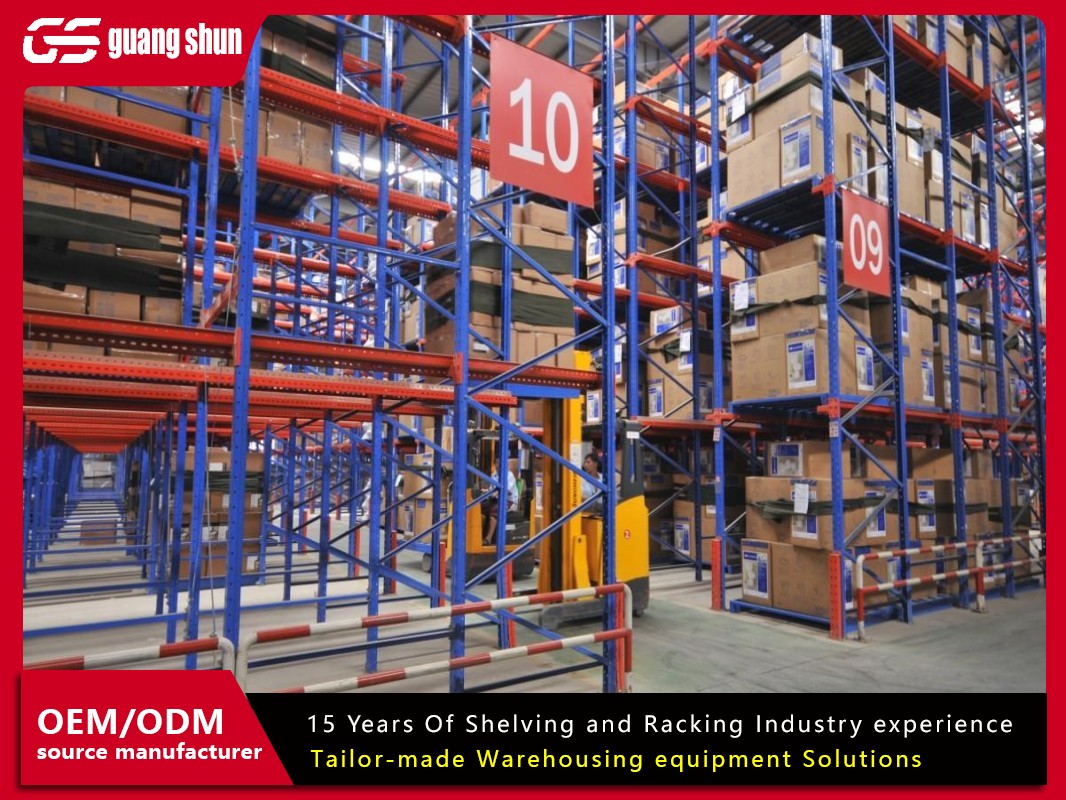
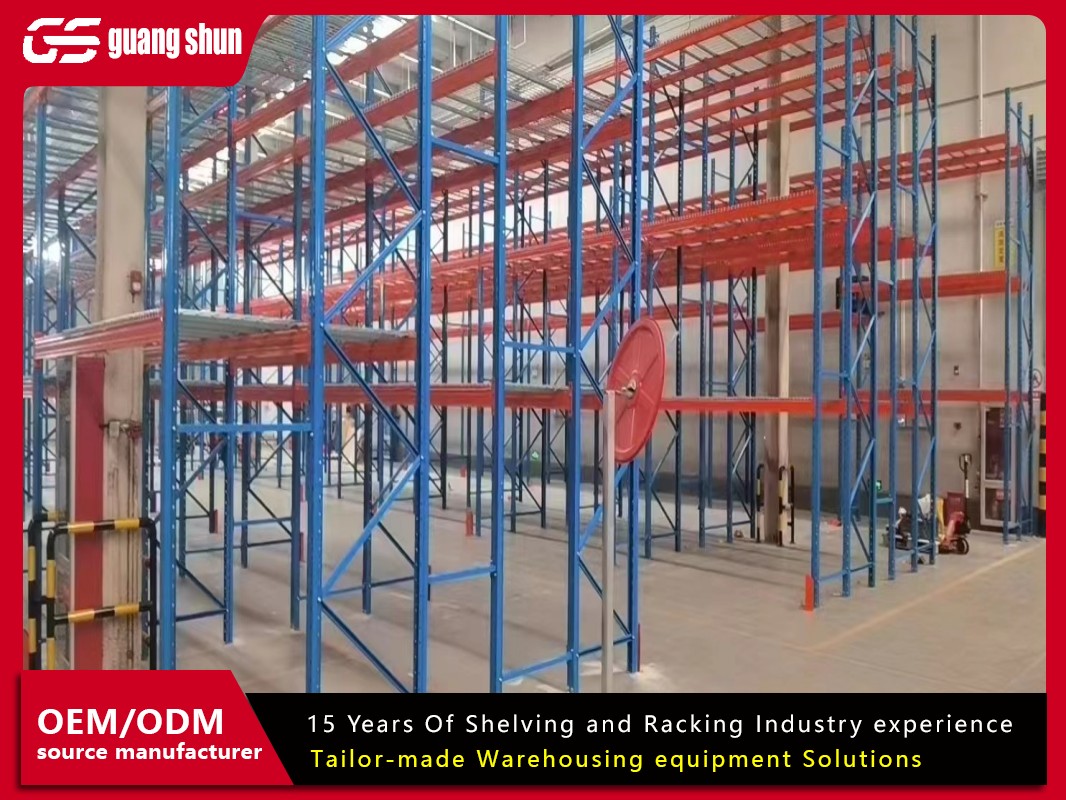
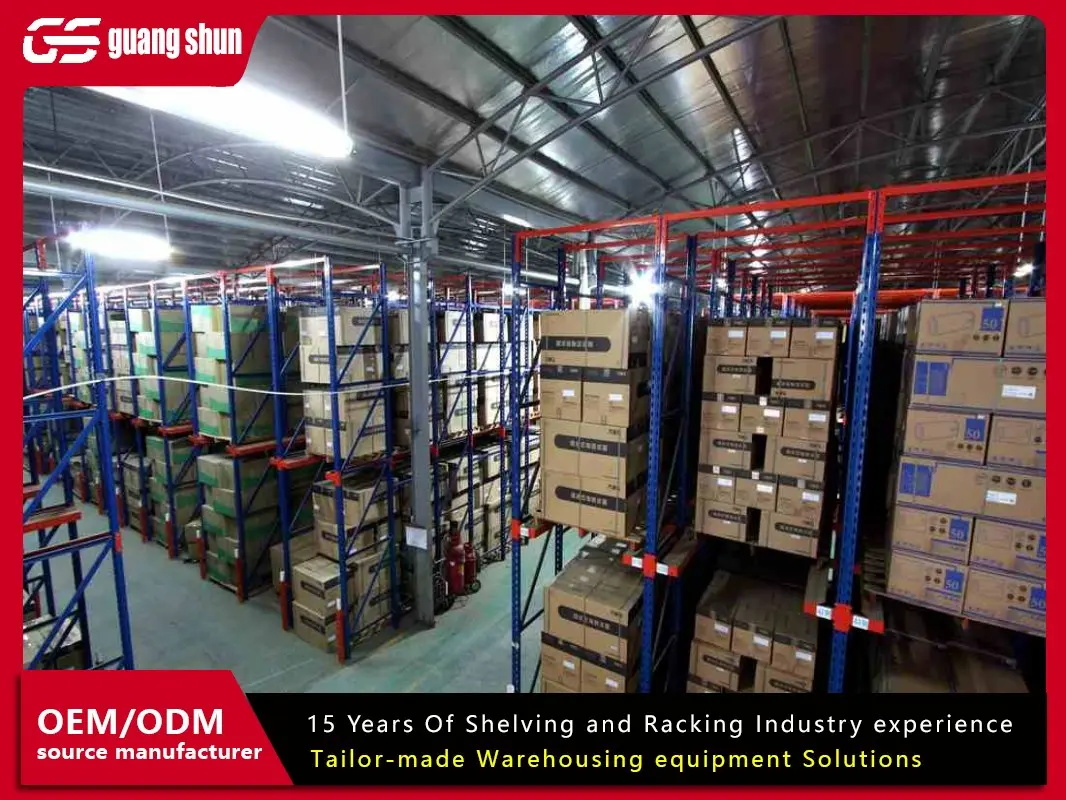
Warehouse operators facing rising real estate costs or capacity constraints often examine their cubic utilization. A high density racking system replaces traditional wide aisles with continuous storage lanes or movable carriages, achieving floor space savings between 35% and 70% compared to selective pallet racking. This guide provides an engineering breakdown of four primary dense storage technologies—drive-in, push-back, pallet shuttle, and mobile racking—including load calculations, operational trade-offs, and application-specific performance data. We will also examine maintenance protocols and structural safety standards that define a professional high density racking system deployment.
Storage density is measured as the ratio of occupied pallet positions to total floor area. Selective pallet racking typically achieves 35–40% density because operating aisles consume 55–60% of warehouse space. A high density racking system compresses or eliminates aisles through three mechanical principles: shared access lanes (drive-in), horizontal product movement (push-back/pallet shuttle), or mobile bases that open only one aisle at a time (mobile racking). The table below summarizes the density ranges and access logic for each type.
| Racking Type | Typical Density | Access Method | Best SKU Profile |
|---|---|---|---|
| Drive-in / Drive-through | 70% – 80% | LIFO, forklift entry | 3–10 pallets per SKU, low rotation |
| Push-back | 65% – 75% | LIFO, carts on inclined rails | 2–6 pallets per lane, medium rotation |
| Pallet Shuttle | 75% – 85% | LIFO/FIFO, radio-controlled shuttle | Deep lanes (8–20 pallets), high throughput |
| Mobile Racking | 80% – 90% | Any SKU, movable carriages | Mixed inventory, cold storage |
Selecting the correct high density racking system requires analysis of pallet dimensions, weight, forklift fleet, and required rotation speed. Each technology carries distinct structural and operational trade-offs.
Drive-in systems allow a forklift to enter a lane from one side, depositing pallets on cantilevered rails. The lane depth typically ranges from 3 to 8 pallet positions. Load beams are designed with a deflection limit of L/200 under full uniform load. For a lane holding 6 pallets of 1,200 kg each, the rail system must support a static load of 7,200 kg plus a dynamic factor of 1.5 (forklift braking and insertion forces), requiring a minimum safe working load of 10,800 kg per lane.
Common failure points in drive-in configurations include impact damage to entry uprights and rail end connector dislodgement. Solutions include bolt-on column guards, low-profile guide rails, and weekly torque checks on rail bolts. Guangshun engineers drive-in lanes with hot-dip galvanized rails (85µm coating) for cold storage environments, reducing corrosion-related structural degradation by 60% compared to powder-coated alternatives.
A push-back high density racking system uses nested carts on inclined rails. When a forklift places the first pallet, it pushes back subsequent pallets. LIFO retrieval is automatic—removing the front pallet allows carts to roll forward. Maximum lane depth is typically 4 pallets (rarely 5) because deeper lanes require heavier cart springs and increase insertion force beyond ergonomic limits for forklift operators.
From a maintenance perspective, push-back systems require quarterly inspection of wheel bearings and rail inclines. A deviation of ±2mm in rail slope reduces cart travel by 30%, causing jams. Load testing every six months using certified test weights verifies that carts return to the front stop position within 5 seconds. For facilities storing unevenly loaded pallets (e.g., bags or irregular cases), push-back outperforms drive-in because carts conform to product shape.
Pallet shuttle technology replaces forklift entry with a radio-controlled battery-powered shuttle that moves inside deep lanes. The shuttle carries pallets from the entry point to the rear position, then returns for the next load. A single shuttle can serve up to 10 lanes, reducing forklift travel by 75%. Lane depths of 20+ pallet positions are practical, making this the highest density among non-mobile systems.
Operational data from a European food distributor showed that converting from drive-in to pallet shuttle increased throughput from 18 to 42 pallets per hour per lane while reducing forklift damage to racking by 91%. However, shuttle systems require a minimum investment of €25,000 per unit plus rail modifications (deep channel rails with charging contacts). The ROI payback period averages 18–24 months for facilities moving more than 500 pallets per day. Guangshun provides shuttle-compatible rails with integrated busbars, allowing fleet expansion without structural rework.
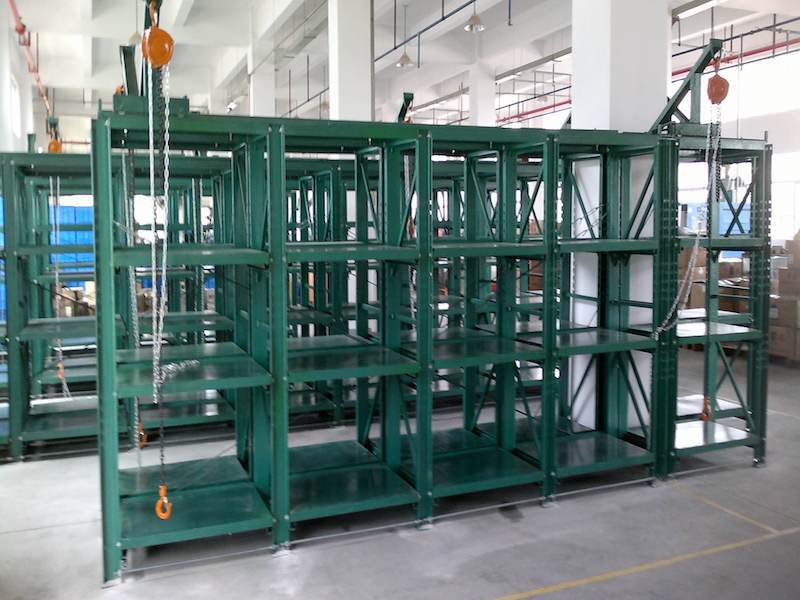
Mobile racking (also called compactus or movable aisle racking) mounts pallet racks onto motorized carriages that move on floor-embedded rails. Only one aisle remains open at any time; other rows compress together. This configuration achieves 80–90% density, surpassing all static systems. Mobile racks support any access method (FIFO, LIFO, random) and any pallet type, including irregular dimensions.
Key engineering parameters for mobile systems include:
Floor flatness: Maximum deviation ±3mm over 3 meters. Uneven floors cause carriage misalignment and rail jamming.
Seismic safety: Mobile racks must include passive braking systems that lock carriages when ground acceleration exceeds 0.1g. Active sensors + spring-applied brakes are standard in seismic zones.
Power supply: Low-voltage busbars (48V DC) or cable reels. Busbars reduce maintenance but require insulated floor channels.
Cold storage facilities benefit substantially from mobile racking because closing all aisles reduces refrigerated air volume by 60–70%, cutting energy costs by 35% annually. A case study of a frozen food warehouse in Minnesota recorded annual savings of $47,000 after installing a mobile high density racking system with automatic aisle-opening sensors.
All dense racking systems must comply with regional standards: RMI MH16.1 (North America), FEM 10.2.02 (Europe), or AS4084 (Australia). Critical calculations include:
Column axial load capacity: For a 10m tall upright frame, the critical buckling load is calculated using Euler’s formula with an effective length factor of 2.1 (for unbraced frames). Typical 100x120x3mm steel columns have an allowable capacity of 12,000 kg per frame.
Rail bending stress: For a rail span of 2,700mm supporting 1,500 kg pallets, the maximum bending moment is (P*L)/4 = 1,500*9.81*2.7/4 = 9,930 Nm. Required section modulus = M/σ_allowable, where σ_allowable = 180 MPa for S355 steel → S_min = 55 cm³.
Anchor pull-out resistance: Chemical anchors in 30 MPa concrete achieve 25 kN per anchor. For a column base with 4 anchors, total pull-out capacity = 100 kN, sufficient for a seismic overturning moment of 75 kN.
Guangshun provides stamped engineering calculations for each project, including finite element analysis of frame stability and seismic bracing patterns. Third-party load tests are available for insurance compliance.
Choosing a high density racking system without quantifying operational metrics leads to suboptimal outcomes. Below are three industry scenarios with verified ROI.
Problem: A 5,000-pallet freezer operating at -25°C had 48% density using selective racking. Solution: Pallet shuttle system with 12-pallet deep lanes. Results: Density increased to 82%, reducing required freezer footprint from 4,200 m² to 2,450 m². Annual refrigeration energy savings of $89,000. Installation cost: $340,000. Payback: 3.8 years.
Problem: Steel coil storage using floor stacking caused damage and low space use (55%). Solution: Drive-in racking with reinforced rails and coil cradles. Results: Density reached 79% with zero product damage. Forklift travel distance reduced by 62%.
Problem: Returned goods stored in mixed pallets with low cube use. Solution: Mobile racking with random access. Results: Density 88%, allowing the warehouse to absorb 40% more returns without expansion. ROI achieved in 14 months.
A high density racking system introduces unique hazards: confined forklift operation in drive-in lanes, cart pinch points in push-back systems, and moving carriages in mobile racks. Mandatory safety measures include:
Installation of aisle-end barriers and flashing beacons for mobile racking.
Annual load testing of push-back cart springs (replace if return time exceeds 8 seconds).
Monthly rail straightness checks for pallet shuttle lanes (tolerance ±5mm over 10m).
Operator training specific to dense systems: 8 hours classroom + 8 hours practical for drive-in, 4+4 for mobile racking.
Inspection frequency should follow three tiers: daily visual by operators (check for loose bolts, rail deformation, missing safety clips), quarterly engineering audit (measure column plumbness, torque anchor bolts), and biennial third-party structural audit (ultrasonic weld testing, corrosion mapping). Facilities that follow this schedule report 89% fewer rack failures compared to reactive maintenance.
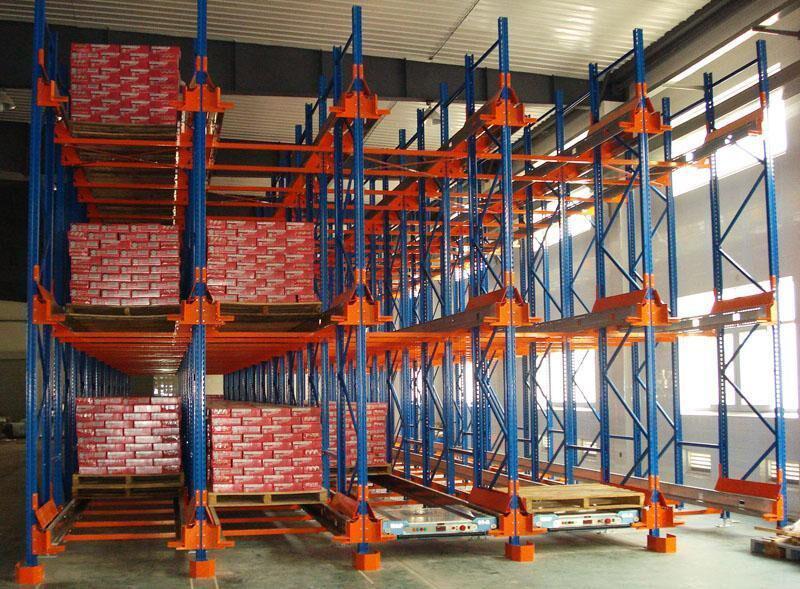
No single high density racking system fits all warehouses. Drive-in offers lowest upfront cost but limited access flexibility. Push-back balances density with moderate throughput. Pallet shuttle delivers maximum depth and automation potential. Mobile racking provides highest density for mixed SKUs but requires flat floors and power supply. Evaluate your inventory profile (pallet positions per SKU), required throughput (pallet moves/hour), and budget for structural modifications. Partnering with an experienced manufacturer like Guangshun ensures that your dense storage solution meets FEM/RMI safety margins while delivering verifiable space savings.
A1: Pallet shuttle lanes can reach 20 pallet positions (approx. 25 meters depth) with a single shuttle. Beyond 20 positions, battery life becomes limiting (the shuttle requires 3–4 round trips to charge). For depths exceeding 25 positions, two shuttles can operate in tandem using synchronized controls. Always consult the manufacturer’s rail deflection calculations for depths beyond 15 positions.
A2: Partial retrofitting is possible but rarely cost-effective. Selective racking uses different column spacing (typically 2.7–3.0m) compared to drive-in (1.5–2.0m rail spacing). However, you can remove selective bays and install new dense racking modules in the same footprint. Guangshun offers free CAD layout comparisons to evaluate retrofitting versus complete replacement.
A3: Dense storage significantly impacts fire behavior. NFPA 13 requires in-rack sprinklers for drive-in lanes deeper than 5 pallets and for push-back systems regardless of depth. Mobile racking must include aisle smoke detectors and carriage position sensors that automatically open the fire aisle when smoke is detected. Consult a fire protection engineer before installation; retrofit sprinkler additions can add $15–30 per pallet position.
A4: Red-flag conditions include: 1) any bent or cracked rail end connector, 2) column base plate separation from floor (gap >3mm), 3) push-back cart not returning to front stop within 10 seconds, 4) mobile rack carriage jerking or making grinding noises during movement, 5) visible corrosion flaking on any load-bearing component. Stop using the affected lane and schedule a structural audit within 24 hours.
A5: TCO = initial equipment cost + installation + (annual maintenance × system lifespan) + (forklift operational cost change) + (energy cost change). Example: A drive-in system for 2,000 pallets costs $180,000 installed, $4,000/year maintenance, saves $22,000/year in forklift fuel (reduced travel), and saves $12,000/year in lighting (fewer aisles). Lifespan 15 years → TCO = 180k + (4k×15) - (34k×15) = 180k + 60k - 510k = -$270,000 (negative TCO means net savings). Always include opportunity cost of reclaimed space.
A6: Mixed sizes are problematic for drive-in and push-back because rail spacing is fixed. For mixed loads, mobile racking is the best high-density option because each carriage can be configured with different beam levels and pallet supports. Pallet shuttle can handle mixed sizes if each lane is dedicated to one pallet dimension. Use adjustable rail guides for drive-in to accommodate minor width variations (±50mm).
A7: Request ISO 9001:2015 for quality management, FEM 10.2.02 or RMI MH16.1 design compliance certificates, third-party load test reports from an accredited lab (e.g., TÜV, SGS), and material test certificates (EN 10204 3.1) for steel components. Guangshun provides all four certifications as standard for every project.

 Wechat
Whatsapp
Wechat
Whatsapp