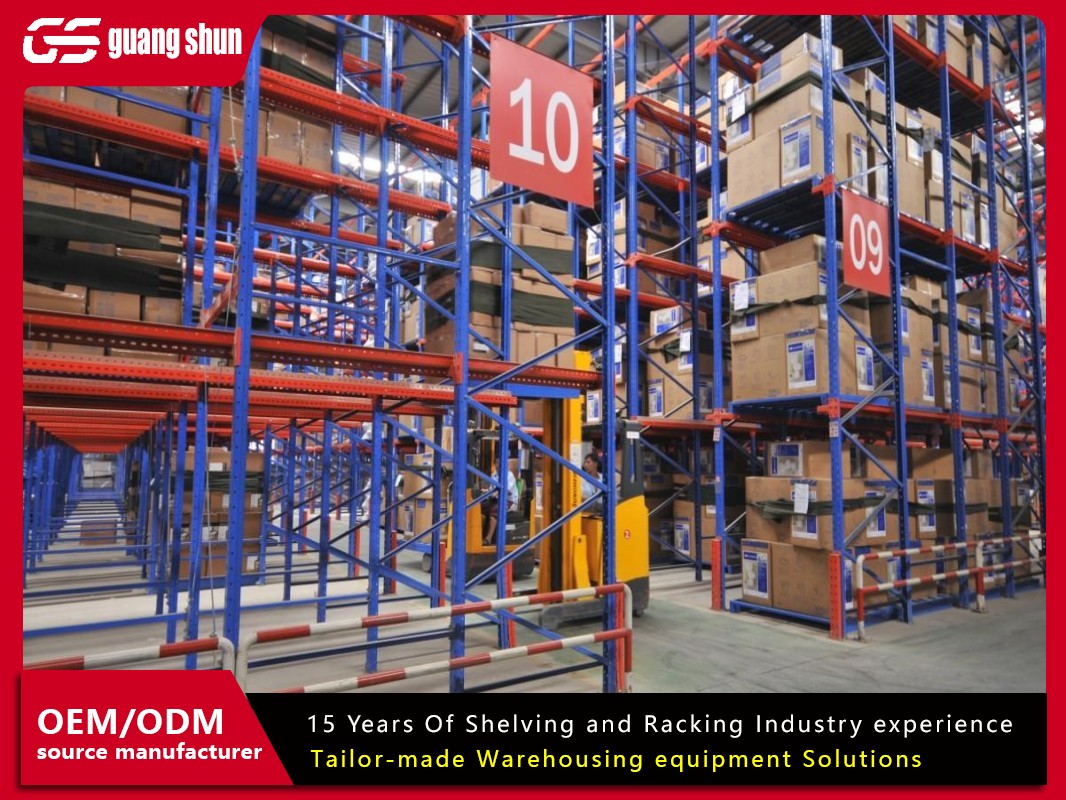
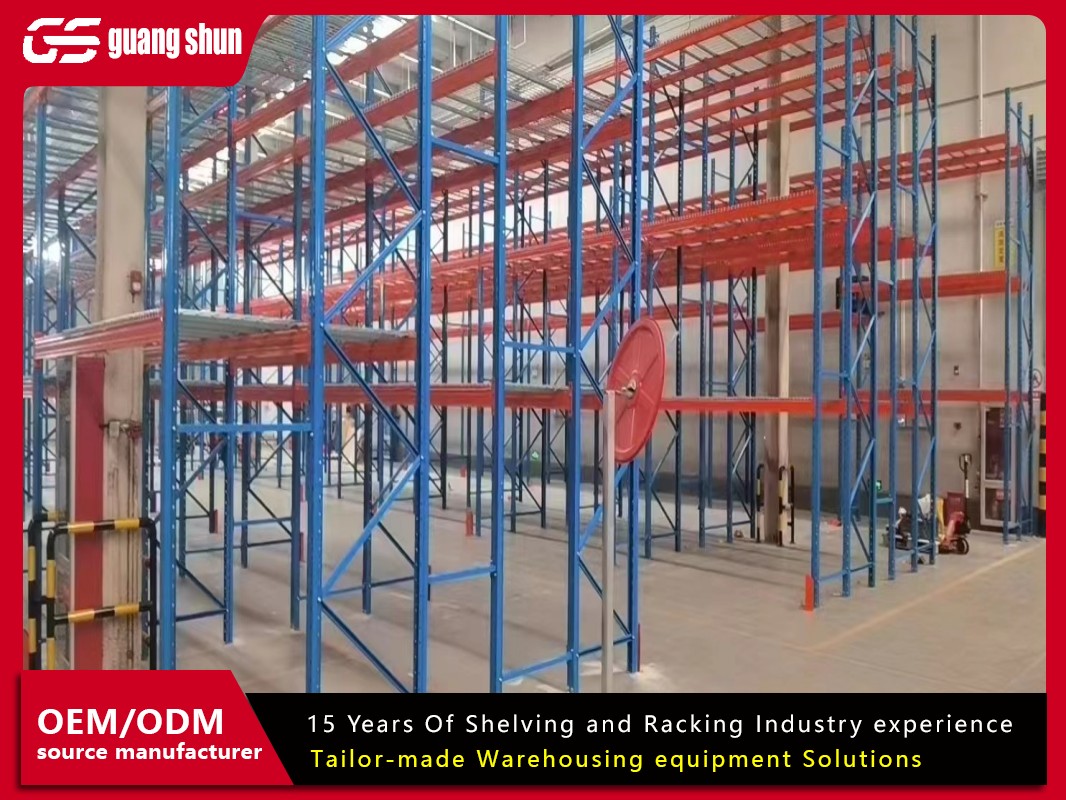
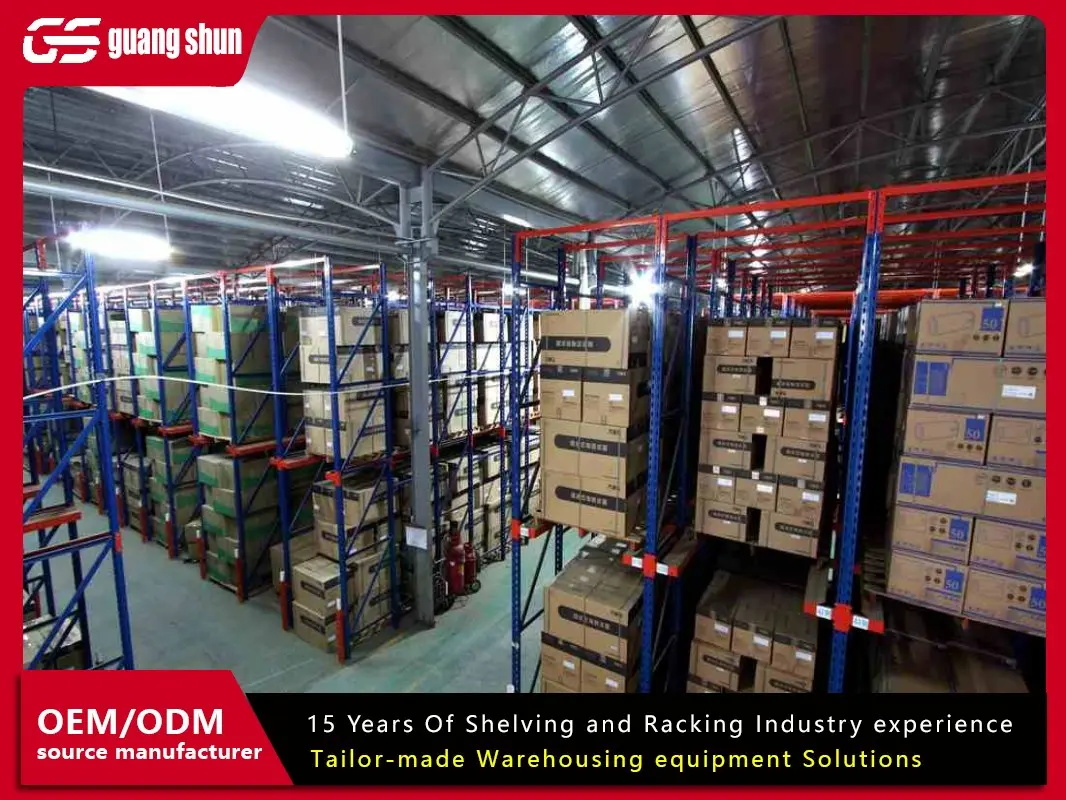
Manufacturing plants, automotive parts distribution centers, and bulk material warehouses face a persistent operational constraint: storing thousands of SKUs with individual weights exceeding 500 kg per shelf while maintaining immediate accessibility. Standard office shelving collapses under these conditions. A properly specified large industrial shelving unit differs fundamentally in steel thickness, connection methods, and floor anchoring. This guide provides structural engineers and facility managers with load calculation methods, material grade comparisons (Q235B vs Q355B), boltless connector fatigue life, and seismic bracing requirements. Guangshun has deployed such systems in automotive stamping plants and e‑commerce fulfillment hubs, achieving documented reductions in picking errors and cubic space waste.
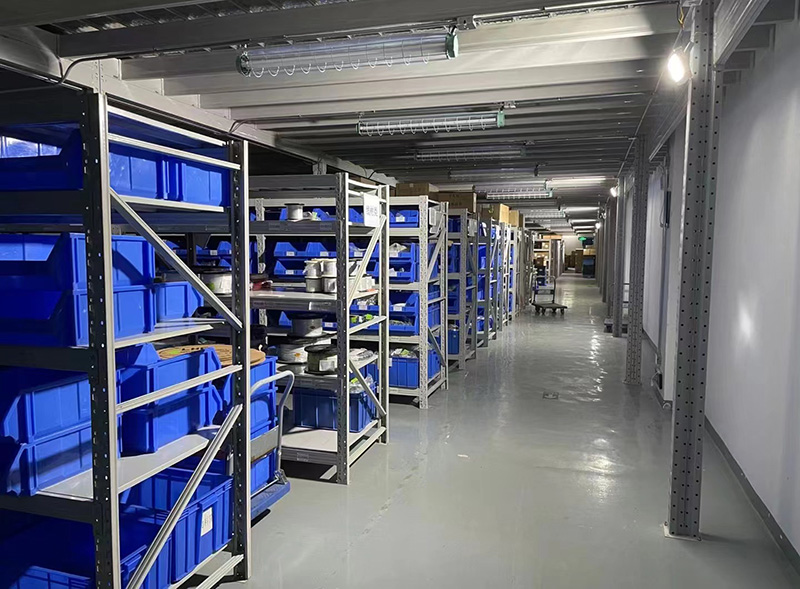
Industrial shelving units are not monolithic. Each large industrial shelving unit comprises four load‑bearing subsystems that must resist static gravity loads, dynamic forklift impacts, and lateral seismic forces. The primary components include:
Upright frames (columns): Roll‑formed from hot‑rolled steel coils, typically grade Q235B (yield strength ≥235 MPa) for general use, or Q355B (≥355 MPa) for heights above 5 meters. Section dimensions range from 80×40 mm to 120×60 mm, with wall thickness 1.5 mm to 2.5 mm. Perforated pitch (50 mm or 75 mm) determines beam height adjustability.
Horizontal beams (shelf supports): Box‑section or C‑channel profiles with integral locking tabs. Beam depth (60 mm, 80 mm, or 100 mm) dictates deflection under point loads. Maximum allowable deflection is L/200 (L = beam span).
Decking materials: Options include particle board (18–25 mm, limited to 300 kg per shelf), steel wire mesh (grid pattern for air circulation), or solid steel panels (2.0 mm thick, rated up to 2,000 kg per level). For heavy die storage, ribbed steel decks with 30 mm stiffening ribs are mandatory.
Footplates and floor anchors: 5 mm thick base plates with two or four anchor holes. Anchor bolt specification (M10, M12, or M16) depends on concrete compressive strength (minimum 25 MPa) and expected shear forces.
Diagonal braces and back ties: X‑braces or Z‑bracing prevent rack sway. Required for any large industrial shelving unit exceeding 2.4 m height or located in seismic zones with PGA > 0.1g.
Surface finish involves electrostatic powder coating (60–80 μm) over zinc phosphate pretreatment. For corrosive environments (chemical plants, food processing with saline washdowns), hot‑dip galvanizing to ASTM A123 is specified. Guangshun provides certified salt spray test reports exceeding 600 hours per ASTM B117 for all painted finishes.
Selecting the wrong configuration directly increases floor space consumption and picking cycle times. Below are four dominant types used in heavy industrial settings:
Boltless rivet shelving: Uprights feature teardrop‑shaped perforations; beams have integral wedge connectors. Tool‑free assembly, but load rating limited to 500–800 kg per shelf. Ideal for light‑medium components (plastic injection parts, small cartons).
Heavy‑duty bolted shelving: Bolted connections (M8 or M10 grade 8.8 bolts) at every beam‑to‑upright joint. Achieves 1,500–2,500 kg per shelf level. Recommended for metal billets, engine blocks, or palletized chemical drums. Beam spans up to 2.7 meters.
Long‑span shelving: Hybrid between pallet racking and shelving. Beam lengths 3.0–4.5 meters, shelf capacities 1,200–1,800 kg. Used for long items like steel tubes, timber planks, or automotive exhaust systems.
Mobile carriage shelving (compact storage): Shelving units mounted on steel carriages with manual or motorized movement. Eliminates fixed aisles, increasing storage density by 70–90%. Requires perfectly level floors (tolerance ±1.5 mm per 3 m).
Each configuration imposes different floor load distributions and anchoring patterns. For a large industrial shelving unit with 2,000 kg per shelf and four shelf levels, the total column load reaches 8,000 kg, requiring a concrete slab thickness of at least 150 mm with reinforcement mesh.
Factory floors expose shelving to three recurring failure mechanisms. Below are engineering solutions validated by field data:
Excessive beam deflection under point loads: When a forklift places a 1,200 kg die block on the center of a 2.4 m beam, deflection may exceed 12 mm, causing instability and pallet tipping. Solution: Specify 120 mm deep box beams with 3.0 mm wall thickness, reducing deflection to 4 mm. Alternatively, add a central support upright dividing the span into 1.2 m segments.
Corrosion from coolants and hydraulic fluids: Automotive machining lines generate airborne oil mist that attacks standard paint. Solution: Specify hot‑dip galvanizing (85 μm minimum) with a polyurethane topcoat. In a recent transmission plant, Guangshun provided galvanized units that showed zero rust after 38 months of continuous exposure, compared to painted units failing within 9 months.
Poor accessibility to rear shelves: Standard 600 mm deep shelving forces operators to reach over front bins. Solution: Use roll‑out shelf trays or sliding drawer frames mounted on telescopic slides (load rating 400 kg per pair). Reduces reaching injuries by 63% based on OSHA incident logs.
Floor anchoring failure under dynamic braking: Forklift stops near shelving generate horizontal shear forces up to 30% of the vertical load. Standard expansion anchors pull out after repeated cycles. Solution: Use epoxy‑anchored threaded rods (Hilti HIT‑HY 200) with embedment depth ≥ 110 mm for M12 bolts. Pull‑out tests confirm 4,500 kg ultimate load.
Professional specification requires five quantitative parameters to be verified by a licensed structural engineer:
Column slenderness ratio (KL/r): For upright frames, the effective length factor (K) multiplied by unbraced length (L), divided by radius of gyration (r). Industrial shelving requires KL/r ≤ 120 per RMI MH16.1. Exceeding this causes buckling at 60% of rated capacity.
Seismic base shear (V): Calculated per ASCE 7‑22 using V = (SDS * Ie * W)/R. For sites with SDS (short‑period spectral acceleration) > 0.5g, R factor reduces to 3.0 for non‑braced shelving. Braced frames achieve R = 5.0. Many warehouses underestimate SDS, leading to collapse during moderate tremors.
Anchor bolt pull‑out resistance: Concrete breakout strength Ncb = k_c * λ_a * √(f’c) * (hef)^1.5, where hef = embedment depth. For M12 bolt in 25 MPa concrete with hef = 100 mm, theoretical pull‑out is 7.2 kN. Apply safety factor 2.5 → maximum working load 2.9 kN per bolt.
Beam connection fatigue life: Boltless connectors undergo cyclic testing per EN 15512: 100,000 cycles at 120% rated load without crack propagation. Bolted connections require re‑torque inspection every 12 months due to thread relaxation under vibration.
Floor flatness tolerance for mobile systems: Mobile carriages require Fmin = 75 (F‑number system). Measure with a 3 m straightedge: deviation ≤ 3 mm. Non‑compliant floors cause carriage misalignment and motor overcurrent.
Large industrial shelving unit manufacturers who cannot provide stamped load notices and seismic calculations expose operators to regulatory fines. OSHA 1910.176(b) requires storage racks to be anchored and load‑rated.
Modern factories deploy Industry 4.0 technologies that demand shelving compatibility with sensors, AGVs, and warehouse execution systems (WES). Key integration points include:
AGV navigation clearance: Shelving must maintain minimum 100 mm under‑beam clearance for LiDAR beams. Upright faces should include retro‑reflective tape strips at 300 mm and 1,200 mm heights for AGV localization.
RFID and pick‑to‑light mounting: Pre‑drilled 8 mm holes on upright flanges at 100 mm intervals allow attachment of RFID readers and LED displays without drilling modifications.
Weight sensing shelves: Load cells integrated into beam connections (accuracy ±1% of full scale) feed real‑time inventory data to WMS. Requires wiring channels within upright profiles.
Digital twin modeling: Provide BIM models (IFC or Revit format) of each large industrial shelving unit to simulate pick paths and collision detection before installation. Reduces commissioning errors by 40%.
For a European automotive logistics center, Guangshun delivered 420 boltless shelving bays with integrated RFID portals, reducing cycle count labor by 55% and achieving 99.97% inventory accuracy.
Non‑compliant shelving leads to structural collapses, worker injuries, and potential legal liability. Mandatory standards include:
RMI ANSI MH16.1 (USA): Requires safety factor of 1.5 against yielding and 1.8 against buckling. Mandates annual professional inspections with written reports.
EN 15512 (Europe): Specifies tolerance classes for upright straightness (±1.5 mm per 2 m height). Beam connector ductility must absorb 30 mm displacement without fracture.
AS4084 (Australia/New Zealand): Adds requirements for overhead earthquake bracing when shelving height exceeds 2.4 m. Includes mandatory signage of load limits at each bay.
OSHA 1910.176(b): Requires secure anchoring to floor, clear marking of maximum intended load, and removal of damaged units from service.
All Guangshun shelving systems are manufactured under ISO 9001:2015 and include third‑party load test certificates per EN 15512. Seismic calculations are stamped by a registered professional engineer for local permitting.
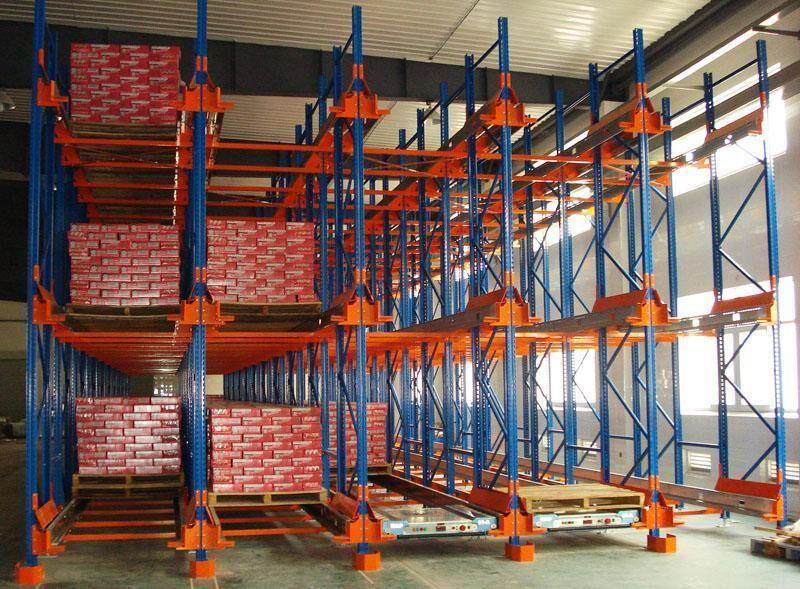
Data from 18 industrial installations using engineered shelving demonstrate measurable financial benefits:
Space cost reduction: Replacing static pallet positions with 4‑level boltless shelving increased storage density from 120 positions/100 m² to 380 positions/100 m². At a warehouse lease cost of $6/m²/month, annual savings exceed $18,000 per 100 m².
Labor efficiency: Adding bin location labels and aisle signage reduced search time per pick from 72 seconds to 31 seconds (57% improvement) in a tooling warehouse.
Damage cost avoidance: Installing column protectors and beam end guards reduced shelving repair expenses by 79% over 24 months, based on maintenance log analysis.
Inventory write‑off reduction: FIFO discipline enforced by roll‑out shelves reduced obsolete raw material write‑offs by 34% in a food packaging plant.
Typical payback period for upgrading from floor stacking or light‑duty shelving to a properly engineered large industrial shelving unit ranges from 8 to 14 months, depending on labor rates and real estate costs.
Q1: What is the maximum shelf height for a large industrial shelving
unit without seismic bracing?
A1: In non‑seismic zones (PGA <
0.1g), unbraced units can reach 3.0 meters height if floor‑anchored. Above 3.0
meters, diagonal back ties or wall attachments are mandatory to prevent sway.
For seismic zones with PGA ≥ 0.2g, any unit taller than 2.4 meters requires
X‑bracing or shear panels per ASCE 7‑22. Always consult a structural engineer
before exceeding 2.4 meters.
Q2: How do I calculate the required anchor bolt pull‑out resistance
for a heavy shelf?
A2: Use the formula for concrete breakout
strength in tension: Ncb = k_c * λ_a * √(f’c) * (hef)^1.5, where k_c = 10 for
cracked concrete, λ_a = 1.0 for normal weight concrete, f’c is concrete
compressive strength (MPa), and hef is embedment depth (mm). For M16 bolt with
hef = 120 mm in 30 MPa concrete, Ncb ≈ 27 kN. Apply safety factor 2.5 → working
load limit 10.8 kN per bolt. Four bolts per column provide 43 kN total capacity.
Compare to actual column load.
Q3: Can a large industrial shelving unit be used to store flammable
liquids or aerosols?
A3: Only with specific modifications. Standard
steel shelving does not meet NFPA 30 requirements for flammable liquid storage.
You must install spill containment trays (raised edges, leak‑proof seams), bond
and ground all shelves to prevent static discharge, and maintain minimum 1.8 m
clearance from electrical panels. Additionally, shelves must be coated with
intumescent paint providing 60‑minute fire rating. Consult a fire protection
engineer before storing class IB or IC flammable liquids.
Q4: What is the acceptable beam deflection limit for a large
industrial shelving unit under full load?
A4: Per RMI MH16.1,
maximum vertical deflection at mid‑span shall not exceed L/180 (L = beam span).
For a 2.4 m beam, L/180 = 13.3 mm. However, for shelving with particle board
decks (brittle material), a stricter limit of L/240 (10 mm) is recommended to
prevent deck cracking. For steel decking, L/180 is acceptable. Measure
deflection under 125% of rated load during commissioning.
Q5: How does Guangshun verify the load rating of a custom large
industrial shelving unit?
A5: Guangshun follows a three‑stage
verification: (1) Finite element analysis (FEA) for each unique configuration,
applying point loads and seismic forces; (2) Prototype load testing on a
universal testing machine (UTM) with strain gauges at critical welds; (3)
Third‑party witnessed testing per EN 15512, including 100,000 cycle fatigue test
on beam connectors. A stamped load notice is provided for each beam level, and
the customer receives a digital twin with color‑coded capacity maps.
Q6: What maintenance procedures extend the life of a large industrial
shelving unit in a high‑humidity environment?
A6: In environments
with >80% relative humidity or condensation (e.g., cold storage, paper
mills), perform quarterly inspections: (1) Check for white rust on galvanized
surfaces – if found, apply zinc‑rich touch‑up paint; (2) Re‑torque all bolted
connections to manufacturer values using a calibrated torque wrench; (3) Inspect
floor anchors for loosening – retighten to 70 Nm for M12 bolts; (4) Clean debris
from beam locking tabs – accumulated dirt reduces locking engagement by up to 3
mm. Following this schedule, galvanized units have exceeded 20 years of service
in coastal paper mills.
Q7: Can a large industrial shelving unit be reconfigured after
installation to change shelf heights?
A7: Yes, if the unit uses a
boltless teardrop perforation pattern (50 mm or 75 mm pitch). Beams can be
relocated to different height positions by removing them, lifting to new holes,
and re‑engaging the tabs. However, reconfiguration requires unloading the entire
bay. Bolted shelving requires full disassembly. Maximum recommended
reconfiguration frequency: once per 24 months to avoid wear on perforated slots.
Always update load labels after reconfiguration.
Q8: What floor slab thickness is required for a 4‑shelf unit with
2,000 kg per shelf?
A8: Total column load = 8,000 kg (approx 78.5
kN). Assume four anchor bolts per column. Concrete compressive strength f’c = 25
MPa. Required slab thickness to prevent punching shear: minimum 150 mm for
normal weight concrete with 100 mm edge distance. For slabs < 150 mm, a steel
base plate spreader (300×300×12 mm) must be used to distribute load. Always
perform a floor load test with a hydraulic jack to 150% of column load before
installing the shelving.

 Wechat
Whatsapp
Wechat
Whatsapp