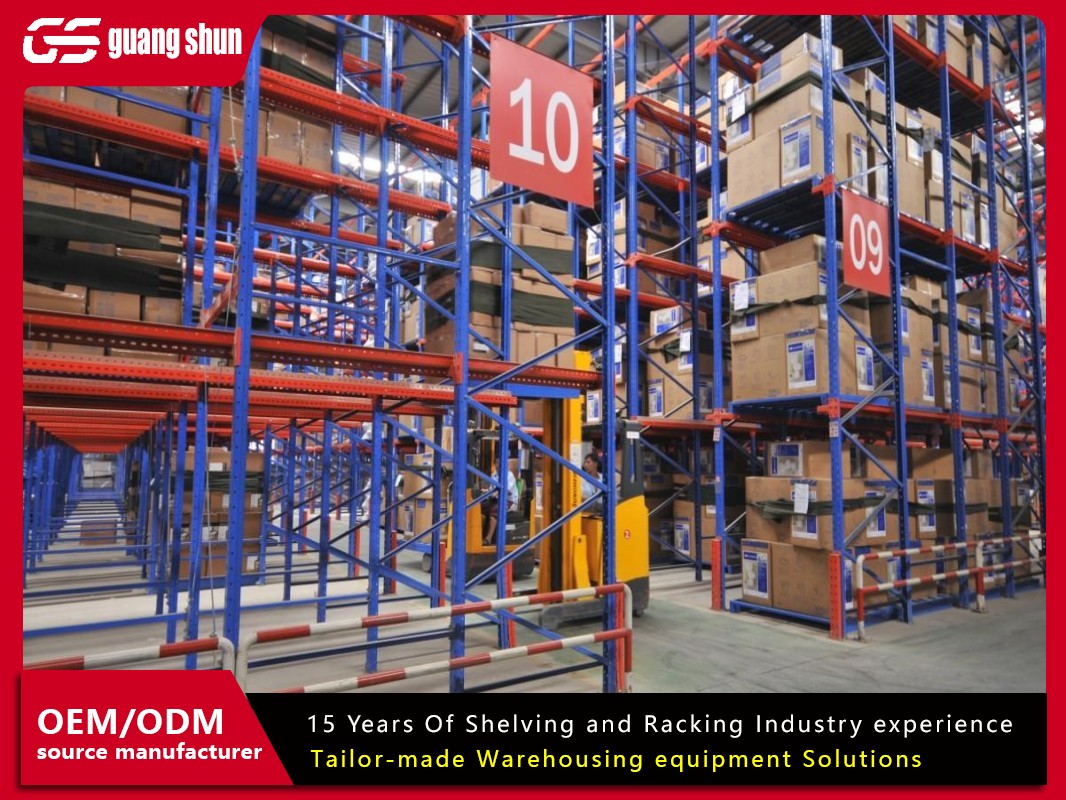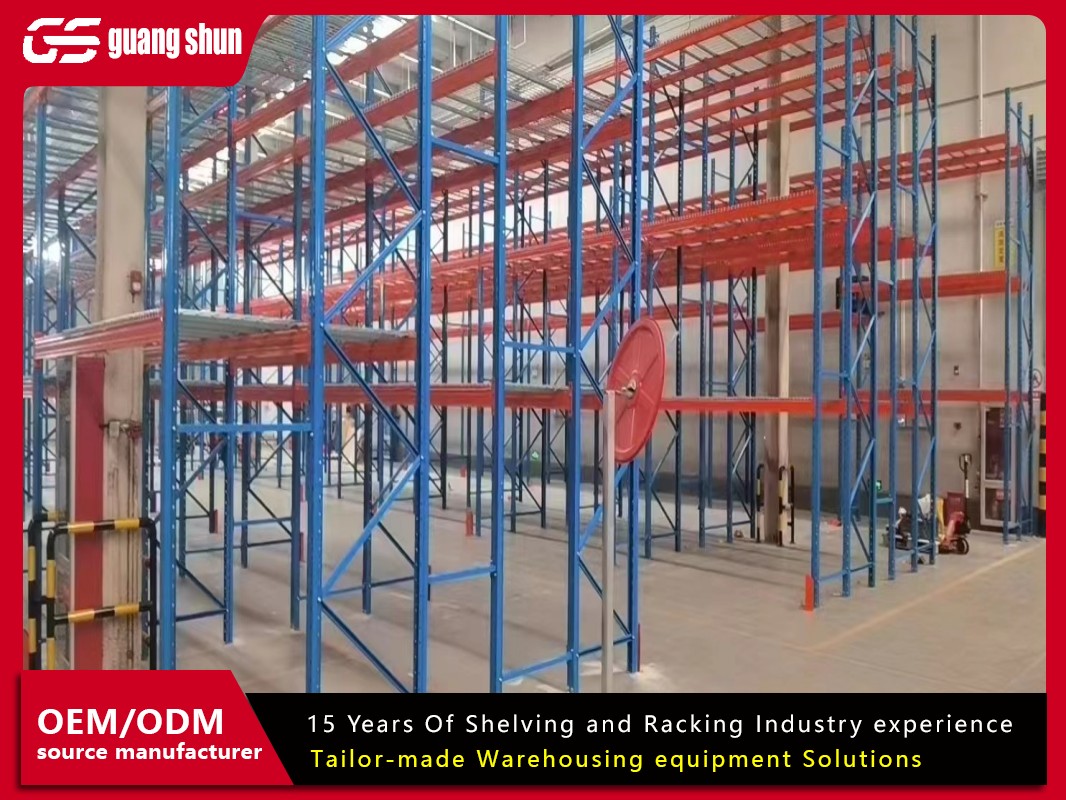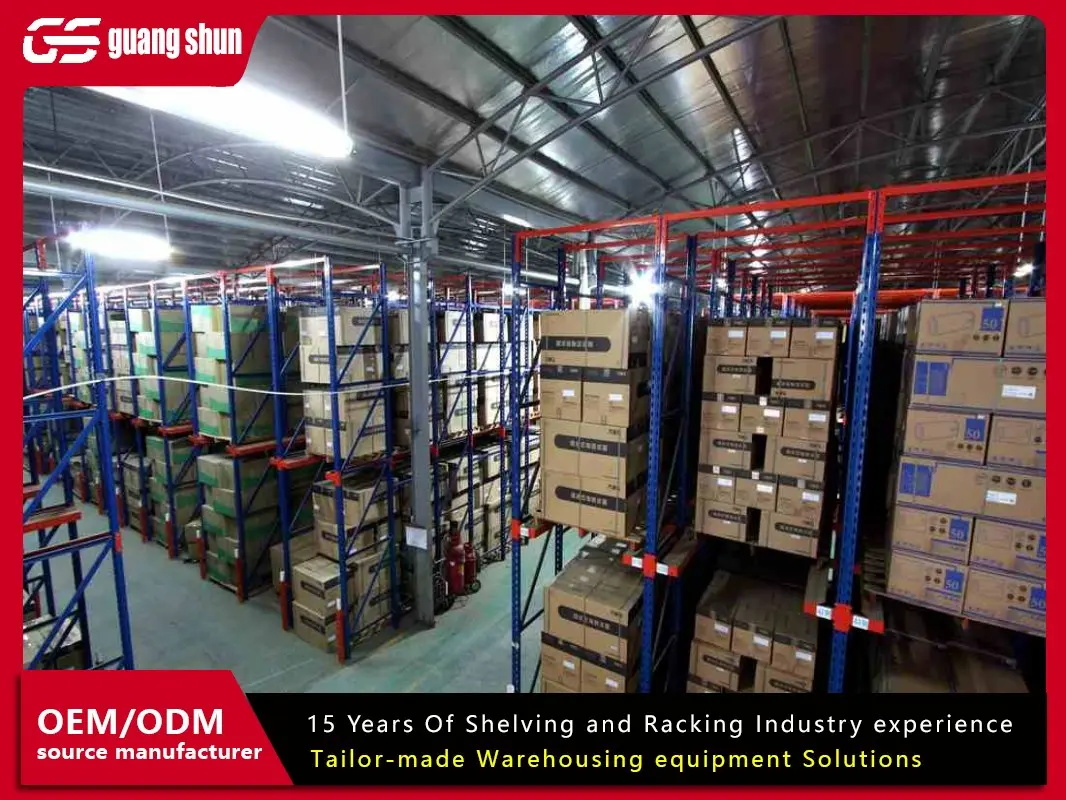
When warehouse operations demand the storage of bulky, heavy components—ranging from automotive dies to steel blanks—the choice of racking system directly impacts throughput and safety. heavy duty spur shelving has emerged as the preferred engineering solution for facilities requiring flexible, high-density storage without compromising on structural integrity. Unlike standard shelving, this system integrates cold-formed steel columns, diagonal bracing, and adjustable beams to handle dynamic loads while maintaining accessibility. At Guangshun, we have engineered these systems to meet the specific demands of heavy manufacturing and distribution centers across Europe and North America.
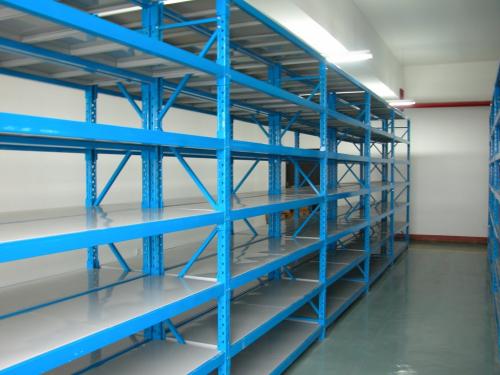
System Anatomy: Columns, Bracing, and Beam Design in Spur Shelving
The term "spur" refers to the cantilever-like supports that engage with upright frames, creating a rigid structure capable of supporting up to 2,000 kg per level in heavy-duty configurations. Primary components include:
Upright frames: Roll-formed from SS400 or equivalent structural steel, with thickness ranging from 2.0 mm to 3.0 mm. Perforations at 50 mm intervals allow for vertical beam adjustment.
Horizontal and diagonal bracing: These members provide torsional resistance, a critical factor when storing long or unevenly distributed items. Bracing patterns (K-brace or X-brace) are selected based on seismic requirements.
Beams and shelving decks: Box-section beams with safety clips lock into the uprights. Decks can be particle board, steel mesh, or corrugated steel—each affecting load distribution and fire protection ratings.
Ancillary components: row spacers, wall ties, and base plates with expansion anchors ensure global stability.
This modular design allows heavy duty spur shelving to be reconfigured as inventory profiles change, a distinct advantage over welded cantilever racks or bulk storage.
Load Protocols and Material Specifications: Beyond Static Capacities
Engineers must differentiate between uniform distributed load (UDL) and point loads. For a typical 2.5 m high frame with 1.2 m beam span, Guangshun’s tested configurations yield:
Beam capacity: 1,500 kg per pair (for 2.0 mm thick 100x50 mm box beams) with a safety factor of 1.6 based on EN 15512.
Frame compression load: Up to 12,000 kg per upright pair, depending on height and bracing density.
Deflection limits: Beam deflection under full load is restricted to L/200 to prevent sagging and ensure beam lock security.
Surface treatment is another quality marker: all components undergo degreasing, phosphating, and electrostatic powder coating (60–80 μm thickness) to pass 500-hour salt spray tests per ASTM B117. This is essential for cold-store environments or facilities with high humidity.
Application-Specific Solutions: Solving Storage Bottlenecks in Key Sectors
Automotive parts distribution: A major German logistics provider replaced pallet flow racks with heavy duty spur shelving to store engine blocks and transmission housings. The 800 mm depth allowed direct access to each SKU, reducing pick time by 34% compared to deep-lane storage.
Metal service centers: Storing sheet metal bundles and bar stock traditionally requires cantilever racks. However, for cut pieces and small batches, spur shelving with steel decking provides higher density—up to 40% more items per square meter—while maintaining load ratings of 1,200 kg per shelf. The key is the adjustable beams that accommodate varying bundle heights.
E-commerce fulfillment (heavy goods): With the rise of bulky-item e-commerce, warehouses need mixed storage for furniture, fitness equipment, and large appliances. Guangshun recently completed a project for a Dutch retailer, installing 2,500 bays of spur shelving with integrated wooden decks—optimized for both manual picking and occasional reach-truck handling.
How to Specify the Correct Heavy Duty Spur Shelving Configuration
Selecting a system involves more than simple load calculations. Consider the following workflow:
1. Load profile analysis
Classify items by weight, dimensions, and frequency of access. For example, a fast-moving item stored on a heavy duty spur shelving level might require a wire deck to allow sprinkler water penetration, whereas slow-moving spares can use solid particle boards to protect against dust.
2. Seismic and building code compliance
For installations in zones with seismic activity, diagonal bracing must be increased and base plates anchored with specified torque. Guangshun provides FEM-calculated seismic kits including cross-aisle braces and row spacers.
3. Integration with material handling equipment
If reach trucks or order pickers are used, the beam placement must allow sufficient fork clearance. The standard first beam height is usually 300 mm from the floor, but for palletized loads, it may be raised to 450 mm. The system’s flush-front design minimizes overhang, reducing collision risks.
Guangshun engineers often use finite element analysis (FEA) to validate custom designs—for instance, when a client needed 3.5 m wide spans to store yacht masts, we doubled the beam section and added mid-span supports.
Field-Proven Installation Protocols and Preventive Maintenance
Even the most robust heavy duty spur shelving can fail if installation is substandard. Critical steps include:
Floor flatness verification: Tolerances must be within ±3 mm over 3 m to avoid frame distortion. Shim plates are used to compensate for irregularities.
Anchor bolt tensioning: Using torque wrenches to achieve specified clamping force—typically M14 anchors with 80 Nm torque.
Beam lock engagement: Inspect that each beam's safety clip is fully seated; audible clicks are checked during handover.
Quarterly inspections should look for bent components, missing safety clips, or impact damage. A recent industry study showed that proper maintenance extends rack lifespan to over 20 years.
Frequently Asked Questions on Heavy Duty Spur Shelving
Q1: What distinguishes heavy duty spur shelving from pallet racking?
A1: Spur shelving typically features a greater number of beam levels and a more closed appearance due to the diagonal bracing in the uprights. It is designed for smaller items or cases that are hand-loaded, whereas pallet racking is optimized for palletized unit loads. However, with heavy-duty beams, spur shelving can also handle light pallets, offering hybrid functionality.
Q2: Can I mix shelf types within one rack run?
A2: Yes, modularity allows combining steel decks for heavy items and particle board for cartons. This is common in distribution centers where the same aisle stores both raw materials and finished goods. Always ensure that the beam load capacity is not exceeded on any individual shelf.
Q3: What is the typical lead time for a custom heavy duty spur shelving order from Guangshun?
A3: For standard configurations, production takes 3–4 weeks including powder coating. Custom colors or seismic-rated designs may extend this to 6 weeks. We offer 3D layout drawings within 48 hours of receiving your floor plan.
Q4: Are there fire safety regulations specific to spur shelving?
A4: Absolutely. In sprinklered buildings, solid shelves can block water distribution. Authorities having jurisdiction (AHJ) often require at least 50% open area decks (wire mesh or slatted steel) for shelves above a certain height. Guangshun provides fire-proof certificates for our materials and can supply sprinkler deflector brackets if needed.
Q5: How does the shelving perform in cold storage environments (-25°C)?
A5: Standard steel grades maintain ductility at -25°C, but bolts and anchors must be rated for low temperatures. We recommend stainless steel safety pins and high-flexibility coatings to prevent brittle fracture. Guangshun has executed multiple cold-store projects in Scandinavia with 10-year follow-up reports showing no degradation.
Q6: What is the maximum height for heavy duty spur shelving without crane assistance?
A6: Typically up to 6 meters if order pickers or scissor lifts are used. Beyond that, seismic forces and frame slenderness become design challenges. We have installed 8-meter-tall systems using heavier profiles and additional bracing, but they require very stable floors and seismic analysis.
Selecting the right heavy duty spur shelving is a strategic decision that impacts warehouse safety, productivity, and scalability. By focusing on engineering fundamentals—actual load paths, material quality, and compliance with international standards—facility managers can achieve a storage system that pays for itself within two to three years. With over 15 years of supplying heavy-duty solutions to the global market, Guangshun remains a technical partner capable of delivering turnkey projects, from initial site survey to installation and load testing. Contact our engineering team to discuss your specific material flow requirements.