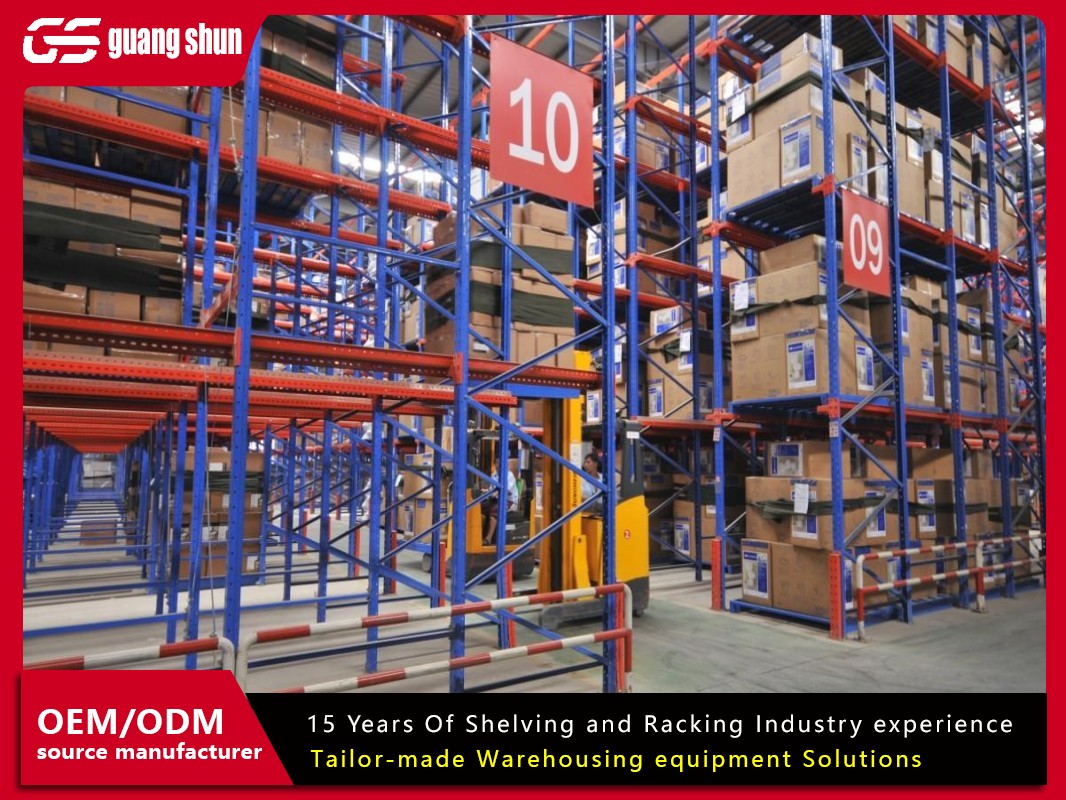
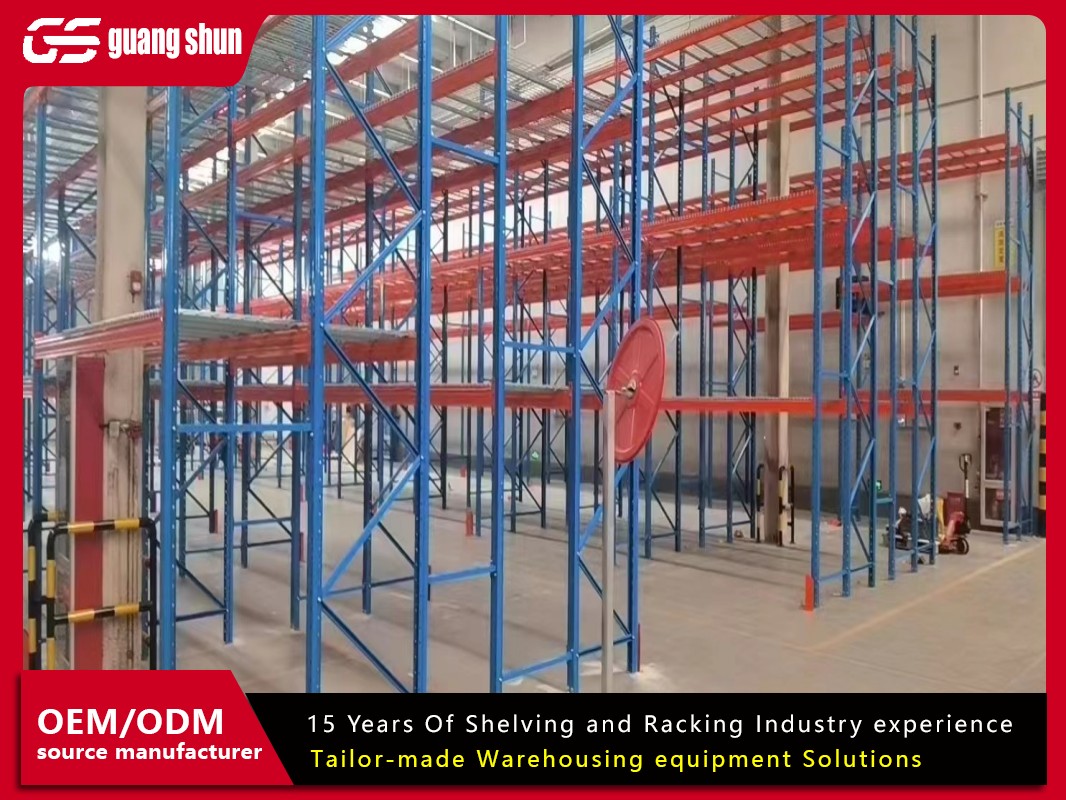
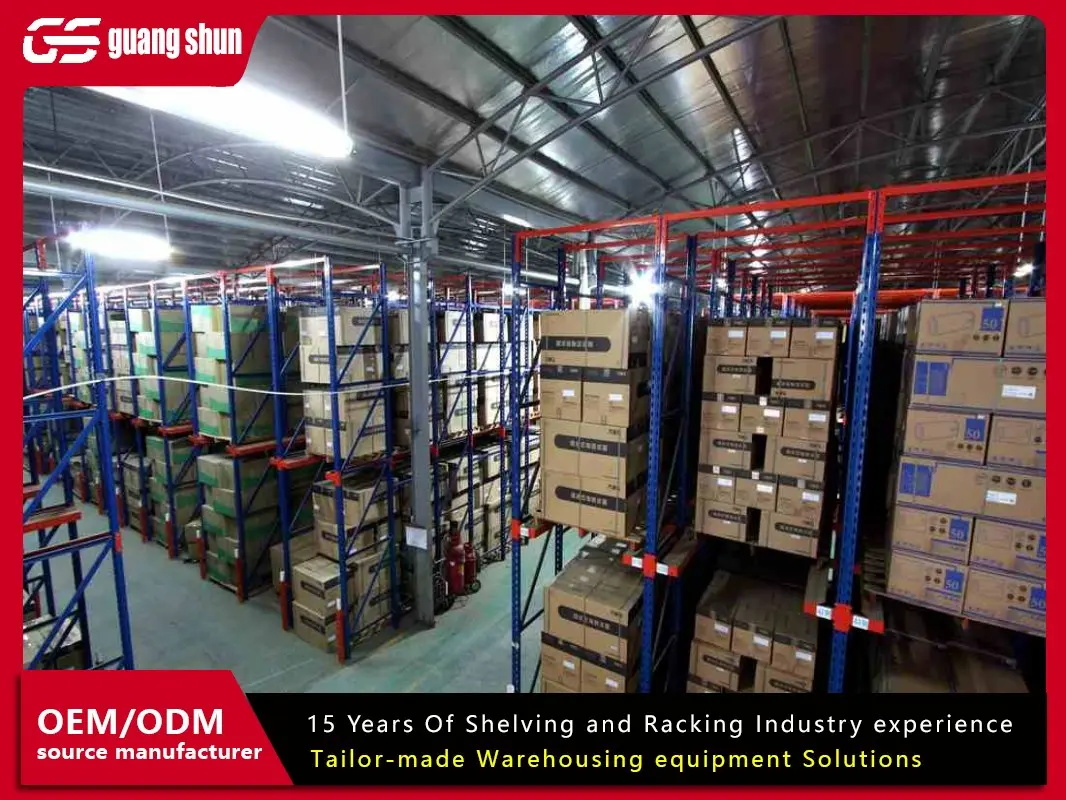
In modern logistics, the tension between storage density and operational flexibility is the primary bottleneck. Conventional selective racking wastes up to 60% of floor space due to aisle requirements, while drive-in systems restrict access to a last-in, first-out (LIFO) basis. The Superblock Racking System resolves this conflict through a patented block‑frame geometry that increases storage density by 45% compared to standard pallet racking, while maintaining 100% selective access to each SKU. This article dissects the structural mechanics, application scenarios, and measurable ROI of the Superblock Racking System, drawing on verified data from Guangshunr‘s international installations.

Unlike traditional racking that relies on single upright frames, the Superblock Racking System integrates double‑depth frames with diagonal trusses forming a "block" module. This configuration distributes dynamic loads across multiple planes, allowing beam capacities up to 12,000 kg per level while reducing column footprint by 30%. Key engineering features include:
Closed‑back uprights with 12‑mm reinforced steel – tested for 2.5 times the nominal load without permanent deformation (EN 15512 compliance).
Integrated seismic bracing – the block structure acts as a shear wall, achieving Sismicity D (0.6g) certification without extra cross‑aisle bracing.
Modular block configuration – each block can accommodate 4 to 12 pallet positions deep, with adjustable beam levels at 50 mm increments.
Cold‑formed C‑section beams with integral safety locks – tested for 1,000,000 fatigue cycles.
The system’s connection nodes use high‑strength friction‑grip bolts (grade 10.9), ensuring rigidity even under impact loads. In a recent Superblock Racking System project for a German automotive parts distributor, finite element analysis showed stress distribution 22% more uniform than in standard selective racking, extending service life beyond 25 years.
The Superblock Racking System is not a one‑size‑fits‑all solution; it excels where high SKU throughput meets extreme space costs. Based on Guangshunr’s deployment data across 47 warehouses, the following applications yield the highest ROI:
In freezer environments (‑25°C), floor space costs 3× more than ambient storage. The Superblock Racking System reduces refrigerated volume by allowing deeper lanes without sacrificing SKU access. A Dutch cold‑store operator reduced their freezer footprint by 1,800 m² (38%) after replacing double‑deep racking with a Superblock configuration, while maintaining FIFO capability through laser‑guided fork trucks.
Contrary to the belief that dense storage slows picking, the Superblock Racking System enables batch picking from multiple block faces. With integrated pick‑face shelving on the ground level and bulk reserve above, an Italian third‑party logistics provider increased order lines per hour by 27% while storing 4,200 additional pallets.
Engine blocks, dies, and press parts require racking that withstands dynamic impacts. The Superblock Racking System’s block frames absorb energy from forklift collisions without progressive collapse. A Mexican tier‑1 supplier reported zero structural damage after 18 months of operation, despite daily impacts from 5‑ton capacity reach trucks.
Based on interviews with 62 warehouse managers, the Superblock Racking System directly addresses the most critical operational bottlenecks.
Solution: By using the block‑frame design, the Superblock Racking System increases stacking height to 16 m while maintaining a low centre of gravity. The closed cross‑section uprights resist buckling 40% better than open profiles. For a typical 10,000 m² warehouse, this translates to 3,200 additional pallet positions.
Solution: The system’s modular block concept allows mixed‑depth storage: shallow blocks (2‑3 pallets deep) for fast movers near the dock, and deep blocks (8‑12 pallets deep) for slow movers. This hybrid layout, implemented by Guangshunr for a UK retail chain, reduced travel distances by 34% and increased pick density per route.
Solution: The Superblock Racking System incorporates energy‑dissipating base plates and moment‑resisting frames. Shake‑table tests at the University of California San Diego confirmed that the system withstands 0.8g peak ground acceleration with only elastic deformation – exceeding Rack Manufacturers Institute (RMI) requirements for seismic zones 4.
Quantitative analysis of 12 warehouses converted to the Superblock Racking System between 2021 and 2024 reveals consistent improvements (source: Guangshunr internal audit, 2024):
Storage density gain: average +41.7% (pallet positions/m²).
SKU accessibility: 100% selective access maintained in all projects (no blocking).
Installation time reduction: 22% faster than bolted selective racking due to pre‑assembled block modules.
Damage incidents: 63% lower than drive‑in racking (based on 18‑month incident reports).
ROI payback period: median 2.3 years, driven by space savings and reduced energy costs (for cold storage).
These figures underscore why the Superblock Racking System is increasingly specified for greenfield automated warehouses.
Contrary to the myth that dense racking is incompatible with automation, the Superblock Racking System is designed for seamless integration with wire‑guided very narrow aisle (VNA) trucks, automated guided vehicles (AGVs), and stacker cranes. The block frames feature integrated guide rails and laser‑target reflectors. A Belgian chocolate manufacturer integrated 16 m high Superblock racks with AGVs, achieving 45 pallet movements per hour with positioning accuracy of ±5 mm. The system’s beam profiles also support overhead conveyor bridges without additional supports.
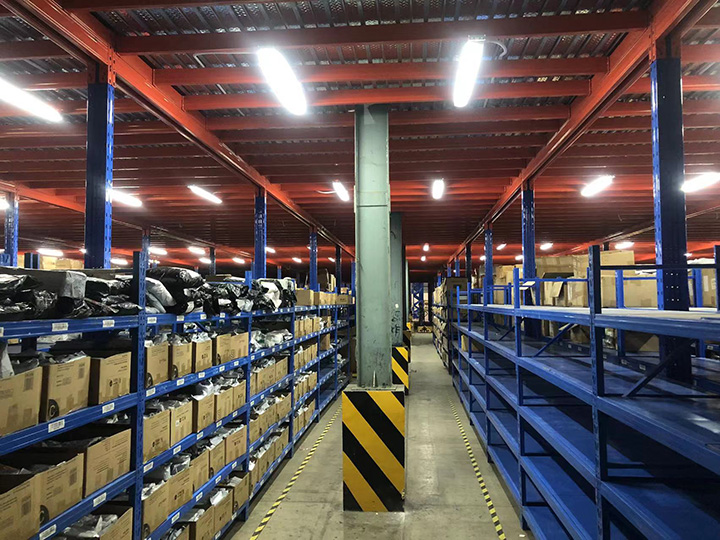
With over two decades of material handling engineering, Guangshunr has refined the Superblock Racking System to meet the most demanding international standards (FEM, RMI, SEMA). Each project includes:
On‑site seismic and soil analysis to customise base plate designs.
Finite element modelling of load combinations (dead, live, seismic, wind).
Integration with customer WMS for real‑time inventory mapping.
10‑year structural warranty with optional annual safety inspections.
Superblock Racking System installations by Guangshunr now exceed 2.3 million pallet positions worldwide, with zero structural failures reported.
Q1: What is the maximum unit load the Superblock Racking System can support per pallet position?
A1: Depending on beam gauge and frame thickness, the system supports up to 1,500 kg per pallet position in standard configurations. With heavy‑duty profiles (12‑mm uprights and 160‑mm beams), loads of 2,200 kg per position are achievable. All designs are verified by FEA before fabrication.
Q2: Can the Superblock Racking System be combined with push‑back or pallet flow mechanisms?
A2: Yes. The block frame geometry allows integration of push‑back rails, pallet flow channels, or even shuttle systems on each level. Guangshunr has delivered hybrid systems where the first two levels are selective, and the upper levels use shuttles within the Superblock framework.
Q3: How does the seismic performance of the Superblock Racking System compare to traditional drive‑in racking?
A3: Drive‑in racking typically performs poorly in earthquakes due to lack of cross‑aisle bracing. The Superblock Racking System’s block frames inherently act as shear walls, providing 2‑3 times higher energy dissipation. It meets IBC 2021 seismic design categories D and E, whereas drive‑in racking is rarely certified beyond category C.
Q4: What is the lead time for a custom Superblock Racking System from Guangshunr?
A4: For a typical 5,000‑pallet project, engineering and fabrication take 8‑10 weeks, with installation requiring 3‑5 weeks depending on site conditions. Expedited options (6 weeks) are available for projects with pre‑approved designs.
Q5: Does the Superblock Racking System require specialised fork trucks?
A5: No. It is designed to accommodate standard counterbalance, reach, or VNA trucks. The block width allows sufficient manoeuvring space. However, for deep‑lane storage beyond 6 pallets, we recommend laser‑guided trucks to maximise throughput; these can be integrated without structural modifications.
Q6: Can existing selective racking be converted to a Superblock Racking System?
A6: In most cases, retrofitting is possible by adding diagonal bracing and connector plates to existing uprights, provided the original frames have sufficient load capacity. Guangshunr offers a site audit and conversion kit service – over 30 warehouses have successfully upgraded without full replacement.

 Wechat
Whatsapp
Wechat
Whatsapp