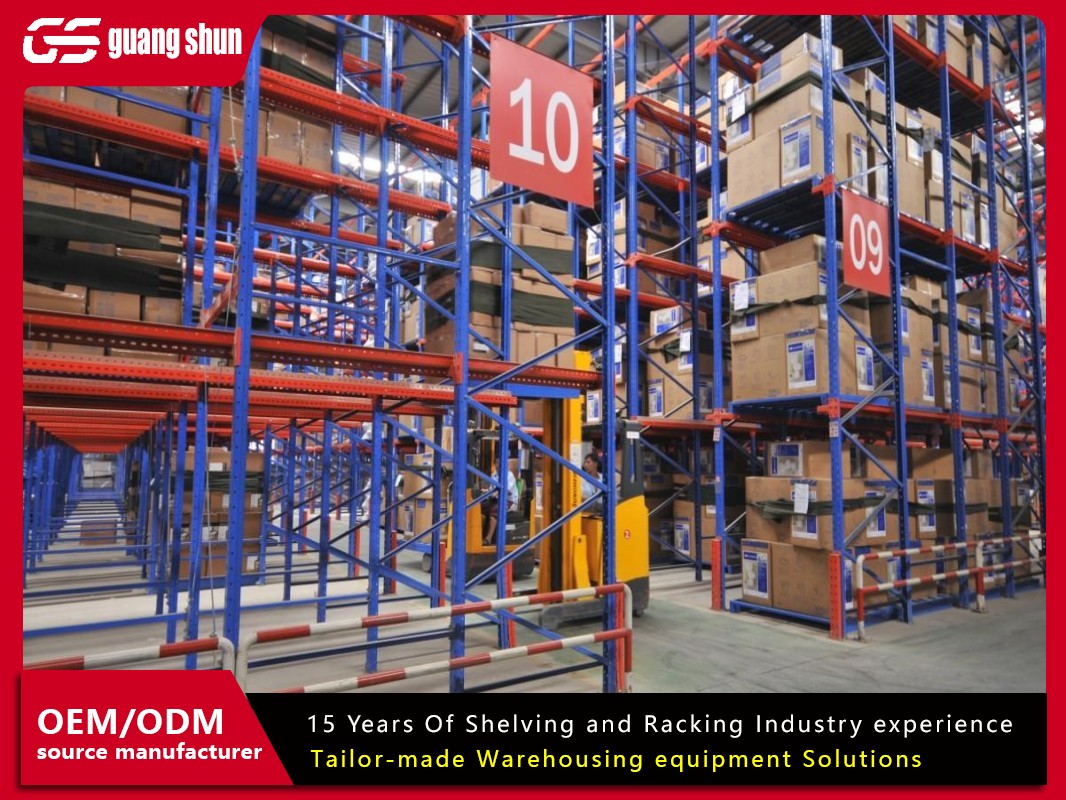
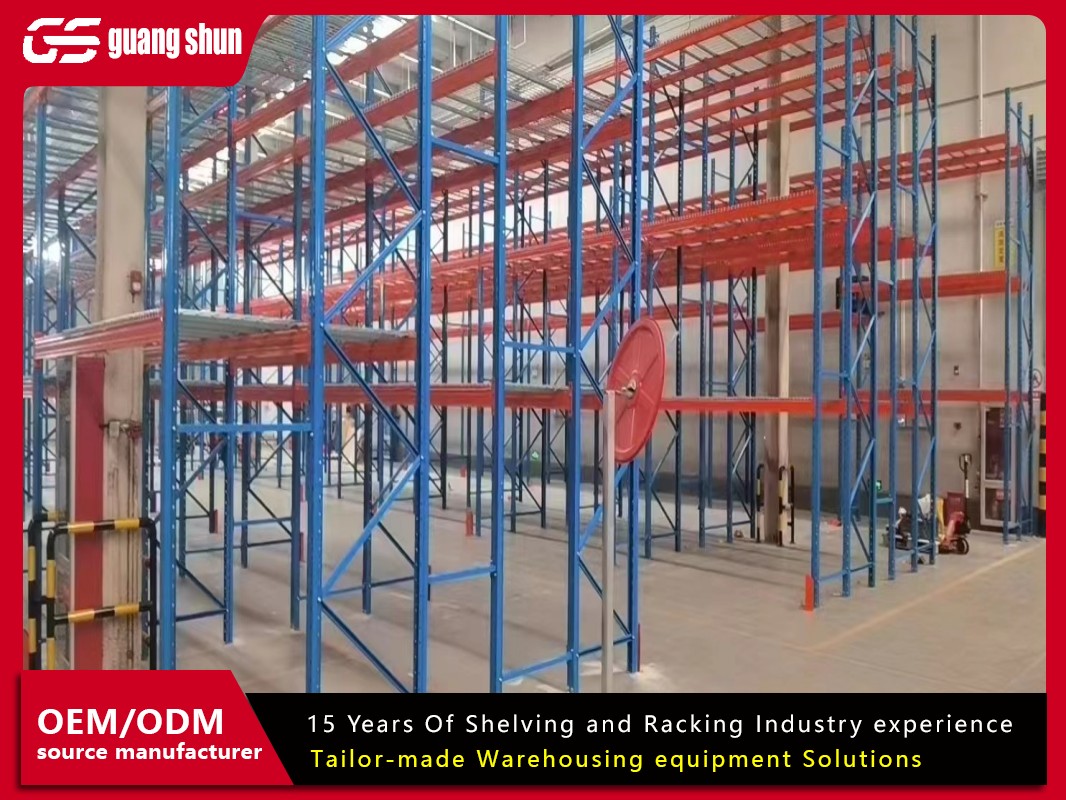
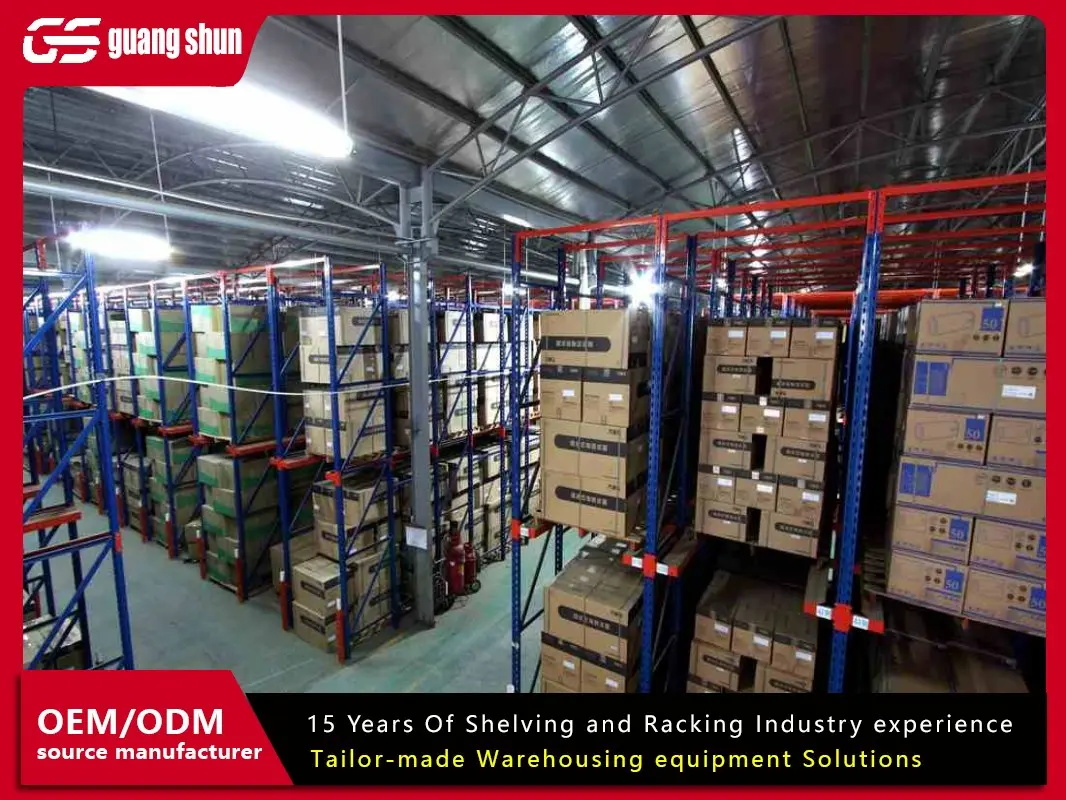
Distribution centers and high-turnover warehouses often face a simple trade-off: increase pallet depth to boost storage density, but risk compromising accessibility and structural safety. Standard selective racks commonly use 42” or 48” deep load beams. Moving to a 60 deep pallet rack adds 12 inches per storage position, which significantly changes beam deflection, anchor bolt shear forces, and forklift overhang requirements. This guide provides engineering calculations, industry-specific case data, and installation protocols. We also reference how Guangshun delivers certified 60-inch deep configurations with FEA-validated frames for cold-formed steel sections.
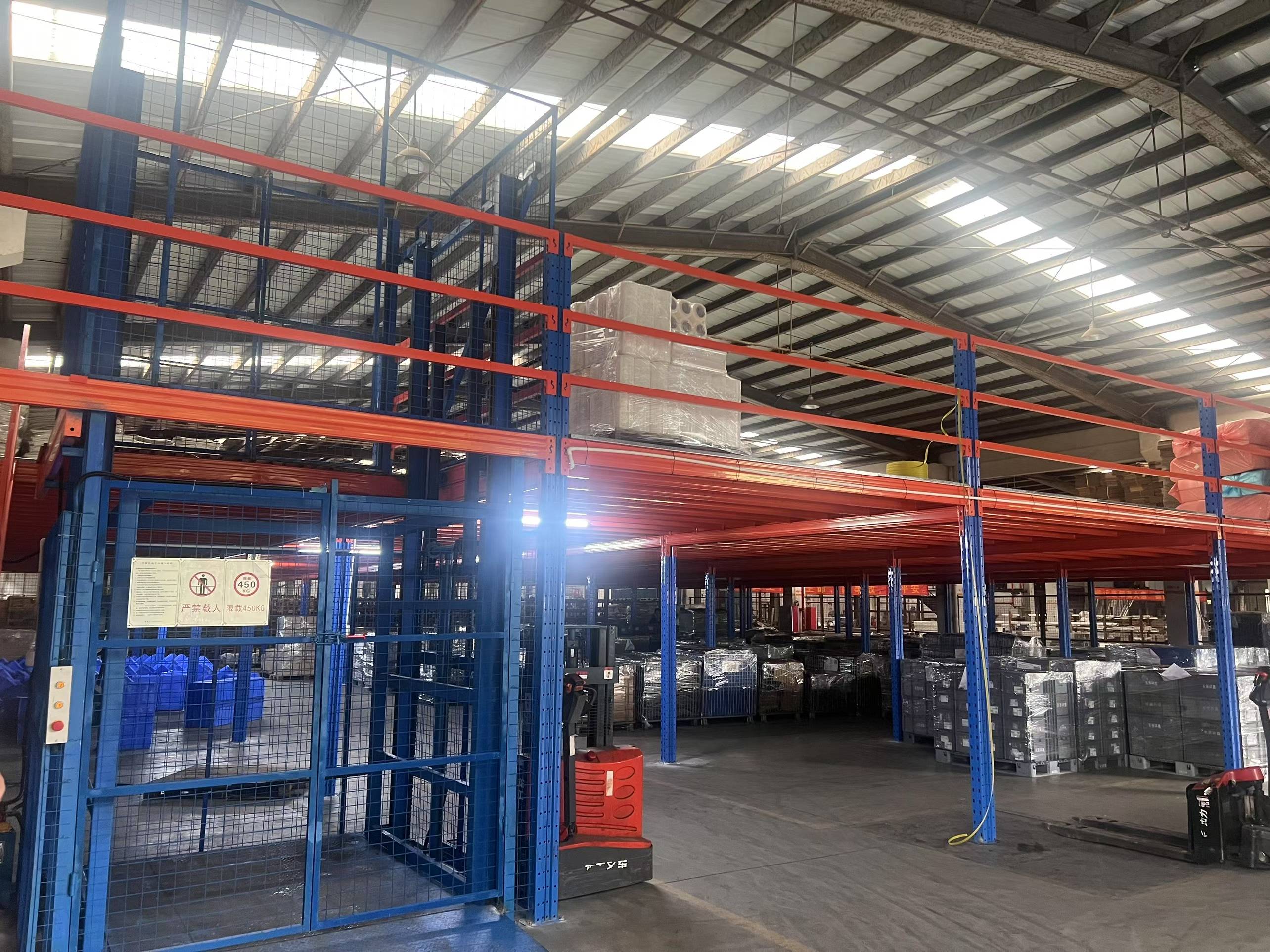
A 60 deep pallet rack refers to the horizontal distance between the front and rear beams of a selective pallet rack, measured from the inside face of the front column to the inside face of the rear column. For standard 40”x48” GMA pallets, a 60” depth allows two pallets placed in tandem (back-to-back) on each beam level, but only if the rack is designed for double-deep or push-back applications. However, for selective (single-deep) storage, a 60” depth creates excess overhang beyond a typical 48” pallet by 12 inches – this is not recommended unless the stored pallet itself has a 52-60” footprint (e.g., automotive parts containers or euro-pallets with longer stringers). Therefore, the primary use of a 60 deep pallet rack is for:
Double-deep racking: Two pallets per beam level (front and rear position), requiring a 60” depth to fully support both pallets without rear overhang.
Oversized or custom pallets: Engineered wood pallets for coil steel or machinery components where length exceeds 48”.
Drive-in / drive-through adaptations: Deep lanes where a 60” depth matches the fork pocket insertion length.
From a steel specification perspective, a 60” deep beam experiences higher bending moments compared to a 48” beam for the same load per linear foot. For a Uniformly Distributed Load (UDL) of 1500 kg per beam level, a 60” span increases maximum moment by 25% (M = wL²/8). Manufacturers must use either thicker beam sections (e.g., 2.5 mm vs 2.0 mm) or deeper beam profiles (120 mm vs 100 mm). Guangshun provides moment capacity charts for each beam series; for 60” deep configurations, their standard RS-150 beams (150 mm height, 2.0 mm base steel) support up to 1800 kg per pair with a safety factor of 1.65 according to ANSI MH16.1-2019.
When evaluating a 60 deep pallet rack, the column capacity is often the limiting factor. A deeper beam shifts the load center of gravity away from the column face, increasing the moment arm at the beam-to-column connection. For a single-deep 48” rack with a 1000 kg load, the moment at connection is approx. 1000 kg × (0.6m center offset) = 600 kg·m. For a 60” double-deep rack with two 1000 kg pallets (front pallet center at 0.3m from column, rear pallet center at 1.2m from column), the total moment becomes (1000×0.3)+(1000×1.2)=1500 kg·m – 2.5 times higher. Therefore, columns must be upgraded from 90 mm to 110 mm profile with thicker flanges. Below is a load rating summary for typical 60” deep rack frames (3-level selective double-deep application):
Frame size: 100x120x2.5 mm (Q355B steel), height 5000 mm, 4 beam levels.
Beam capacity per level (pair of 60” beams): 1350 kg uniformly distributed, deflection ≤ L/180 (L=1524 mm) → max deflection 8.5 mm.
Column capacity per upright (including moment): 5400 kg at the lowest beam level, derated to 4200 kg when using 60” deep configuration (includes a 0.8 moment factor).
Floor anchor requirement: 2 M16 wedge anchors per column, concrete compressive strength ≥ 25 MPa, pull-out resistance ≥ 18 kN per anchor.
Operators must never exceed the rated capacity per beam position. Guangshun supplies load placards with each rack, specifying the safe working load (SWL) for 60” deep levels and requiring annual re-inspection per AS4084-2012.
Converting from standard 48” selective racks to a 60 deep pallet rack in double-deep layout changes aisle width, forklift requirements, and pallet accessibility. The table below summarizes key metrics for a warehouse section of 50,000 sq.ft:
48” selective (single-deep): Aisle width 3.2 m (counterbalanced forklift), storage positions 2,480, pick face accessibility 100% (each pallet directly reachable). Density index = 1.0 baseline.
60” double-deep rack: Aisle width 3.8 m (requires reach truck with 1.2 m extended forks), storage positions 3,870 (56% increase), pick face accessibility 50% (rear pallets require moving front pallet). Density index = 1.56.
60” push-back rack (4 pallets deep): Same footprint as double-deep but stores four pallets per lane, positions 6,200, access only front face. Density index = 2.5, but requires specialized push-back carts and higher per-position cost.
For warehouses with high stock keeping unit (SKU) velocity but lower variety (e.g., beverage distribution or bagged goods), the 60” double-deep layout offers a balanced ROI. A food distribution center in Georgia replaced 48” selective racks with 60 deep pallet rack double-deep; after 18 months, pallet positions increased by 54%, but labor for rear pallet retrieval rose 22%. Net annual savings on warehouse expansion avoided: $340,000.
In freezer environments, structural steel becomes more brittle, and ice accumulation adds mass. A 60 deep pallet rack in double-deep configuration reduces the number of aisles, minimizing cold air exchange when doors open. However, beam-to-column connections must use Grade 8.8 bolts with anti-seize coating. Guangshun offers freezer-grade racks with Teflon-based shims that accommodate thermal contraction.
Automotive suppliers handling returnable racks (stillages) with dimensions of 60”x40” can directly use 60” deep selective racking without overhang. Each stillage weighs up to 800 kg; beam deflection must stay within 3 mm to prevent damage to sensitive body panels. Laser-cut endplates and reinforced beam-to-column keyhole slots are standard in such applications.
For bulky items like large pet cages or furniture flat-packs, a 60” deep pallet rack paired with hand-stackable shelves (wire decks) allows storage of mixed carton sizes. Use waterfall beam ends to prevent snagging on robotic arms if using automated guided vehicles (AGVs).
Installing a 60 deep pallet rack requires stricter floor flatness and anchoring due to higher overturning moments. Follow these guidelines per RMI (Rack Manufacturers Institute) specifications:
Floor flatness: Within 3 mm over 3 m. For double-deep 60” racks, any floor slope increases roll force on rear pallets. Use epoxy floor patch to level column bases.
Anchor bolt pattern: 4 anchors per column for racks taller than 6 m. Use chemical anchors (Hilti HIT-RE 500) in seismic zones; torque to 110 Nm for M16.
Row spacers: Install horizontal row spacers every 4.5 m of rack height to connect back-to-back rows. For 60” deep double-deep, row spacers prevent column buckling under eccentric loads.
Seismic sway bracing: In SDC (Seismic Design Category) D and above, add diagonal cable bracing at every third bay. The increased depth creates a larger seismic demand – base shear increases by approx. 18% compared to 48” rack.
After installation, perform a proof load test using 125% of rated beam capacity for 24 hours. Measure permanent deflection; acceptance limit is 0.2% of beam length. Guangshun provides third-party inspection reports for each large-scale project.
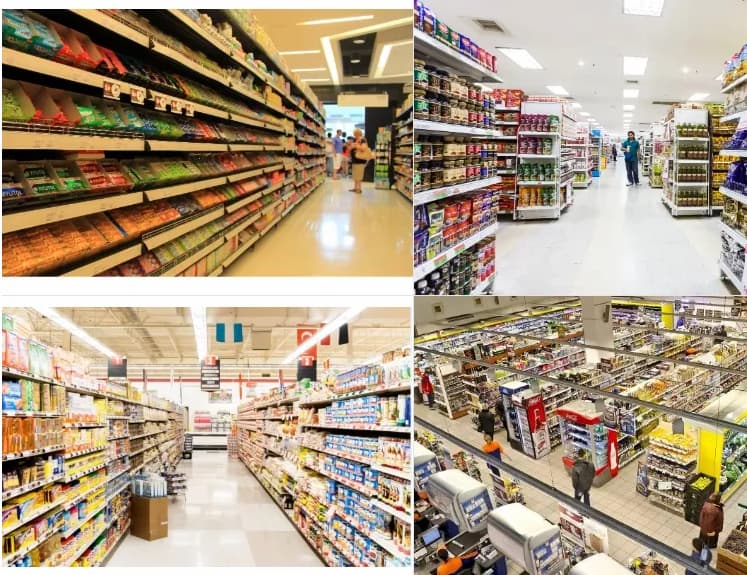
While a 60 deep pallet rack initially costs 15-20% more per position than a 48” selective rack (due to heavier steel and more anchors), the cost per stored pallet drops significantly in high-density layouts. For a 20,000-pallet warehouse, the 60” double-deep system reduces footprint by 30% – saving $12 per square foot per year in lease or construction costs. Maintenance intervals:
Quarterly: Inspect beam lock connectors for cracks or deformation, especially on rear beams that are less visible.
Semi-annual: Check anchor torque; retorque any loose anchors (15% of initial torque loss expected after first year).
Annual: Perform ultrasonic thickness measurement on column bases where floor washing chemicals may corrode steel.
5-year replacement: Replace wire deck panels if deflection exceeds 15 mm under rated load to prevent pallet tip-over.
Case data from a logistics operator in the Netherlands: using Guangshun 60” deep double-deep racks, they achieved an 11-year service life with only one beam replacement due to forklift impact. Average annual maintenance cost per rack bay was €47 – substantially lower than low-bid systems that required three full bay rebuilds within 8 years.
Q1: Can I use a standard 48” pallet on a 60 deep pallet rack designed
for selective storage?
A1: Technically yes, but not recommended. The
12” excess depth creates a gap behind the pallet, increasing the risk of the
pallet slipping backward and falling off the beam. Use pallet support bars or
reduce beam depth to match pallet length. For double-deep configurations, 48”
pallets can be placed in the front position only, but the rear position requires
a 48” pallet plus an additional 12” spacer or a larger pallet.
Q2: What forklift specifications are required for a 60 deep pallet
rack double-deep system?
A2: You need a reach truck or a dedicated
double-deep forklift with fork length of at least 1,500 mm (60 inches) and a
pantograph mechanism that extends to 2,400 mm reach. For a 60” deep lane, the
truck must reach past the front pallet (approximately 1,000 mm insertion) to
access the rear pallet. Confirm the truck’s residual capacity at full extension
– many standard reach trucks derate by 35%.
Q3: How do I calculate beam deflection for a 60” beam with a 1,200 kg
point load (not distributed)?
A3: Use the formula δ = (P × a × (L² –
a²) × (3L – a)) / (6 × E × I × L) for a point load at distance ‘a’ from support.
For a 60” beam (L=1524 mm), load centered (a=762 mm), E=200 GPa, I for typical
beam (e.g., 120x65x2.5 mm) = approx 1.2e6 mm⁴. The deflection will be roughly
5.8 mm, which exceeds L/180 (8.5 mm) – so it's acceptable. But point loads near
the beam center cause higher stress; always prefer distributed loads.
Q4: Are there fire safety restrictions for 60 deep pallet rack
systems?
A4: Yes. NFPA 13 requires in-rack sprinklers when the rack
depth exceeds 48” and storage height exceeds 12 ft. A 60” deep configuration
automatically triggers in-rack sprinkler requirements regardless of height,
because the deeper flue spaces (between front and rear pallets) need
suppression. Install sprinklers at each beam level with a minimum of 2 heads per
bay. Consult local codes; Guangshun provides pre-engineered sprinkler integration brackets.
Q5: Can I convert existing 48” selective racks to 60 deep pallet
rack?
A5: No, because the beam connectors and column hole patterns
are different. Simply replacing beams with longer 60” beams would exceed the
column’s moment capacity. You must replace both upright frames and beams.
However, you can add bolt-on cantilever arms or use bolt-on pallet supports to
partially extend the depth, but this does not achieve true double-deep capacity.
A safer approach is a new engineered system from a certified supplier.
Q6: What is the typical lead time for a custom 60 deep pallet rack
with seismic bracing?
A6: For most manufacturers, standard beams are
kept in stock (2 weeks). However, seismic bracing, special coatings (e.g., zinc
phosphate), and custom heights add 4-6 weeks. Guangshun offers a quick-ship program for
60” deep beams in popular capacities (up to 1500 kg) with 7-day production.
Q7: Does a 60 deep pallet rack require different floor loading
calculations?
A7: Yes. The point load at each column increases
because 60” deep double-deep racks concentrate more pallet weight onto fewer
columns. For a standard 48” selective rack, each column supports 2 pallet
positions. For 60” double-deep, each column supports 4 pallet positions. So
floor loading per column can double. Verify the concrete slab’s subgrade modulus
(k value); for a typical 6” slab with k=100 pci, a 60” double-deep rack with
4×1000 kg pallets per column may require a 12” thick reinforced pad under each
column.
For detailed engineering drawings and load table PDFs for 60 deep pallet rack configurations, contact the project team at Guangshun. Their structural engineers provide site-specific calculations including seismic zone mapping and anchor pull-out verification.

 Wechat
Whatsapp
Wechat
Whatsapp