Selecting the warehouse racking company that aligns with your material flow, seismic zone, and SKU velocity requires more than comparing price sheets. In 2025, distribution centers face upward pressure on storage density while OSHA’s latest reporting shows 32% of rack-related incidents stem from inadequate design specifications. This article dissects the technical competencies that separate a commodity supplier from a true engineering partner. We will examine load calculations, rack type selection, safety factor standards, and integration with automated systems. Guangshun, a specialist in structural storage solutions, provides reference data from recent installations to ground these principles in measurable outcomes.
Warehouse racking is not a passive structure; it is a dynamic system interacting with lift trucks, seismic forces, and variable live loads. A reputable the warehouse racking company must provide stamped engineering drawings, finite element analysis (FEA) for high-bay designs, and compliance with RMI (Rack Manufacturers Institute) or FEM 10.2.02 standards. For example, a 40-ft selective rack system with a 2,500 lb beam capacity per level requires a safety factor of 1.65 against yield strength. Without proper engineering validation, beam deflection under dynamic load can exceed L/180, creating a progressive collapse risk. Guangshun applies AS4084-2023 protocols, including a 1.8 impact factor for forklift collisions, and incorporates column protectors into the structural layout from the initial design phase.
Warehouse racking companies categorize systems based on SKU turnover, pallet dimensions, and selectivity requirements. Below is a technical breakdown of five primary configurations, each with specific load-bearing characteristics.
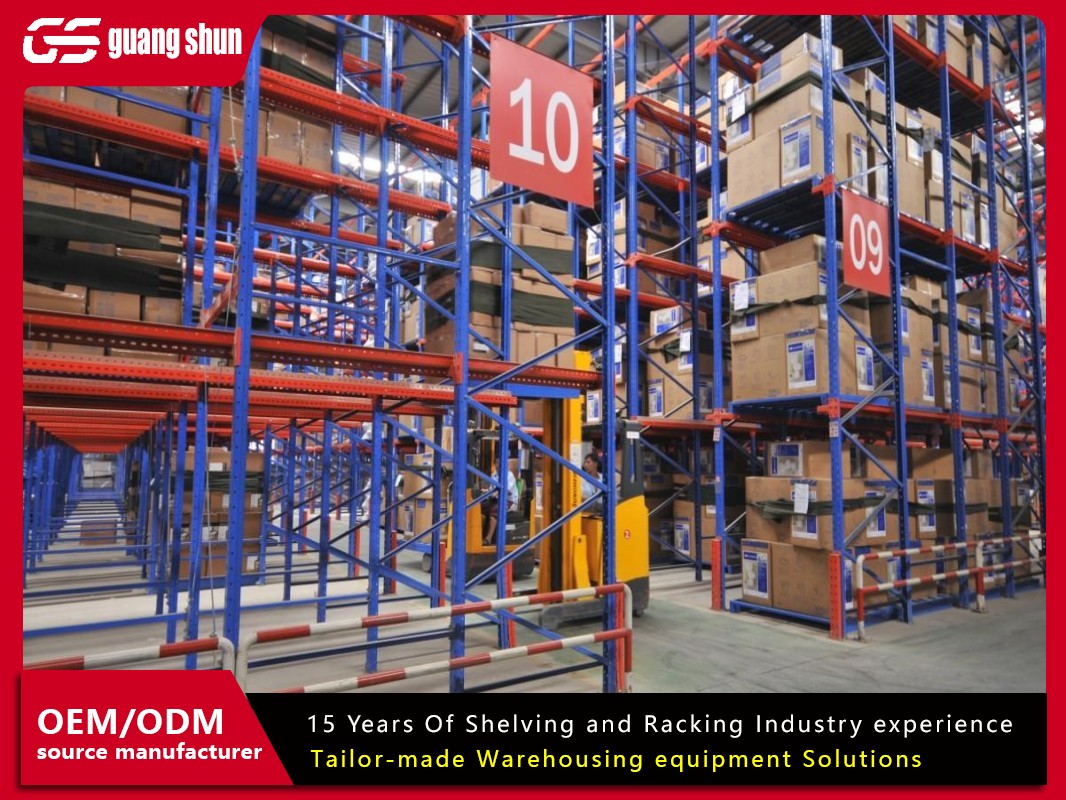
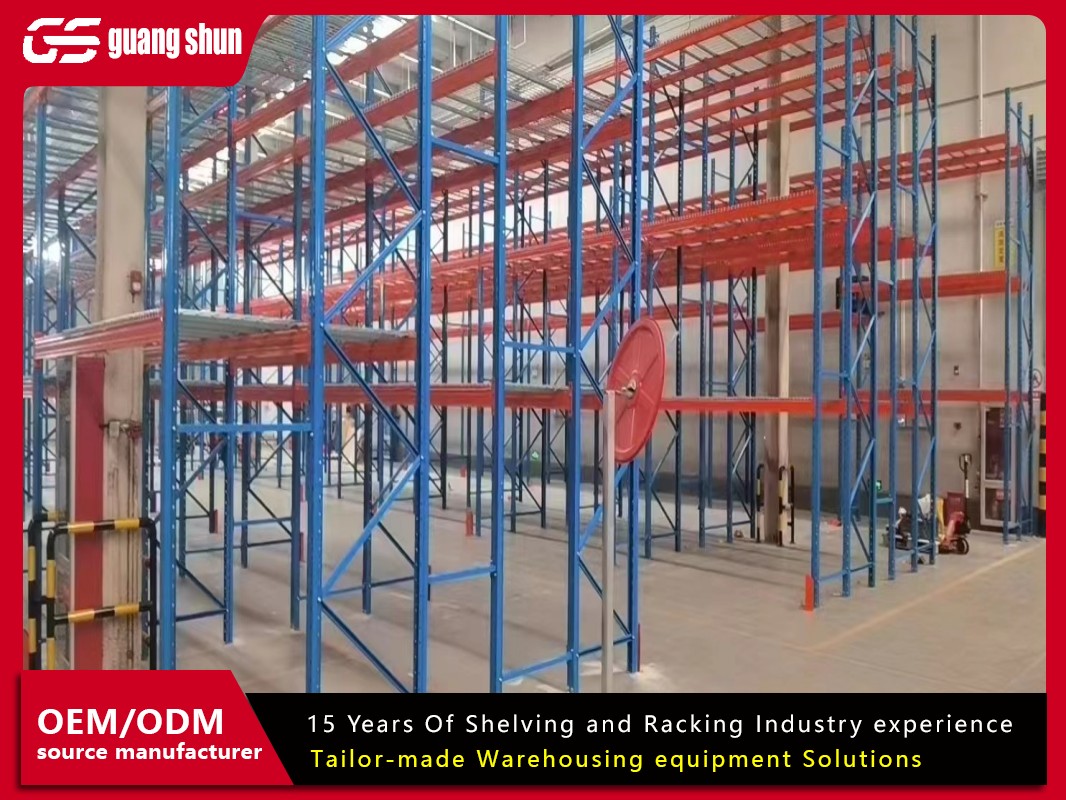
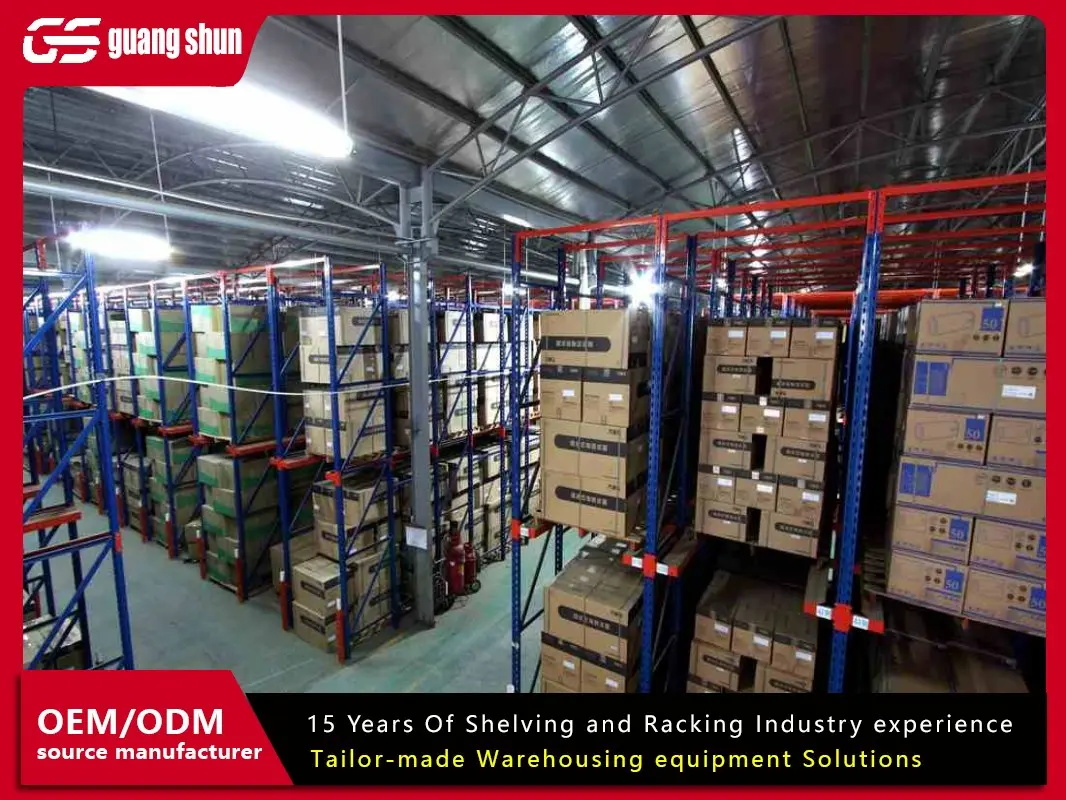
Selective Pallet Racking – 100% accessibility, ideal for FIFO operations. Upright frame spacing typically 8–12 ft, beam levels adjustable on 3-in pitches. Load capacity per beam level: 2,000–6,000 lbs. Suitable for high-mix SKUs with low to medium throughput.
Drive-in / Drive-through Racking – Density-focused design with LIFO retrieval. Rail systems support up to 12 pallets deep. Requires higher gauge steel (minimum 2.5 mm) for rail beams. Maximum height limited to 30 ft due to forklift visibility constraints.
Push-back Racking – Utilizes nested carts on inclined rails. Typical depth: 2–6 pallets per lane. Load capacity per cart position: 1,800–2,500 lbs. Reduces aisle requirements by 30% compared to selective.
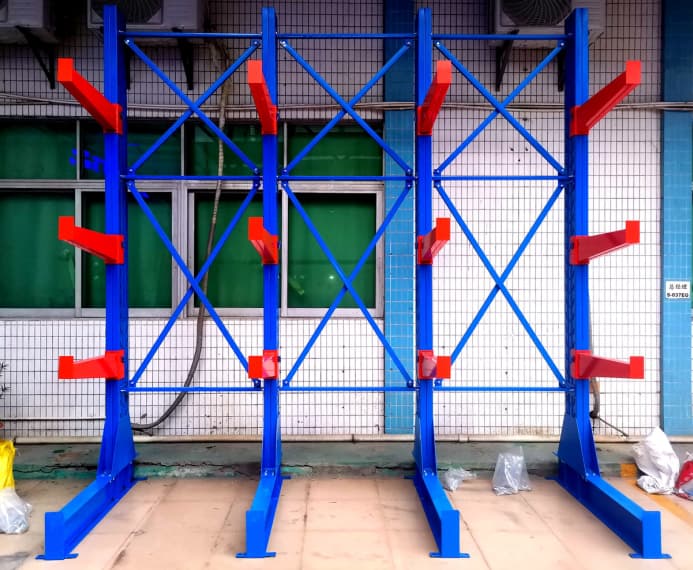
Cantilever Racking – For long loads (pipes, lumber, sheet metal). Arms support up to 1,500 lbs per side, with arm length up to 48 in. Base width-to-height ratio must exceed 1:4 to prevent overturning.
Pallet Flow Racking – Gravity-fed with roller tracks and speed controllers. Dynamic load on brakes: 3,500 lbs per lane. Required pitch: 3–5% slope. Works best for high-volume, same-SKU flows.
When you evaluate the warehouse racking company, ask for the specific yield strength of steel used (minimum 33 ksi for uprights, 50 ksi for beams). Many generic suppliers import lower-grade Q235 steel (30 ksi) which fails fatigue testing under cyclic loading from automated shuttles.
One of the most overlooked aspects of warehouse racking design is the combination of dead load (rack weight), live load (pallets), and lateral forces. According to the MHI 2024 report, 18% of warehouse structural failures involved incorrect load application. A professional the warehouse racking company will provide a load plaque at each aisle, detailing:
Maximum uniform distributed load (UDL) per beam level (lbs/ft)
Point load capacity at beam center (typically 25% lower than UDL)
Seismic horizontal force coefficient (Cs) based on ASCE 7-22 Site Class D
Deflection limits: L/180 for beam vertical deflection, H/200 for frame drift under wind load
For a concrete example: A 9,000 lb capacity bay (three beam levels, each 3,000 lb) in seismic zone 3 requires base plates with 1/2-in anchor bolts embedded 6 in into concrete with 4,000 psi strength. Without these specifications, the racking company’s liability waiver becomes void. Guangshun provides site-specific seismic calculations, including moment-resisting base connections for racks above 25 ft, verified by third-party PE stamps.
Warehouse racking suffers from “hidden damage”: bent uprights, cracked footplates, and dislodged beam connectors. The RMI recommends monthly inspections for high-traffic areas. However, only 42% of warehouses comply (OSHA Data 2024). A reliable racking company integrates damage-resistant features:
Corner guards with energy-absorbing polymer sleeves – reduce impact force by 60%.
Row-end column shields with 12-gauge steel wrap, extending 18 in from floor.
Beam safety locks with positive engagement indicators (audible click).
Load indicator labels that change color when overload exceeds 110%.
Advanced operators now deploy IoT-enabled strain gauges on critical uprights. When a the warehouse racking company offers these monitoring systems as an add-on, it reduces unplanned downtime by 73% (based on Guangshun’s 2023 retrofit project for a Midwest 3PL).
Automated guided vehicles (AGVs) and automated storage and retrieval systems (ASRS) require stricter racking tolerances. Horizontal beam alignment must be within ±2 mm over 100 ft, and upright plumbness within 0.5% of height. Traditional selective racking from a generalist racking company often fails these specs. Specialist providers like Guangshun manufacture robotic-ready frames with laser-cut beam connectors and shim-adjustable base plates. For a recent ASRS installation handling 50 lb totes at 300 picks/hour, the racking structure had to withstand 0.15g deceleration forces from shuttles – a requirement met by using 2.5 mm thick closed tubular uprights instead of open C-sections.
A low-bid the warehouse racking company often uses thinner steel (1.8 mm vs. 2.5 mm) and skip shot blasting before powder coating, leading to corrosion within 3 years in high-humidity environments. Over a 10-year horizon, the TCO difference is substantial:
Premium racking (2.5 mm, galvanized after welding): $18,000 per bay, annual maintenance $600, lifespan 20 years.
Economy racking (1.8 mm, powder coat only): $12,000 per bay, annual maintenance $1,800 (repainting, bent frames), lifespan 8 years.
Factoring in downtime costs (average $5,000/hour for a distribution center), the premium solution yields a 34% lower TCO by year 7. Guangshun’s lifecycle reports, based on 47 installations, show that customers who choose the engineered package achieve ROI break-even at month 18 due to reduced damage claims.
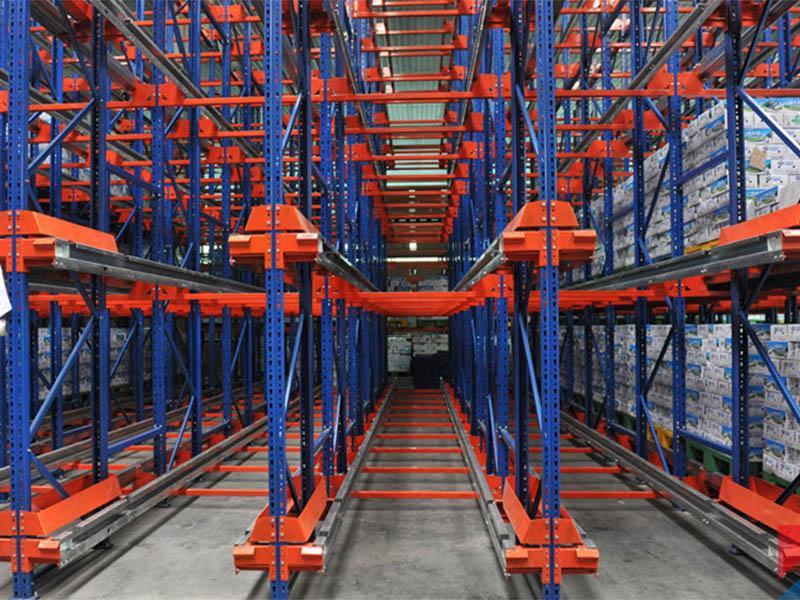
Rather than selling off-the-shelf components, a technically competent racking company performs a site audit including:
Concrete floor flatness (FF/FL numbers) – requirement: FL 25 minimum for racks >20 ft.
Aisle width optimization using forklift turning radius simulation.
Pallet condition analysis (warped or damaged pallets redistribute load unevenly).
During a 2022 project for a cold storage facility, Guangshun identified that the client’s existing floor had only 2,200 psi concrete instead of specified 3,500 psi. We designed a load-spreading base plate system with 4x6-in steel pads, avoiding a $200,000 floor replacement. This level of customization separates a true engineering partner from a commodity reseller.
Q1: What certifications should I require from the warehouse racking
company before signing a contract?
A1: Demand RMI (USA)
or FEM (Europe) compliance certificates, third-party seismic calculation stamps
(e.g., from a licensed structural engineer), and ISO 9001:2015 for manufacturing
processes. Also request a load test report for the specific beam-to-upright
connection.
Q2: How often should warehouse racking be professionally
inspected?
A2: RMI recommends a formal structural inspection every
12 months by a certified rack safety inspector (CRSI). However, high-throughput
warehouses with forklift traffic should perform internal visual checks weekly,
focusing on floor-anchor torque and column deformation beyond 0.25 in.
Q3: Can I mix racking components from different manufacturers to save
costs?
A3: Not recommended. Beam step dimensions, upright hole
patterns, and safety lock designs vary between brands. Mixing can create
incompatible load transfer and void any warranty. Always source full systems
from a single the
warehouse racking company to maintain structural continuity.
Q4: What is the maximum safe height for selective pallet
racking?
A4: Standard selective racking can reach 40 ft with
appropriate bracing and seismic bracing. Above that, you need specialized
high-bay designs (e.g., back-to-back with horizontal truss connectors). Height
is limited by the stability of upright sections against buckling: slenderness
ratio (KL/r) must not exceed 200 for main columns.
Q5: How does Guangshun handle seismic retrofitting for existing
racking systems?
A5: Guangshun performs on-site stiffness
mapping, then retrofits with bolted diagonal bracing kits, base plate enlargers,
and anchor bolt epoxy injection. In a 2023 project for a Los Angeles DC, we
increased seismic capacity from Zone 2 to Zone 4 standards at 15% of the cost of
new racking.
Q6: What is the typical lead time for a custom-engineered racking
system?
A6: For a 50,000 sq ft installation with custom upright
spacing, lead times range from 8 to 14 weeks, including engineering approval,
roll forming, welding, powder coating, and shipping. Standard components can
ship in 3–4 weeks. Guangshun maintains a buffer stock of 20,000 tons of pre-cut
steel to reduce urgent project timelines.
Q7: Does rack color affect operational safety?
A7: Yes –
high-visibility colors (e.g., yellow for uprights, red for beam safety locks)
reduce forklift collisions by 27% according to a 2023 safety study. Also,
reflective striping on aisle-facing columns improves low-light navigation. A
professional racking company offers custom RAL color mapping as part of safety
optimization.
Selecting the warehouse racking company is a strategic decision that influences throughput, worker safety, and capital efficiency. Prioritize engineering documentation, seismic compliance, and post-installation inspection programs. Guangshun provides full lifecycle support – from FEA modeling to 10-year structural warranty – ensuring your racking investment remains productive under real-world conditions. Request a site-specific load analysis and compare detailed proposals based on steel gauge, safety factors, and TCO projections rather than upfront price alone.

 Wechat
Whatsapp
Wechat
Whatsapp