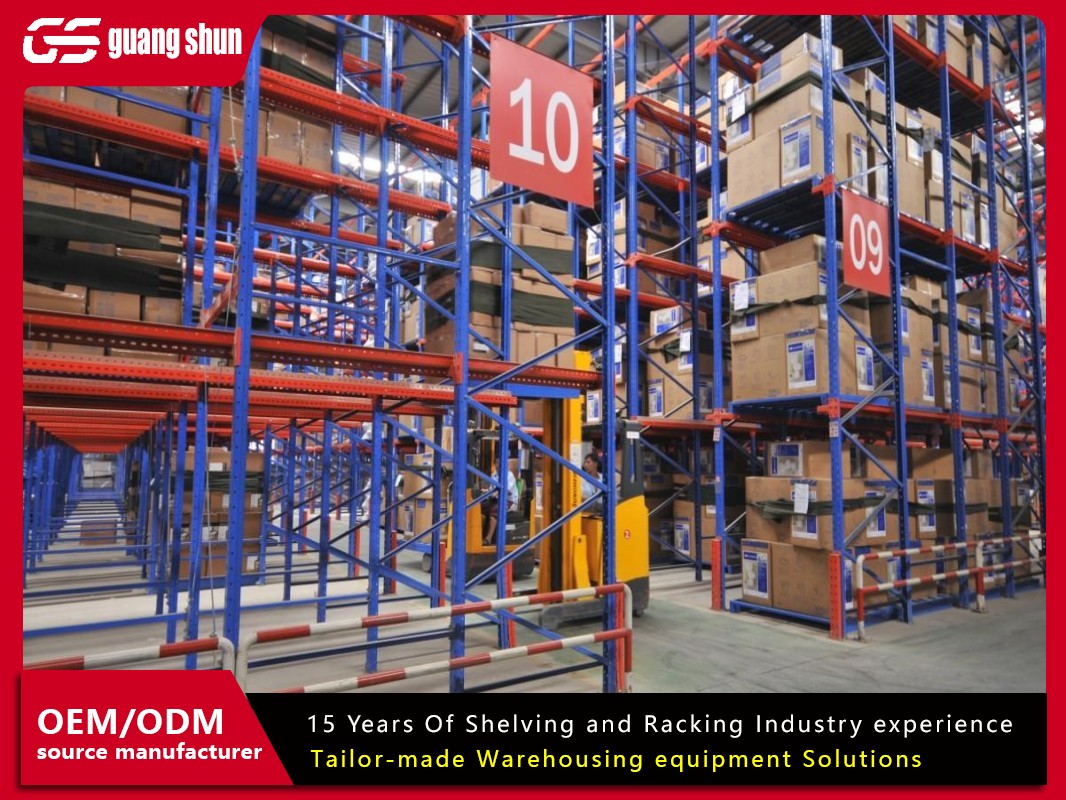
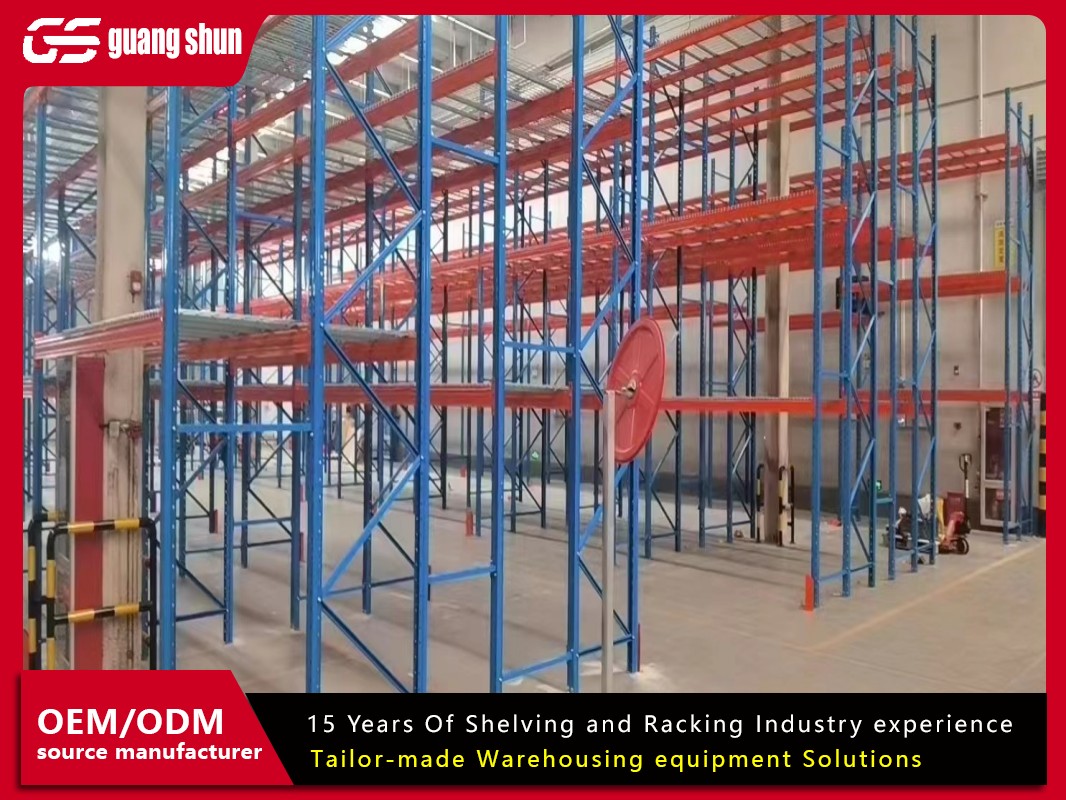
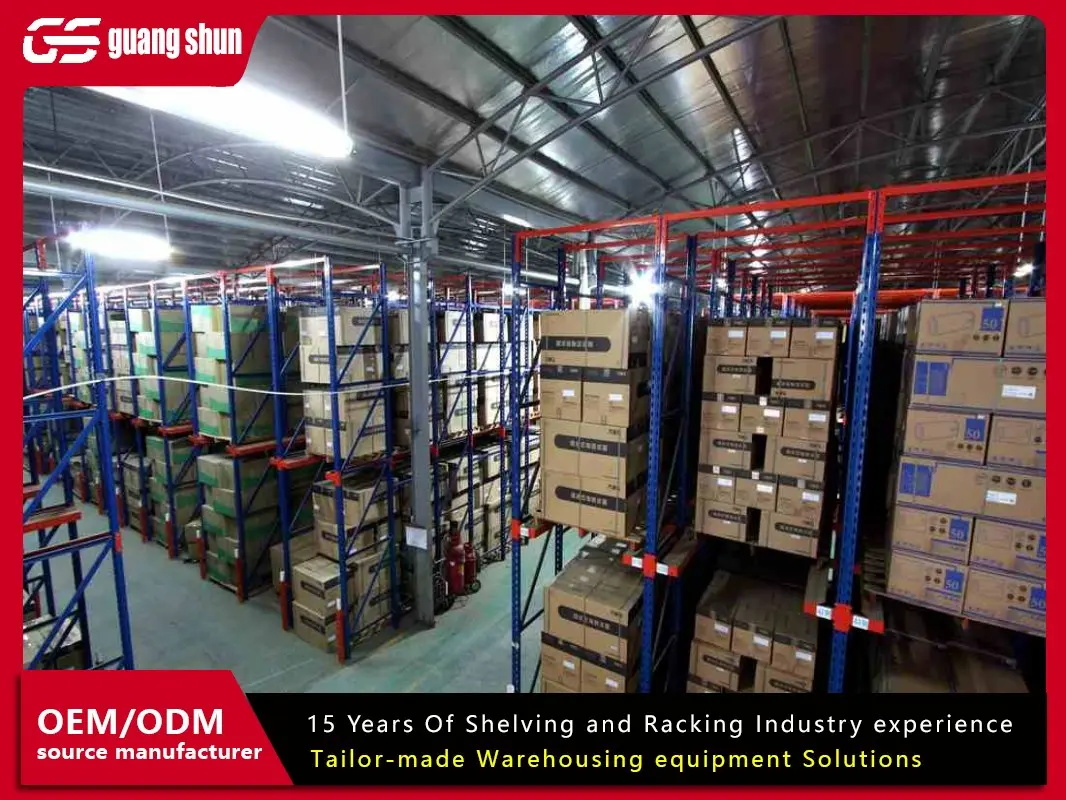
Modern distribution centers face persistent pressure to increase storage density without sacrificing inventory accessibility. Traditional static pallet racks often lead to inefficient use of cubic space, unnecessary fork truck travel, and compromised FIFO (First-In-First-Out) discipline. Engineered warehouse roller racks provide a physics-based answer—using gravity, low-friction roller beds, and intelligent lane design to transform how goods move through a facility. This article breaks down the mechanical design principles, application-specific configurations, and quantifiable performance gains from implementing professional roller rack systems, with references to real-world installations from Guangshun engineering projects.
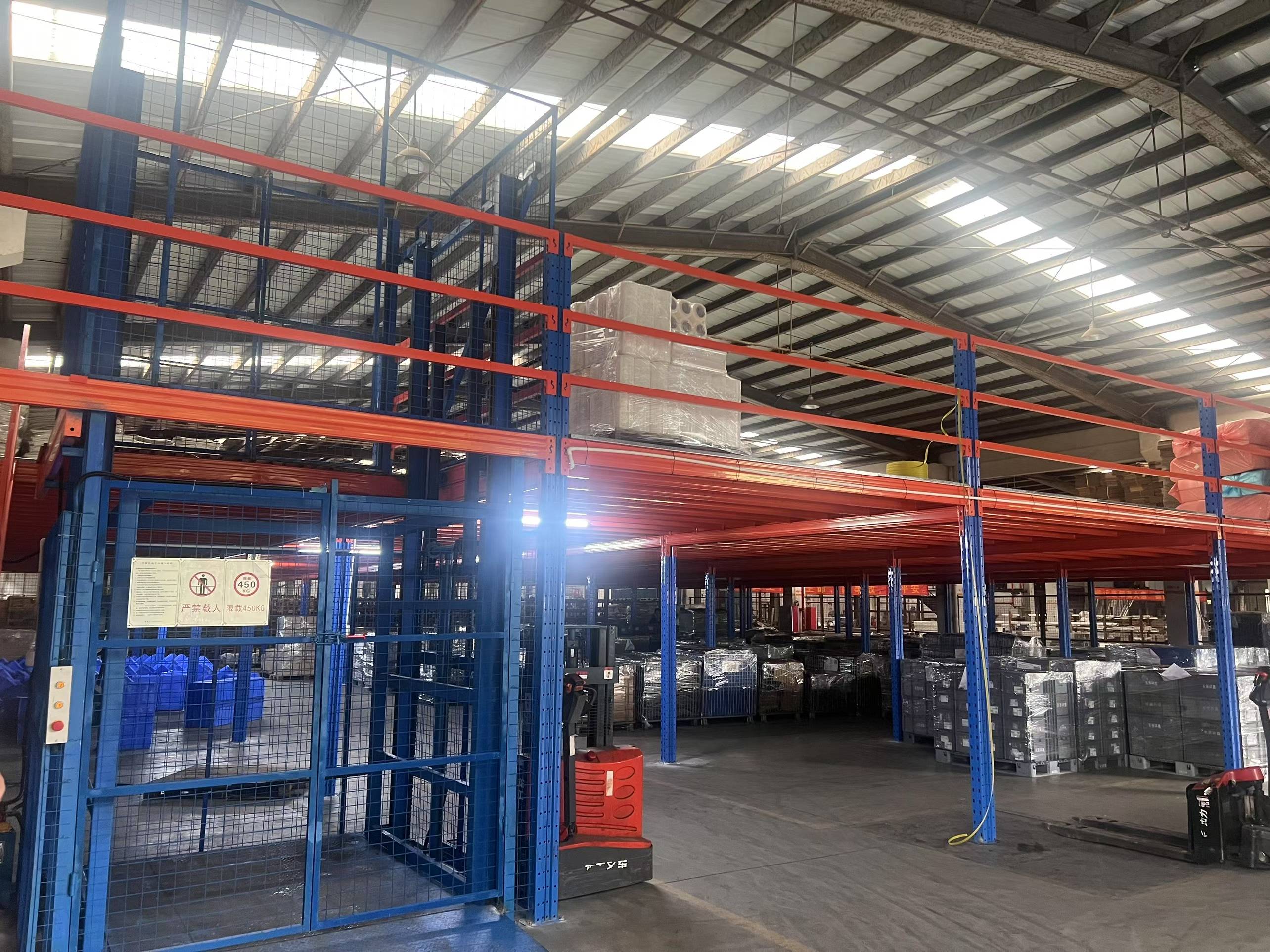
Unlike beam or cantilever racks, warehouse roller racks integrate conveying elements directly into the storage structure. Each lane consists of parallel roller tracks set at a precise decline angle (typically 3–6 degrees, depending on product weight and roller pitch). When a load is placed at the loading end, gravity pulls it toward the picking face. The rollers—often zinc-plated steel, stainless steel, or polyurethane-coated—minimize breakaway friction and rolling resistance. Key design factors include:
Roller pitch: Spacing between rollers ranges from 50 mm to 150 mm. Tighter pitches (≤75 mm) support smaller cartons or totes, preventing “hang-up” between rollers.
Axle material and bearings: Sealed precision ball bearings reduce starting torque, allowing loads as light as 5 kg to flow smoothly. For cold storage (< -10°C), special low-temperature grease and stainless steel axles prevent freezing.
Lane dividers and separators: Galvanized steel guides maintain lane integrity, preventing SKU mixing and ensuring each lane operates independently.
End stops and shock absorbers: Picking-end stops incorporate polymer bumpers to absorb kinetic energy, protecting both the load and the rack structure.
These engineering choices directly impact throughput. A comparative study by the Material Handling Institute shows that converting from static shelving to properly designed roller rack lanes reduces order pick travel time by 38% and increases pick density by up to 55% per square foot.
No single roller rack design fits every warehouse. Based on load type, turnover velocity, and environment, engineers select among several architectures:
Ideal for e-commerce fulfillment and spare parts distribution, these warehouse roller racks handle individual cartons weighing 15–50 kg. Lane depths from 6 to 18 positions allow dense buffering of fast-moving SKUs. The picking face replenishes automatically as items are removed. For high-volume facilities, double-deep flow lanes can double SKU capacity per square meter. Critical metric: Roller rack lanes achieve a 92%–97% FIFO compliance rate without any digital tracking, reducing inventory write-offs due to expiration.
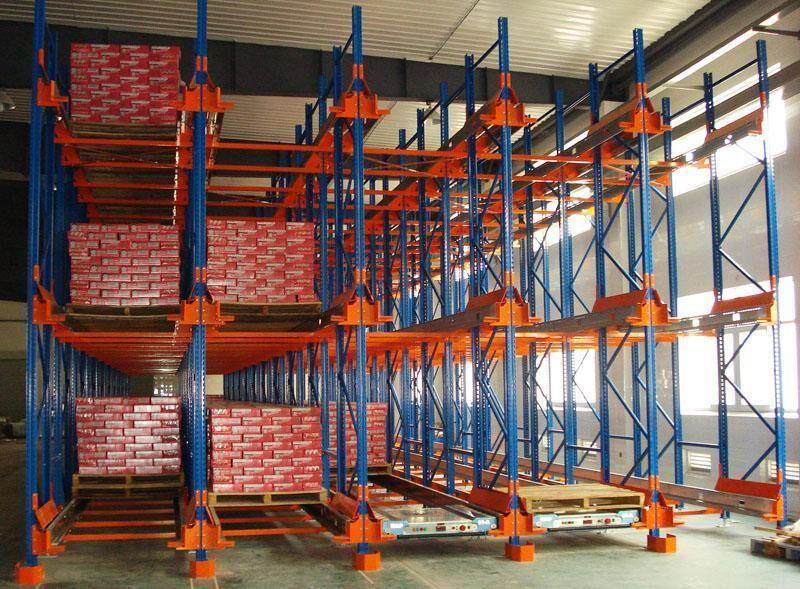
For full pallet loads (600–1,200 kg), heavy-gauge steel rollers with 100–150 mm pitch are required. The decline angle is reduced to 2–3 degrees to control descent speed. Speed controllers (hydraulic or centrifugal brakes) are installed at the rear to prevent pallet impact damage. These systems are standard in beverage, grocery, and cold storage DCs where deep lane storage (up to 12 pallets deep) maximizes cube utilization. Data from Guangshun installations indicate that converting from drive-in racks to pallet flow roller racks reduces forklift travel distance by 60% per pallet retrieved while eliminating the need to re-enter lanes.
Next-generation facilities incorporate roller racks as passive accumulation buffers for autonomous vehicles. The picking face includes photo-eye mounting brackets and transfer interfaces that align with AGV lift decks. Rollers with 1.9% slope allow loads to advance under gravity while AGVs pick from the front. This hybrid approach reduces investment in powered conveyors while maintaining semi-automated material flow.
Many warehouse managers hesitate to adopt roller-based dynamic storage, citing higher upfront costs or perceived complexity. However, a closer examination of operational friction reveals clear justification:
Pain point: Low space utilization in static selective racks. Standard selective racks use only 35–45% of available depth. Roller flow racks utilize 85–95% of lane depth, effectively adding storage positions without expanding footprint.
Pain point: Labor waste in stock rotation. With static racks, workers spend 20–30% of their shift performing “wall-to-wall” moves to rotate inventory. Gravity-fed roller racks automate rotation, reducing labor cost by up to $4.50 per pallet stored/retrieved.
Pain point: Damage to goods from improper handling. Forklifts maneuvering in deep lanes frequently damage pallets and rack uprights. Pallet flow roller racks eliminate entry/exit maneuvers, cutting product damage by 70–80% based on industry loss reports.
Pain point: Inefficient batch picking for multi-SKU orders. Roller rack “pick faces” can be organized into zones, where each lane supplies a specific SKU. Order pickers walk a straight aisle, collecting items from multiple lanes—this “goods-to-person” layout improves pick rates from 60 lines/hour to over 180 lines/hour in documented case studies.
To select the correct roller rack, engineers must calculate dynamic load characteristics. The following parameters are non-negotiable for safe and efficient operation:
Standard steel rollers (tube wall thickness 1.5–2.5 mm) support up to 150 kg per roller for carton flow applications. For pallet flow, solid steel rollers or machined aluminum rollers with 5 mm wall thickness support >300 kg per roller. Where corrosive environments exist (seafood cold stores, chemical warehouses), 304 or 316 stainless steel rollers are mandatory. Guangshun offers a roller material selection matrix based on humidity, temperature range, and load acidity—this ensures 15+ year service life without seizing.
The required incline angle θ follows the formula: tan θ = μ_r + (a/g), where μ_r is the rolling resistance coefficient (0.005–0.015 for clean steel-on-steel) and a/g is the desired acceleration factor. For most carton flow racks, a 4.5° angle yields a steady 0.15 m/s² acceleration, reaching 0.8 m/s terminal velocity after 2 meters. Speed controllers (either mechanical centrifugal or oil-damped) keep velocity below 0.5 m/s to prevent product shift.
Warehouse roller racks must comply with RMI (Rack Manufacturers Institute) or FEM 10.2.02 standards. In seismic zones, cross-aisle horizontal bracing and baseplate anchorage are critical. Dynamic analysis shows that roller racks with bolted beam-to-column connections outperform clip-in systems under lateral loading by a factor of 2.3 in shake-table tests.
Even the best-engineered warehouse roller racks require scheduled maintenance to prevent flow interruptions. A proactive program includes:
Quarterly roller bearing inspection: Check for radial play and axial end float. Replace any roller with >0.5 mm radial play.
Lane cleaning schedule: Dust and debris accumulation increases rolling resistance. Blow out lanes with compressed air monthly; for high-dust environments (e.g., cement or flour), schedule weekly cleaning using a HEPA vacuum wand.
Declination angle re-verification: Settling of floor slabs or rack anchors can alter the angle. Use a digital inclinometer to check every 12 months; adjust shims if deviation exceeds ±0.5° from design angle.
End stop and bumper replacement: Polymer bumpers typically last 3–5 years under normal use. Replace when cracks or deformation >10 mm are visible.
Following this schedule reduces unplanned downtime by over 85%, as verified by maintenance records from a major third-party logistics provider operating 200+ flow rack lanes.
While the upfront cost of roller racks is 40–70% higher than static selective racks, the total cost of ownership (TCO) over a 10-year period is often 25–35% lower due to labor and space savings. A typical financial model for a 1,000-pallet-position warehouse shows:
Space reduction: Roller racks achieve same storage capacity in 60% of the floor area, potentially avoiding a $2M warehouse expansion.
Labor efficiency: Eliminating dedicated forklift re-handling saves 2.5 full-time equivalents (FTEs) per shift, equivalent to $180,000 annual labor cost reduction.
Inventory accuracy improvement: FIFO compliance reduces obsolete or expired stock by 12–18%, directly improving gross margin.
Energy savings: Less forklift travel reduces battery consumption and charging cycles, cutting energy costs by up to $8,000 annually per 10 trucks.
Most projects achieve payback within 18–24 months. Guangshun provides lifecycle cost analysis tools to compare static vs. dynamic storage for any given SKU profile.
As SKU proliferation accelerates and labor shortages persist, the shift from static to dynamic storage is no longer optional—it is a competitive necessity. Properly designed warehouse roller racks combine the simplicity of gravity with rigorous engineering to deliver measurable gains in density, throughput, and inventory control. Whether handling cartons, totes, or full pallets, roller-based flow racks offer a proven path to reduce operating costs while improving order accuracy. For facilities aiming to integrate automation, roller racks provide a low-complexity bridge to AGV-compatible workflows. By adhering to the technical specifications, maintenance regimes, and ROI models outlined above, warehouse operators can confidently deploy roller rack systems that perform reliably for decades.
Q1: What is the typical load capacity range for warehouse roller racks designed for carton flow versus pallet flow?
A1: Carton flow roller racks typically handle loads from 5 kg to 80 kg per lane, with individual roller capacities of 50–150 kg. Pallet flow roller racks are engineered for 600 kg to 1,500 kg per pallet position, using heavy-duty steel rollers (≥300 kg per roller) and reinforced frames. Always consult manufacturer load charts—exceeding rated capacity accelerates bearing wear and risks structural failure.
Q2: Can warehouse roller racks support FIFO (First-In-First-Out) inventory management without software integration?
A2: Yes. Gravity-fed roller racks are inherently FIFO-compliant: loads loaded from the rear automatically flow to the picking face, ensuring the oldest stock is always presented first. No WMS or barcode scanning is required for physical FIFO compliance, though combining roller racks with inventory tracking software provides audit trails and real-time stock counts.
Q3: How do I choose the correct roller material for a cold storage environment (-20°C to 0°C)?
A3: For sub-zero applications, select stainless steel rollers (grade 304 or 316) with low-temperature-compatible grease (operating range -40°C to +80°C). Avoid nylon or polyurethane-coated rollers below -10°C, as they become brittle. Additionally, use sealed bearings (2RS type) to prevent moisture ingress and ice formation. Guangshun offers cold-storage-specific roller racks with verified performance down to -30°C.
Q4: What safety standards apply to warehouse roller racks, and how often should they be inspected?
A4: RMI (ANSI MH16.1-2020) and FEM 10.2.02 are the primary standards for roller rack design and testing. Inspections should follow OSHA guidelines: daily visual checks for damage or misalignment, monthly detailed inspections of rollers, bearings, and end stops, and a full engineering audit annually. Any bent frame member or seized roller requires immediate lane shutdown until repair.
Q5: Are warehouse roller racks compatible with automated guided vehicles (AGVs) and robotic picking arms?
A5: Absolutely. Modern roller racks can include AGV interface kits—laser-reflective targets, alignment guide rails, and photo-eye mounting brackets. The picking face can be designed with a consistent Z-height and flat transfer plate so that AGV forks or robotic grippers can extract loads without human intervention. Many semi-automated DCs use roller racks as buffer storage between AGV delivery zones and packing stations.
Q6: How does lane depth affect the required incline angle and flow reliability?
A6: Deeper lanes (e.g., 15–20 cartons deep) require a slightly steeper angle (5°–6°) to overcome cumulative rolling resistance from multiple loads. Shallow lanes (≤8 positions) can use 3°–4° angles. For pallet flow lanes deeper than 8 pallets, speed controllers become mandatory to prevent excessive impact forces at the picking face. A flow simulation should be run for lane depths exceeding 12 positions.
© 2026 Technical resource for warehouse professionals. For custom engineering support and roller rack specifications, consult Guangshun material handling experts.

 Wechat
Whatsapp
Wechat
Whatsapp