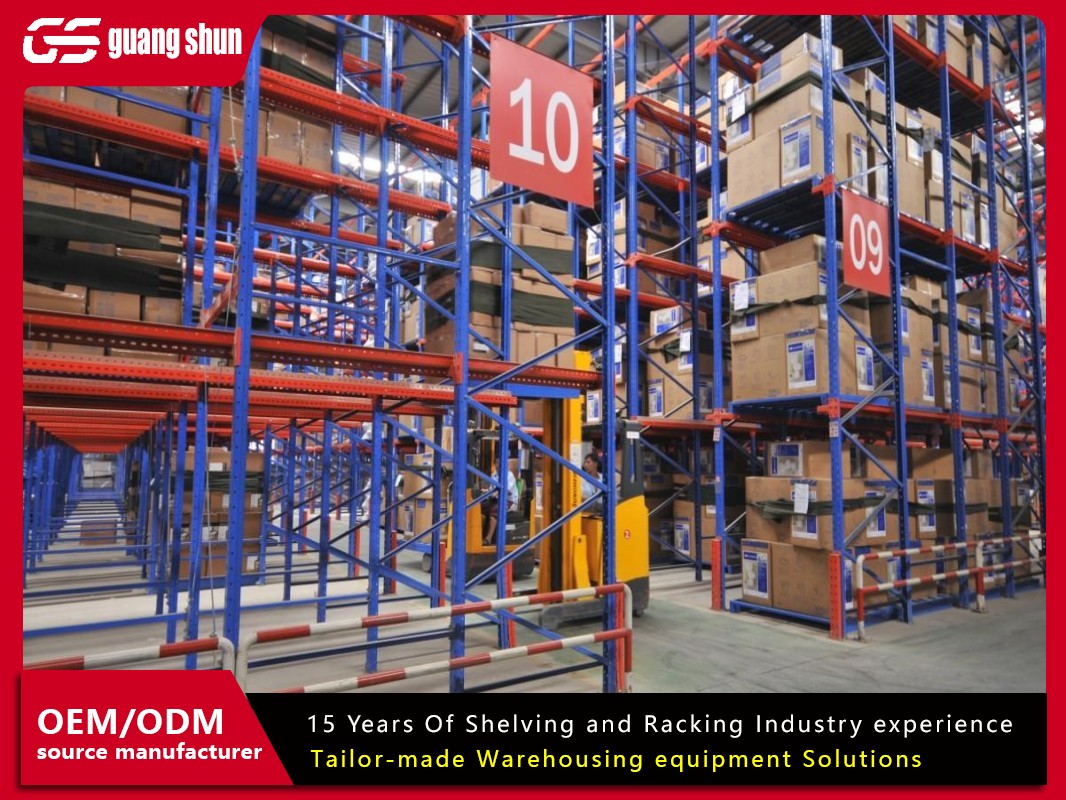
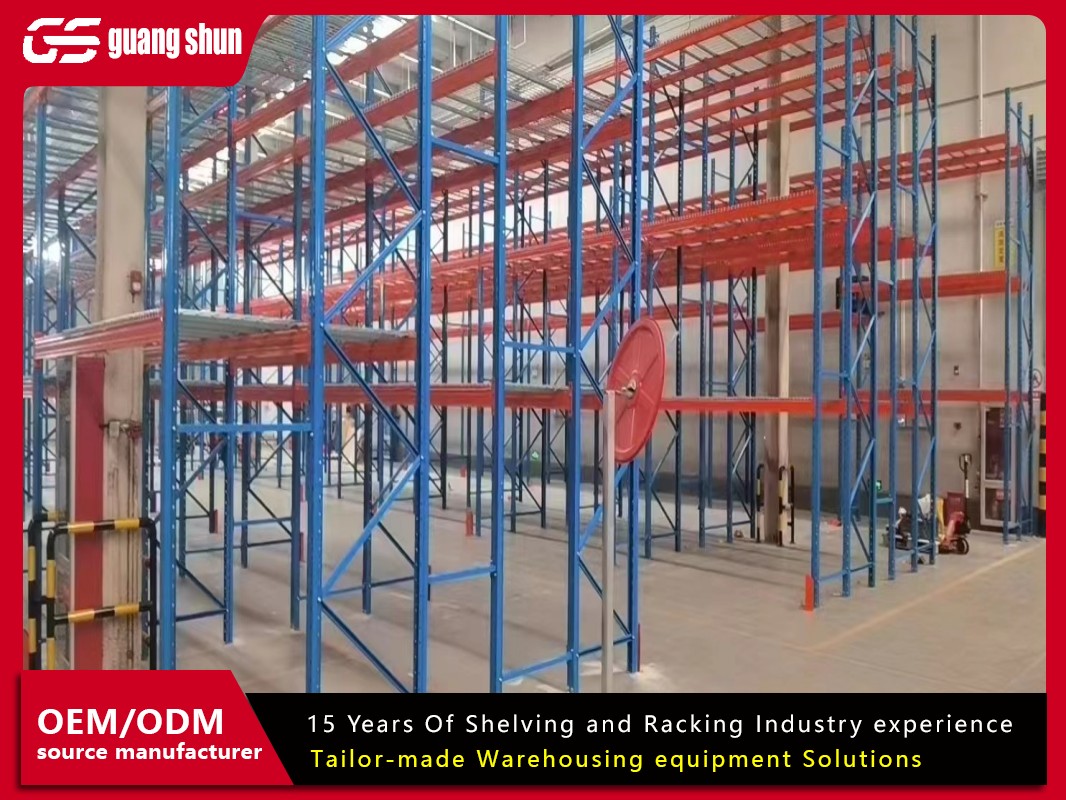
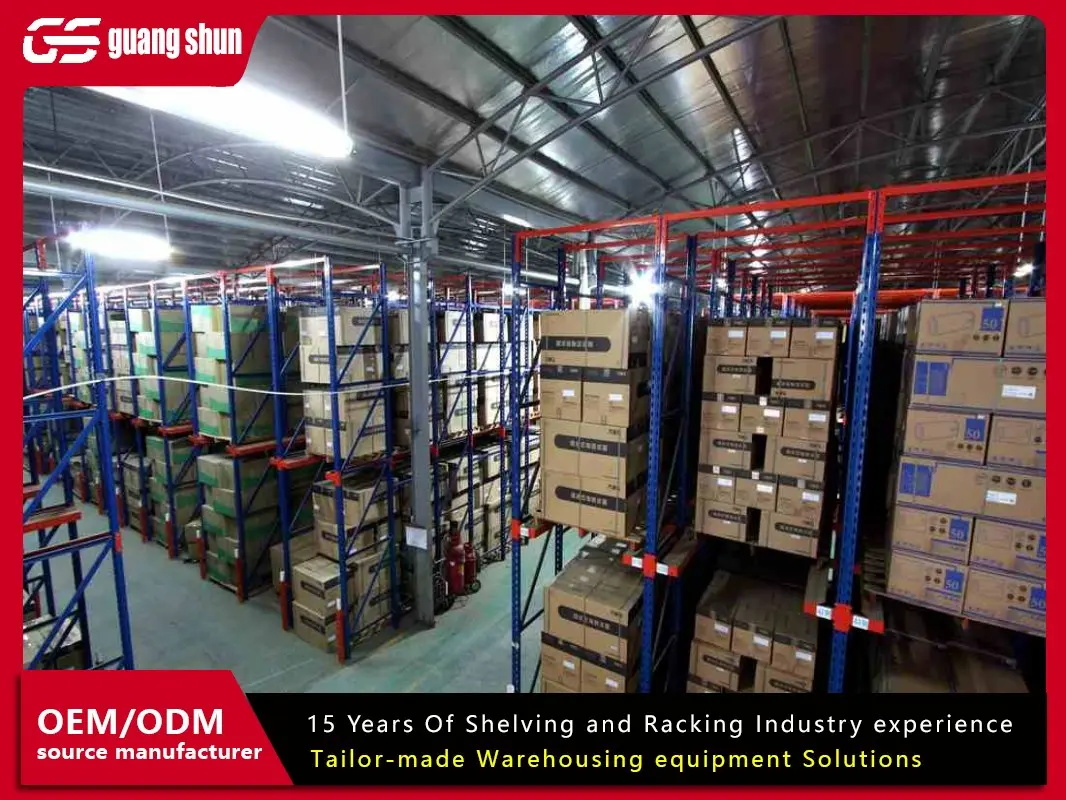
The architecture of a distribution center directly dictates its throughput capacity and safety profile. For operations managers, understanding the different types of racks in warehouse environments is not an academic exercise; it is the foundation of supply chain efficiency. Selecting the wrong configuration leads to cube loss, product damage, and retrieval bottlenecks. This guide dissects the mechanical properties, space utilization metrics, and application scenarios for the primary industrial racking families, providing a data-driven framework for your investment decisions.
Selective racking remains the most widely recognized among the different types of racks in warehouse facilities due to its 100% SKU accessibility. Each pallet position is directly accessible without moving others, making it ideal for high-turnover inventory.
A selective system consists of upright frames and load beams. The integrity relies on the beam-to-upright connection—typically a welded keyhole and safety clip mechanism. When evaluating different types of racks in warehouse design, note that selective racking offers lower storage density (approximately 1-2 pallets deep) but compensates with superior selectivity. Beam levels can be adjusted vertically in 2-inch increments, accommodating varying pallet heights. Guangshun engineers utilize cold-formed steel with closed sections to resist torsional forces from forklift impacts.
Grocery distribution where FIFO (First-In, First-Out) rotation is mandatory.
Third-party logistics (3PL) warehouses handling diverse client inventories.
Facilities with non-standard pallet sizes requiring frequent reconfiguration.
When storage volume takes priority over accessibility, drive-in racks become the optimal choice among different types of racks in warehouse systems. These structures allow forklifts to enter the rack bay directly to deposit or retrieve pallets.
Drive-in racks operate on a Last-In, First-Out (LIFO) basis, as the forklift accesses the same lane for putaway and retrieval. This suits homogeneous products like bulk food items or bottled beverages. Conversely, drive-through racks (a slight variation) are open at both ends, allowing FIFO rotation, though this requires two aisles. The density gain is significant: compared to selective systems, drive-in configurations can increase storage capacity by up to 75% by eliminating multiple access aisles. However, the different types of racks in warehouse with drive-in design require more rigorous operator training to prevent column damage.
The absence of front beams means the uprights must withstand lateral forces independently. Rail guides are installed on the floor to steer forklifts. Guangshun’s drive-in systems feature reinforced double-rail construction to absorb the repeated impact of pallet entry, extending the operational life of the structure.
Push-back racking bridges the gap between selective and drive-in models. It utilizes nested carts or inclined rails that move along a slight slope. When a new pallet is loaded, it pushes the existing pallets back one position.
Standard push-back systems are typically 2 to 5 pallets deep. They offer higher density than selective racks but better selectivity than drive-in. Among the different types of racks in warehouse solutions, push-back provides a distinct advantage in medium-turnover SKUs. The system naturally organizes inventory by LIFO logic. It reduces the need for multiple aisles while maintaining distinct lanes per SKU.
The critical component is the cart and rail interface. High-quality systems use sealed ball bearings and zinc-plated rails to ensure smooth operation even in cold storage environments. Guangshun specifies rail gauges based on pallet weight, ensuring that the carts do not rack or bind over years of continuous use. When comparing the different types of racks in warehouse equipment, factor in the cost of these mechanical subassemblies against the labor savings from reduced travel time.
For operations requiring First-In, First-Out (FIFO) inventory management with high density, pallet flow racks are the engineering answer. These systems use gravity rollers or wheels on a slight decline.
Pallets are loaded at the high end and flow to the low end for retrieval. Speed controllers (brakes) are integrated into the roller tracks to regulate pallet descent. This is one of the more technically complex different types of racks in warehouse systems, as it requires precise calibration based on pallet weight and condition. Guangshun utilizes variable-speed controllers that automatically adjust to the actual load, preventing runaway pallets and ensuring operator safety at the pick face.
Pallet flow is ideal for high-volume, short shelf-life products such as dairy, beverages, and pharmaceuticals. The system consolidates the pick face, reducing travel distances significantly compared to wide-aisle selective configurations.
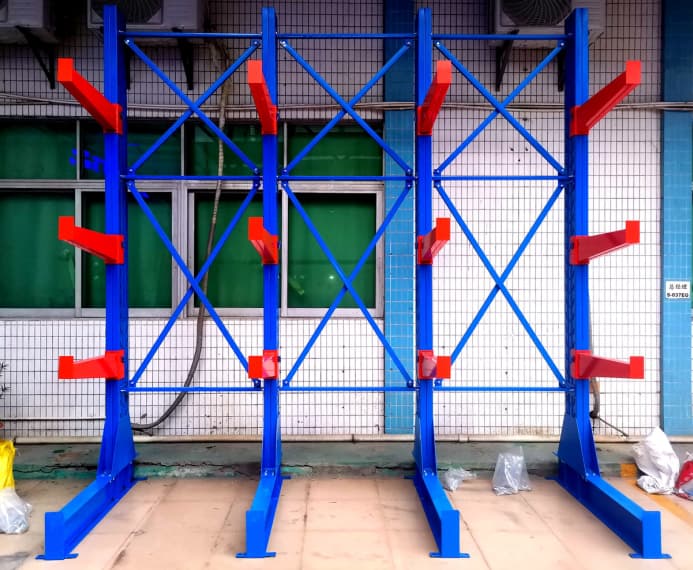
Standard pallet racks fail when handling long, irregular items. Cantilever racks feature arms extending from a central column, providing unobstructed horizontal storage.
The engineering challenge with cantilever racks is the significant moment (torque) applied to the baseplate. Arms are available in varying lengths and capacities, typically from 1,000 lbs to 3,000 lbs per arm. The columns are often braced with tension rods to counteract overturning forces. As one of the essential different types of racks in warehouse designs, cantilever systems are essential for lumber yards, pipe distributors, and furniture warehouses.
Options include wood decking for delicate items or steel decking for heavy bundles. Guangshun provides seismic calculations specifically for cantilever installations, ensuring the arms and columns are anchored to withstand lateral forces during earthquakes.
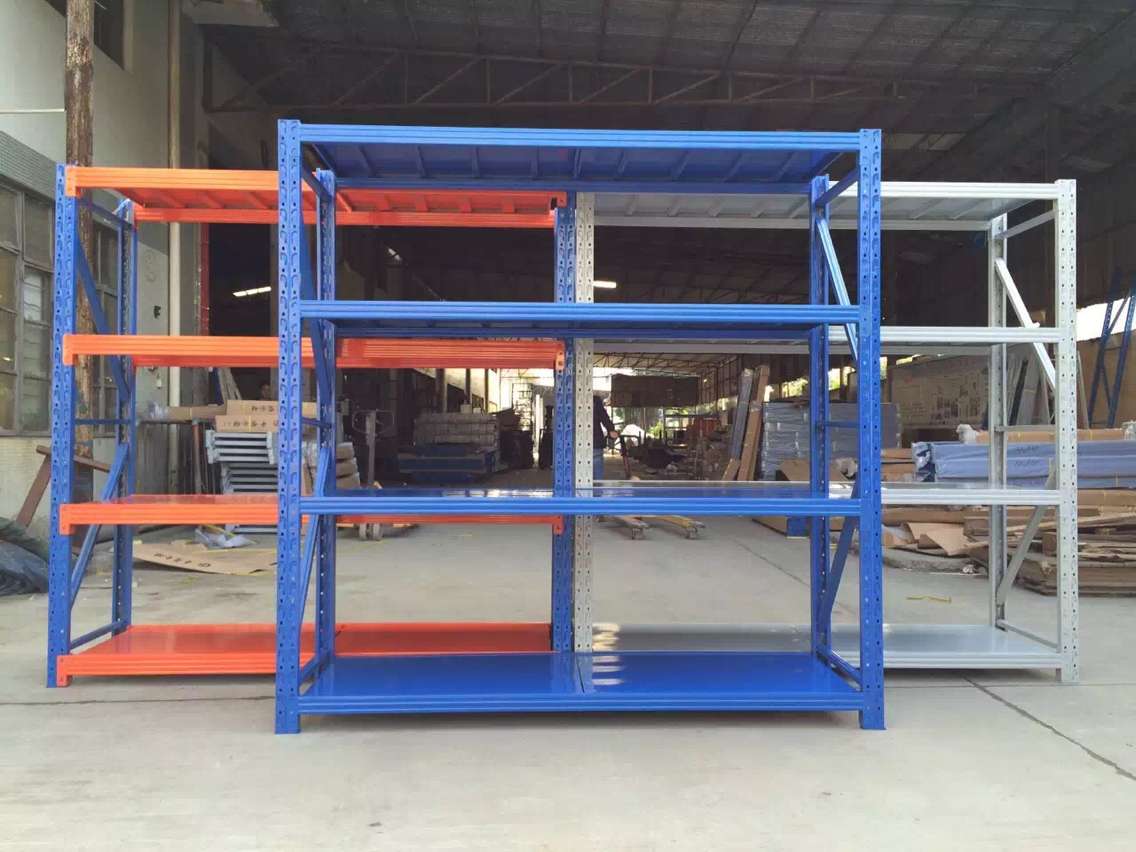
Regardless of the configuration—whether selective, drive-in, or cantilever—the base materials and safety features define the system's longevity. All different types of racks in warehouse structures should comply with ANSI MH16.1 (USA) or AS4084 (Australia) standards.
Industrial racks are predominantly fabricated from high-strength steel with yield strengths of 50,000 psi or higher. The protective finish is critical. For ambient warehouses, a powder-coated finish provides excellent abrasion resistance. For cold storage or humid environments, a hot-dip galvanized coating is superior. Different types of racks in warehouse environments require different corrosion protection; Guangshun offers a complete range of finishes to match your facility's atmospheric conditions.
Modern rack systems are incomplete without column guards, mesh decking (to prevent falling debris), and row spacers. When evaluating proposals, verify that the quote includes seismic anchors and load placards. These components are non-negotiable for OSHA compliance.
The lines between static storage and dynamic retrieval are blurring. Today, the different types of racks in warehouse are often designed as the framework for automation.
Shuttle racks are a modification of drive-in systems where a motorized cart (shuttle) travels inside the lane, depositing and retrieving pallets automatically. This removes the need for forklifts to enter the structure, drastically reducing product damage. The shuttle rails require extremely tight tolerances. Guangshun manufactures shuttle-compatible racks with laser-cut rail slots to ensure smooth robotic navigation.
Even standard selective racks now feature location barcodes or RFID tags for real-time inventory tracking. The physical structure must be designed to allow for clear line-of-sight for scanners. Selecting a supplier who understands these digital integration points is as important as the steel itself.
A1: Start with an SKU profiling analysis. Calculate your inventory turnover rates, pallet dimensions, and required SKU access frequency. High-turnover products are best on selective or pallet flow racks. Low-turnover, bulk items are suited for drive-in. Long items require cantilever. Consult with Guangshun's layout engineers who can run a cube utilization report based on your specific data.
A2: Selective racks generally support beam capacities from 2,000 to 5,000 lbs per level. Drive-in racks, due to the continuous support of pallets on rails, often have higher per-pallet positions but the overall frame load must be carefully calculated. The load capacity varies with the gauge of steel and the frame depth. Always refer to the manufacturer's engineering specification for the specific different types of racks in warehouse you are considering.
A3: Yes, hybrid layouts are common and often optimal. You might use selective racking for fast-movers near the shipping dock, push-back racking for medium movers in mid-bay, and drive-in racks for bulk storage at the rear. Guangshun designs integrated systems where the aisle widths and forklift types remain consistent across these zones.
A4: Custom dimensions are standard practice in B2B racking. While many different types of racks in warehouse use standard beam lengths (96", 108", 120"), custom upright heights and depths are routinely fabricated. Guangshun custom-rolls beams to your exact length to ensure no wasted vertical space above your tallest load.
A5: OSHA recommends immediate inspection after any known impact and formal visual inspections at least annually. However, for high-activity facilities, a quarterly "red-tag" inspection by a certified rack specialist is advised. When purchasing any of the different types of racks in warehouse from Guangshun's product line, ask about their inspection and maintenance training programs.
Selecting the appropriate system from the myriad of different types of racks in warehouse options requires a balance of density, accessibility, and cost. By aligning your inventory profile with the structural characteristics of selective, drive-in, push-back, or cantilever systems, you create a storage infrastructure that directly contributes to operational throughput. Guangshun provides the engineering depth to ensure that your chosen configuration meets current safety codes and future operational demands.

 Wechat
Whatsapp
Wechat
Whatsapp