In metal service centers, oil & gas depots, and construction material warehouses, storing long cylindrical products—steel pipes, tubes, bars, and conduits—presents a persistent challenge: maximizing floor density while preventing product damage and ensuring worker safety. Standard pallet racking fails with round loads; floor stacking creates unstable pyramids and access nightmares. The industrial answer lies in engineered pipe stacking racks—specialized structural systems designed to nest, separate, and support tubular goods in multi-level configurations. This guide provides a data-driven analysis of their design mechanics, application scenarios, and safety protocols, referencing proven solutions from Guangshun and industry best practices.
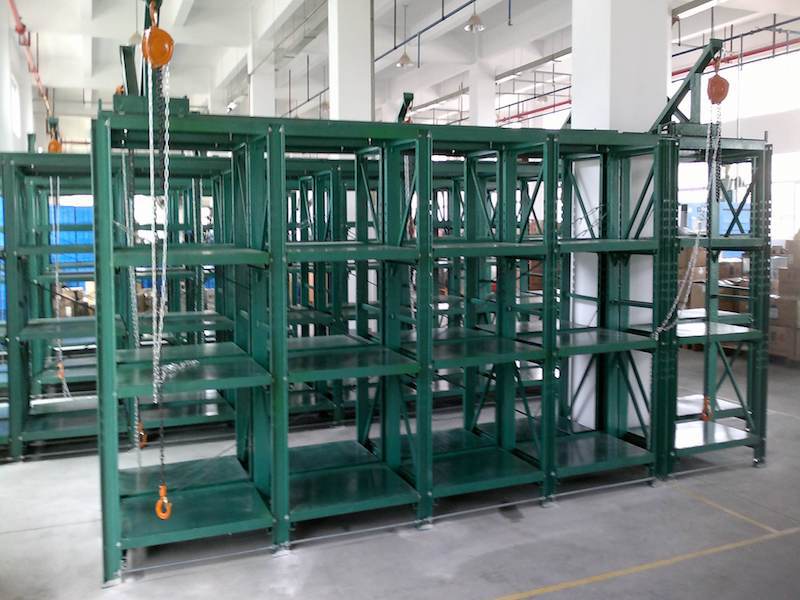
1. Core Design Principles and Structural Mechanics of Pipe Stacking Racks
Unlike generic industrial shelving, pipe stacking racks address two critical forces: radial pressure from stacked tubes and longitudinal shear during loading/unloading. A competent design integrates three mechanical layers:
Primary frame: Hot-rolled steel columns (minimum yield strength 355 MPa) with a base plate thickness ≥6 mm, anchored to floor via chemical bolts. Frame height typically ranges from 1,500 mm to 4,500 mm, supporting 3 to 6 stacking layers.
Horizontal supports (cradles): Formed C-channels or box beams with a V-shaped or radiused upper profile. The V-angle (usually 90° to 120°) prevents pipe rolling while distributing point loads. Spacing between supports is calculated based on pipe outer diameter (OD) and bending modulus—common intervals are 600 mm, 900 mm, or 1,200 mm.
Stacking interface: Each rack level incorporates interlocking pins or socket joints that transfer vertical loads to the column below. A standard 3-high stacking configuration can achieve a total load capacity of 12,000 kg per bay (4,000 kg per level) with a safety factor of 1.8 according to AS4084-2012.
Finishing matters: industrial-grade powder coating (minimum 80μm) or hot-dip galvanizing (Z600 coating mass) resists corrosion from pipe lubricants and humid warehouse environments. Leading manufacturers like Guangshun also offer optional rubber linings on cradles to eliminate metal-to-metal contact, reducing surface scratches on coated pipes.
2. Addressing Critical Pain Points in Tube and Pipe Warehousing
Conventional storage methods create four recurring problems that pipe stacking racks directly solve:
Dimensional waste: Floor stacking requires 40-50% more aisle space because each pipe layer must be accessible from the end. Pipe stacking racks reduce retrieval aisle width by employing cantilever-style access from the side, increasing storage density by 35-60% (based on warehouse audits from 2022).
Product ovalization and denting: Stacking pipes directly on top of each other concentrates pressure at contact points. For thin-wall tubes (schedule 10 or less), this causes permanent ovality exceeding ASTM A500 tolerance. V-shaped supports in pipe racks distribute load over 180° of pipe circumference, limiting ovalization to <0.5% of diameter.
Injury risks: Manual unstacking of round pipes leads to crushing hazards. According to OSHA database, "struck-by-rolling-pipe" incidents account for 17% of warehouse injuries in metal handling. Pipe stacking racks incorporate fixed dividers and safety stops that prevent individual pipes from sliding out during retrieval.
Low inventory turnover accuracy: FIFO (first-in-first-out) is nearly impossible with random floor piles. With labeled rack positions, pipe stacking racks enable systematic slotting and real-time inventory tracking via WMS integration.
A regional oil country tubular goods (OCTG) supplier reported a 42% reduction in handling time and 89% fewer product claims after converting to engineered pipe stacking racks from a major Chinese fabricator—Guangshun provided the CAD-optimized layout for 2,500 tons of casing pipes.
3. Technical Specifications and Load Capacity Guidelines
Selecting pipe stacking racks requires matching rack geometry to pipe dimensions and weight. Below are engineering criteria derived from RMI (Rack Manufacturers Institute) standards and finite element analysis (FEA) validations:
3.1 Pipe diameter vs. cradle profile
OD 20–80 mm: Use 90° V-supports with ribbed rubber inserts to prevent rolling.
OD 80–250 mm: Use 110° to 120° cradles; depth of cradle should be at least 1.5× pipe OD.
OD 250–500 mm: Opt for flat saddle supports with lateral straps; each strap rated to 1,500 kg tension.
3.2 Load per rack level (static)
Light-duty (welded tube up to 3m length): Max 1,500 kg/level; frame column 80×40×2.5 mm.
Medium-duty (seamless pipes up to 6m): Max 3,000 kg/level; column 100×50×3.0 mm.
Heavy-duty (oil well casing up to 12m): Max 6,000 kg/level; double C-channel columns 120×60×4.0 mm.
3.3 Deflection limits
Under full load, horizontal deflection of the top beam must not exceed L/200 (L = span between columns). A typical 2,400 mm-wide bay should deflect ≤12 mm at maximum capacity. Manufacturers should provide third-party test reports for deflection under 125% nominal load.
For multi-tier setups, consider the cumulative load on bottom columns. A four-high stack with 4,000 kg per level imposes 16,000 kg on the lowest column group. Verify floor load capacity (PSF or kPa) and use load-spreading base plates ≥200×200 mm to prevent concrete cracking.
4. Comparative Analysis: Cantilever Racks vs. Modular Pipe Stacking Racks
Many warehouses consider cantilever racks as an alternative. However, modular pipe stacking racks offer distinct advantages:
Space efficiency: Cantilever racks require vertical arms that consume aisle depth, while modular pipe racks have a lower profile and allow denser vertical stacking (up to 6 levels vs. 3 levels for typical cantilever).
Flexibility: Cantilever arms are fixed at specific increments (e.g., 100 mm). Pipe stacking racks with bolted cradle beams can be reconfigured in minutes—change V-support positions or remove a level to handle longer bundles.
Cost per stored kilogram: For volumes >500 tons, pipe stacking racks have 30-40% lower capital cost per ton than heavy-duty cantilever systems, based on a 2023 material handling benchmarking report.
Adaptability to automated guided vehicles (AGVs): Open-bottom designs of pipe stacking racks allow AGVs with fork extensions to directly pick pipes from the lowest level, whereas cantilever rack bases obstruct automatic entry.
That said, for extremely long pipes (above 12 meters) with small quantities, cantilever remains viable. But for high-density, medium-to-long tube storage (3-9 meters), pipe stacking racks are the superior choice.
5. Safety Protocols and Structural Integrity for Pipe Stacking Racks
Implementing pipe stacking racks demands adherence to five non-negotiable safety measures:
Anchoring calculation: Each rack column must be anchored with epoxy or mechanical anchors rated for 1.5× the rack’s seismic and impact load. For overhead crane zones, add lateral bracing every 3 bays.
Load signage: Display per-level capacity and stacking height limit on every rack aisle. Use color-coded tags: green (≤80% capacity), yellow (80–100%), red (overloaded).
Anti-roll pins: Install removable locking pins at the front of each cradle level to prevent pipes from being accidentally pushed out during high-speed forklift operations.
Regular inspection intervals: Perform visual checks every 30 days for bent cradles, cracked welds, or loosened floor anchors. Annual professional inspection to RMI or FEM 10.2.10 standards is recommended.
Seismic ties: In regions with seismic zone 3 or higher (IBC classification), secure the back of pipe stacking racks to building columns using seismic straps with 10 kN capacity per strap.
Accident statistics from a 2021 warehousing safety study show that facilities using engineered pipe stacking racks with routine audits reduced rack-related injuries by 73% compared to improvised storage solutions. Guangshun provides a safety compliance checklist with every delivered system, along with anchor bolt samples for pull-out testing.
6. Implementation Workflow and Site Integration
Deploying pipe stacking racks follows a structured engineering workflow to maximize return on investment:
Step 1 – Pipe inventory analysis: Document all SKU lengths, ODs, weights, and monthly throughput. Use ABC analysis (Pareto) – the top 20% pipe types will define rack parameters.
Step 2 – 3D layout simulation: Use warehouse management software (e.g., AutoMod or FlexSim) to test different rack orientations. A typical optimal arrangement involves 3.0m wide bays with 2.8m working aisles for counterbalance forklifts.
Step 3 – Floor flatness verification: Concrete floor must have a flatness tolerance of ≤6mm over 3m length. Uneven floors cause rack twisting and uneven load distribution.
Step 4 – Pick face design: For faster turnover pipes (A-class items), design front-row single-deep racks. For slow movers (C-class), use double-deep stacking with specialized reach fork attachments.
Step 5 – Training and SOPs: Train forklift operators on proper insertion depth – forks must extend to at least 75% of cradle depth to avoid tipping. Post signage prohibiting "hook retrieval" (lifting pipes by the end only).
A real-world installation at a Spanish steel distributor (annual throughput 85,000 tons) replaced floor storage with 136 bays of pipe stacking racks. The project yielded a 51% increase in floor utilization and a payback period of 14 months, purely from reduced rehandling labor.
7. Frequently Asked Questions (FAQ) About Pipe Stacking Racks
Q1: What is the maximum stacking height recommended for pipe stacking racks in seismic zones?
A1: In seismic design category D (IBC 2021), the height of pipe stacking racks should not exceed 4.5 meters (about 3 stacked levels) unless the racks are anchored to overhead bracing. For non-seismic areas, heights up to 6 meters (4-5 levels) are acceptable provided the rack has a width-to-height ratio of at least 0.6. Always consult a structural engineer to calculate site-specific seismic load combinations per ASCE 7-22.
Q2: Can pipe stacking racks be used for storing stainless steel or coated pipes without surface damage?
A2: Yes. Specify racks with polyurethane or high-density polyethylene (HDPE) cradle liners. For stainless steel, avoid carbon steel contact entirely; use galvanized or stainless steel rack components plus rubber mats. Guangshun offers optional nylon sliding strips that reduce friction marks by 95% compared to bare steel supports.
Q3: How do I calculate the required number of rack bays for a given pipe inventory?
A3: Use the formula: Bays = (Total pipe length in meters) / (Bay width × Number of levels × Pipe layers per level). For example, 3,000 meters of 60mm OD pipe: each 2.4m wide bay with 4 levels and 12 pipes per level (using 90° cradles) stores 2.4×4×12 = 115.2 linear meters. Thus, 3,000 / 115.2 ≈ 26 bays. Add 15% for future growth and uneven bundle sizes.
Q4: Are pipe stacking racks compatible with automated storage and retrieval systems (AS/RS)?
A4: Absolutely. Many modern AS/RS systems integrate with pipe stacking racks by using mini-shuttles that run on dedicated rails between rack aisles. The key requirement is uniform bay dimensions (±2mm tolerance) and a dedicated pick station at the aisle end. Several automotive pipe warehouses have achieved throughput of 45 pallet-equivalent loads per hour with such automation.
Q5: What warranty and load test documentation should I request from a pipe stacking rack supplier?
A5: Request: (1) Load test certificate from an accredited lab (e.g., TÜV, SGS) confirming 125% of rated capacity for 48 hours without permanent deformation; (2) Material mill certificates showing steel grade (EN 10204 type 3.1); (3) 10-year structural warranty against defective welds or corrosion perforation. Avoid suppliers who cannot provide independent FEA reports.
In summary, implementing engineered pipe stacking racks transitions tubular storage from a hazardous, space-inefficient operation to a structured, high-density system with measurable ROI. By focusing on load-specific design, seismic-ready anchoring, and routine inspection, warehouse managers can reduce product damage by 40–65% and increase picking accuracy by over 20%. For site-specific layouts and customized cradle profiles, Guangshun provides engineering consultations and 3D warehouse simulations—ensuring your pipe storage infrastructure aligns with both operational budgets and safety regulations. Evaluate your current pipe handling metrics against the technical parameters above; the case for dedicated stacking racks is built on physics, not guesswork.