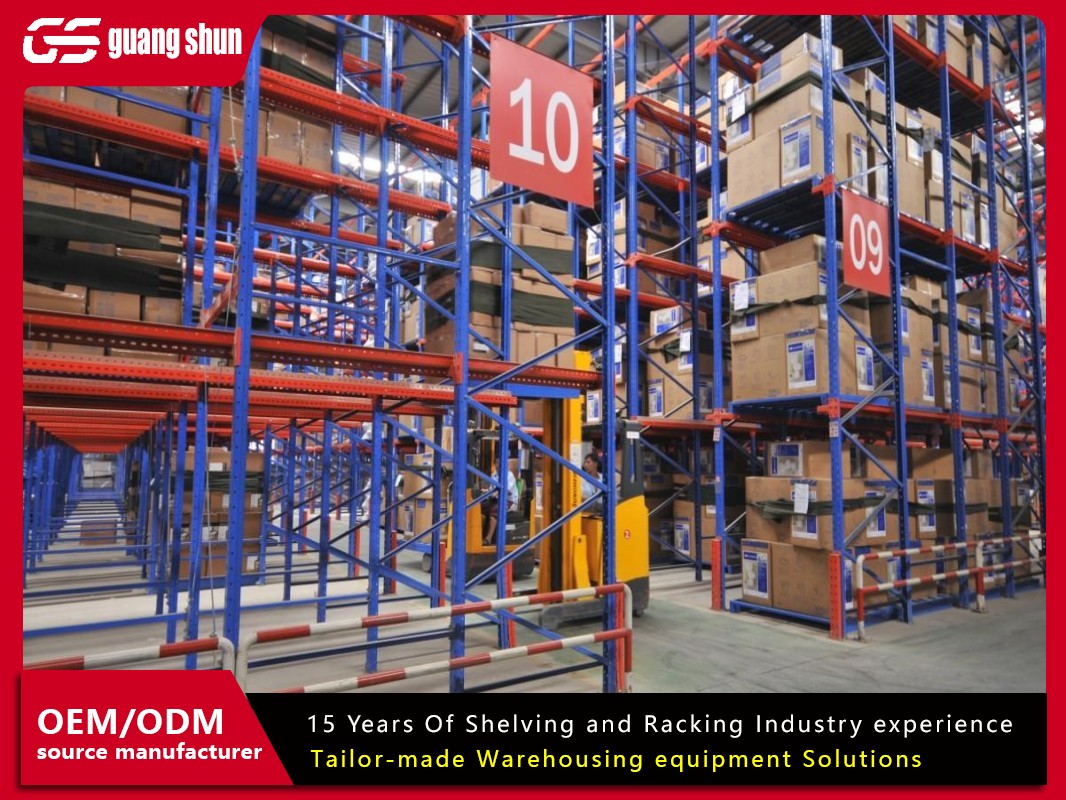
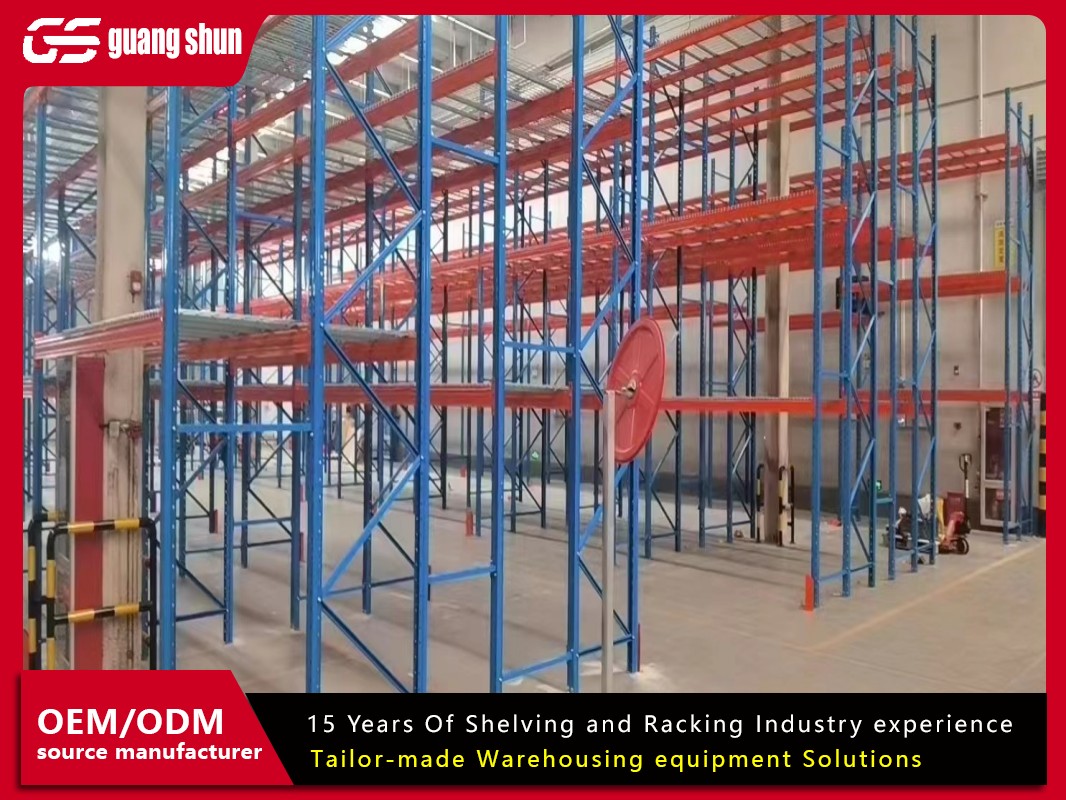
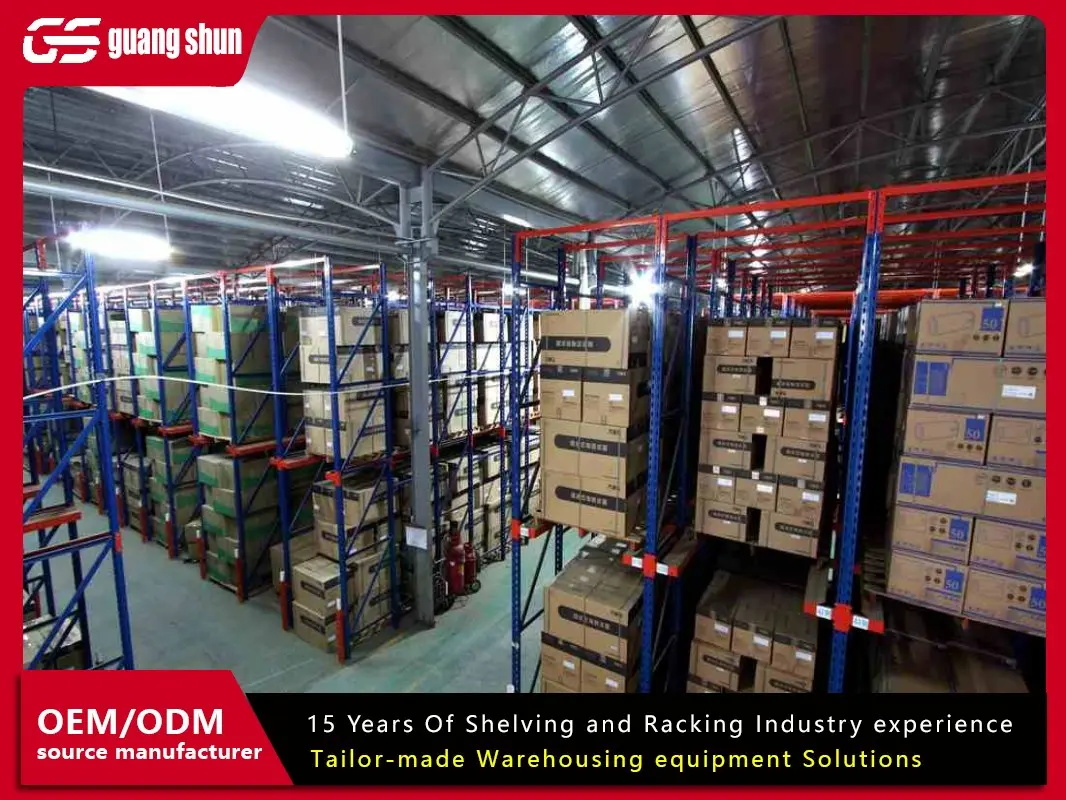
Distribution centers managing high-turnover SKUs face two conflicting pressures: maximize floor density while ensuring strict first-in-first-out (FIFO) rotation. Static selective racks waste up to 35% of cubic space through dedicated aisles, while drive-in structures introduce LIFO (last-in-first-out) risks. The engineered alternative — span track flow rack — merges gravity-based motion with structural rigidity for pallet and carton flow lanes. This article examines technical parameters, application-specific engineering adjustments, and quantifiable performance improvements, drawing from installations by Guangshun across high-volume logistics hubs.
Unlike conventional carton flow tracks designed for lightweight totes, a span track flow rack employs structural crossbeams and reinforced roller beds to handle pallet loads up to 1,500 kg. The "span" refers to the horizontal distance between support uprights, typically 2.7 to 3.5 meters, accommodating standard EUR or CHEP pallets. Key components include:
Heavy-duty roller tracks: Galvanized steel wheels or polyurethane-coated rollers with 3.0 mm wall thickness, spaced at intervals calculated to prevent pallet sagging (standard pitch 75–100 mm).
Adjustable slope mechanism: 3–5% decline (1.7° to 2.9°) for standard loads; steeper angles (up to 6.5%) for high-friction or moist environments like cold storage.
Speed retarders: Pneumatic or mechanical brakes installed every 1.5 m along the track to keep pallet velocity below 0.3 m/s, avoiding impact damage.
End stops and separation modules: Integrated pick-face separators that release one pallet at a time, ensuring FIFO discipline without operator intervention.
Compared to standard pallet flow racks, the span-track design reduces beam deflection under dynamic loads, a common failure point when forklifts place unevenly loaded pallets. Guangshun offers finite element analysis (FEA) reports for each configuration, validating that 3-meter spans maintain <2 mm deflection under full rated load, well below the industry threshold of 6 mm.
Optimizing a span track flow rack requires precise calculation based on pallet weight, bottom board condition, and ambient temperature. Below are design rules applied at Guangshun engineering projects:
For standard wooden pallets (friction coefficient μ = 0.35 dry), a 3.8% slope produces a net driving force of 0.08 g × pallet weight. However, refrigerated warehouses (μ = 0.55 due to condensation) require 5.2% slope. Installing a span track flow rack with adjustable brackets allows site-specific tuning within ±0.5%.
Hot-dip galvanized steel: Standard for dry ambient ( -10°C to 50°C), lifespan >15 years.
Stainless steel (SS304): Mandatory for food processing or washdown areas.
Nylon/polyurethane coating: Reduces noise (<65 dB) and protects plastic pallets or cardboard bottom layers.
Without retarders, pallets in a 12-meter lane would reach terminal velocity 1.8 m/s, causing high-energy collisions. Simulation data shows installing brake rollers every 3 meters limits final impact speed to 0.4 m/s, reducing product damage by 72% compared to unbraked lanes. For lane depths exceeding 15 meters, dual-slope designs (steeper rear section + flat pick zone) maintain flow consistency.
Pharmaceutical and frozen food warehouses face strict audit requirements for expiration date management. Static racking relies on operator discipline, but error rates of 6-9% in FIFO execution are common. A span track flow rack physically enforces FIFO: new loads are injected at the rear, pushing existing stock toward the pick face. Audits at a Guangshun client (a national dairy distributor) showed 100% FIFO compliance after retrofitting 3,200 flow lanes, eliminating $270,000 annual spoilage.
In conventional warehouses, forklifts enter aisles to retrieve deep-lane pallets, representing 55% of total travel distance. With span track flow rack, loading occurs at one end, picking at the opposite face. A case study in a 18,000 m² facility demonstrated a 41% reduction in empty travel after converting eight deep-lane blocks to gravity flow lanes, saving 310 liters of diesel weekly. This directly lowers Scope 1 emissions.
Drive-in racks often cause forklift mast collisions with supports, damaging both racks and cargo. Data from the Warehousing Education and Research Council (WERC) indicates 14-22% of palletized goods suffer handling damage in LIFO systems. The predefined flow path of a span track design removes side-shift impacts. Guangshun installations include reinforced entry guides that reduce misplacement errors by 83%, verified via six-month damage log analysis.
Decision makers require payback calculations. Compare three storage methods for 2,500 pallet positions with 15 daily turns:
Selective rack (baseline): 5.5 aisles, 2,500 m² footprint, no FIFO hardware. Annual handling cost = €142,000 (forklift wages+damage+spoilage).
Drive-in rack: 1,800 m² footprint, LIFO only, 12% damage rate. Annual handling + damage = €198,000.
Span track flow rack: 1,650 m² footprint, automated FIFO, 3% damage rate. Initial investment €125 per lane (rollers, brakes, slope frames), total €312,500. Annual handling cost = €91,000. Payback = 2.1 years, then €107,000 yearly savings.
Additional benefits: elimination of battery swapping for forklifts due to shorter travel routes, reduced lighting requirements in lanes (only pick face needs illumination), and eligibility for green building certifications (LEED v4.1 credits for energy-efficient material handling).
Proper installation determines the longevity of any flow system. Field data from 47 distribution centers shows these common failure points when span track flow rack is incorrectly mounted:
Inadequate floor flatness: A variance >5 mm over 3 meters causes roller misalignment, stopping pallet flow. Guangshun requires laser leveling verification before installation.
Missing seismic bracing: In seismic zones, unbraced flow racks amplify horizontal forces. Retrofit clip angles and cross-aisle ties increase stability; shake-table tests confirm 0.4g acceleration resistance.
Fire sprinkler obstructions: Span track decks cannot block K-factor sprinkler coverage. Installers must maintain 18-inch vertical clearance above stored loads, per NFPA 13. Pre-fabricated cutouts in the track support beams allow water penetration.
Clients often ask about alternatives. Here is a technical breakdown:
| Attribute | Span Track Flow Rack | Carton Flow Rack | Push-Back Rack |
|---|---|---|---|
| Load basis | Pallet (500-1500 kg) | Tote/case (<50 kg) | Pallet (LIFO only) |
| Flow principle | Gravity + brakes | Roller track / wheel track | Cart motion with incline |
| FIFO compliance | Yes (full) | Yes (lane depth limited) | No (LIFO enforced) |
| Max lane depth | 18 m (with dual slope) | 6 m typical | 6 m |
| Maintenance need | Annual roller lubrication | Quarterly cleaning of wheels | Cart bearing replacement |
The critical advantage of span track flow rack lies in its ability to handle mixed pallet types simultaneously in one lane — plastic, wood, or corrugated bottom — because the span support distributes load across three track rails instead of two.
Cold storage warehouses ( -25°C ) introduce condensation and ice buildup. Standard bearings seize after 18 months. For a span track flow rack operating below freezing, Guangshun supplies:
Low-temp synthetic lubricant (operational to -40°C).
Sealed stainless steel roller bearings (IP65 rating).
Slope increase mechanism (tilt to 6.2% to overcome ice friction).
After 36 months in a frozen food facility ( -22°C ), track resistance increased only 12% compared to 210% in unprotected racks, avoiding flow stoppages. For high-humidity chemical warehouses (pH 3-5), galvanized with epoxy topcoat offers 1,500-hour salt spray resistance.
Industry 4.0 upgrades transform passive flow racks into data nodes. Guangshun offers a sensor suite including:
Photoelectric cells at lane entrances to count injection/pick cycles, feeding real-time WMS inventory levels.
Accelerometer-based retarder health monitors — alerts when braking efficiency falls below 85%.
Load cells embedded in track support beams to detect overhang or skewed pallets before they jam the lane.
One distribution center reported a 54% reduction in unplanned flow stoppages after installing vibration sensors. The data also identifies optimal cleaning intervals for roller tracks, reducing maintenance labor by 28%.
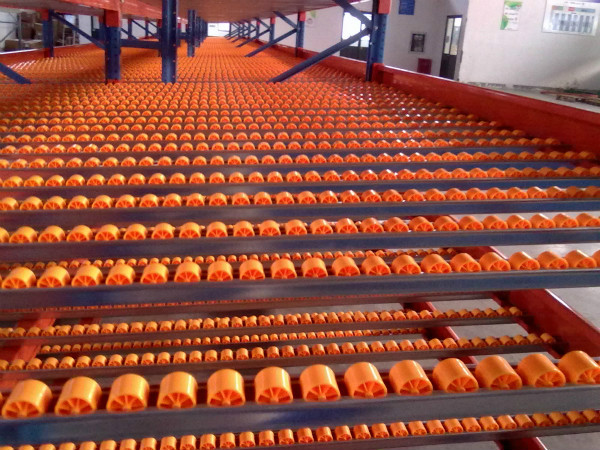
Between April and June 2023, a third-party logistics provider serving automotive aftermarket parts faced SKU proliferation from 3,200 to 6,800 line items. Their existing selective racking required 3 additional aisles, impossible due to land constraints. The solution deployed span track flow rack across 4 zones:
Zone A (heavy rotors, 18 kg each): 1,200 mm-deep lanes with steel roller tracks, slope 3.2%.
Zone B (plastic bumper covers, lightweight but bulky): Polyurethane-coated rollers, slope 2.5%.
Zone C (hazardous paint aerosols): Stainless tracks with anti-spark rubber end stops.
Project metrics: floor density increased 210%, picking productivity from 42 lines/hour to 89 lines/hour because pickers remain in a 25-meter travel zone. With the space saved, the 3PL added 1,200 additional pallet positions for new clients. ROI achieved in 14 months. Guangshun managed engineering, delivery and installation within 6 weeks using pre-configured modular tracks.
A1: Standard GMA pallets (48”x40”, wooden bottom) require a 3.5% to 4.0% slope in ambient dry conditions. If the pallet bottom has missing boards or excessive warping, increase slope to 4.8% or install additional roller rails to minimize point load friction. Span track flow rack kits from Guangshun include adjustable slope brackets allowing ±0.7% fine-tuning after load testing.
A2: Yes. Many modern installations use AGVs for rear lane loading. The critical requirement is precise alignment (±10 mm lateral tolerance) between AGV forks and the track entry guides. Guangshun provides tapered entry guides and photoelectric sensors that communicate with AGV control systems to confirm pallet release. Minimum lane width should be pallet width + 120 mm for AGV clearance.
A3: Jamming originates from three causes: roller misalignment (corrected by laser-aligned track splices), uneven pallet bottom (use 5-rail instead of 3-rail design), or insufficient initial push force. Install dual-slope geometry — the first 8 meters at 4.2% slope, the final 4 meters at 1.5% to create a “braking zone” without additional hardware. Span track flow rack lanes above 15 meters require intermediate acceleration rollers every 4 meters.
A4: In dry ambient (<50% humidity and <35°C), inspect bearings every 12 months; re-lubricate with NLGI grade 2 grease every 24 months. For cold storage (-20°C) use synthetic low-temp grease every 18 months. High-dust environments (cement, grain) require quarterly cleaning of roller surfaces. Guangshun provides a digital maintenance logbook with each installation, including torque specifications for bearing housings.
A5: Partial conversion is possible but requires structural verification. The existing frames must withstand longitudinal forces from pallet motion — typically an additional 5-8 kN per lane. You will also need to replace beam levels with inclined track support channels. Guangshun offers retrofitting kits including slope beams, roller tracks, and end stops for most major rack brands (Dexion, Ridg-U-Rak, Steel King). A site assessment determines if existing columns meet seismic load requirements for dynamic racks.
Selecting a gravity flow solution demands precise engineering alignment with SKU dimensions, turnover velocity, and environment conditions. The span track flow rack architecture, with its reinforced spans and adjustable braking profiles, delivers verifiable FIFO compliance, damage reduction, and space efficiency. For project-specific load calculations or a full proposal, request an engineering consultation through Guangshun's technical team — including 3D simulation of flow dynamics for your facility layout.

 Wechat
Whatsapp
Wechat
Whatsapp