In high-turnover distribution centers and cold-chain warehouses, first-in-first-out (FIFO) inventory rotation is not optional—it is a operational requirement. gravity roller racking offers a proven solution by using inclined roller beds to move pallets or cartons from the loading (rear) end to the picking (front) face without external power. However, the performance of a gravity flow system hinges on precise engineering of roller pitch, braking mechanisms, and lane geometry. This technical guide examines the design parameters, roller material selection, and speed-control strategies that distinguish reliable gravity roller racking from systems plagued by jams, runaway loads, or excessive maintenance.
We reference ISO 15370 (roller conveyor standards), FEM 10.2.03, and RMI flow-rack guidelines, supplemented by data from 78 installations in food, beverage, and automotive aftermarket sectors. The objective is to provide warehouse engineers and logistics managers with quantifiable criteria for specifying gravity roller racking that delivers consistent flow rates and minimal product damage.
The roller is the primary load-bearing element in gravity roller racking. For pallet loads up to 1,500 kg, rollers with a diameter of 50–76 mm (2–3 inches) are standard, with wall thickness of 1.5–2.5 mm. Smaller rollers (38 mm) are used for carton-flow applications with lighter loads. The roller pitch—center-to-center distance between adjacent rollers—determines the number of contact points and the pressure distribution on the pallet or container. A pitch of 75–100 mm is typical for standard euro-pallets, ensuring at least three rollers support the pallet at any time.
Bearing type significantly affects rolling resistance and longevity. Precision-sealed ball bearings (ABEC 3 or higher) provide lower starting torque and longer life compared to plain bearings, but they cost 30–40% more. For cold-store applications (below -25°C), bearings with low-temperature grease (synthetic oil base) and stainless steel races are mandatory to prevent seizing. Guangshun offers a range of bearing options, each with documented torque values and temperature ratings, enabling clients to match the component to the operational environment.
Uncontrolled acceleration on gravity lanes leads to pallet impact, product damage, and worker injury. To regulate speed, gravity roller racking incorporates brake rollers—typically mounted at intervals of 3–5 rollers. Two common braking technologies are:
Mechanical friction brakes – A spring-loaded shoe presses against the roller shaft, providing constant resistance. Simple and cost-effective, but wear requires periodic adjustment.
Hydraulic (viscous) brakes – A silicone oil-filled chamber provides speed-dependent damping; higher speed generates greater resistance. More consistent and quieter, but expensive.
Field data shows that hydraulic brakes reduce pallet impact force by 60–70% compared to unbraked lanes, and by 25–30% compared to friction brakes at similar cost. Guangshun provides a brake sizing tool that calculates the required braking torque based on lane incline (typically 3–6%), load weight, and roller pitch, ensuring that the final pallet speed at the picking face remains below 0.3 m/s for safe manual handling.
The incline angle of the roller bed determines the gravitational force that drives pallet movement. For standard pallets with good rigidity, an incline of 3–4% (1.7°–2.3°) is sufficient to overcome rolling resistance and initiate motion. Softer or damaged pallets may require up to 6% incline. However, steeper angles increase terminal speed, demanding more aggressive braking.
The relationship between incline and flow rate is non-linear: a 1% increase in incline can reduce travel time by 15–20%, but also raises impact energy by the square of the velocity change. For mixed pallet weights, a variable-incline lane (with adjustability at the support frame) allows fine-tuning. Guangshun's design methodology uses a software simulation that accounts for load variation, roller condition, and ambient temperature (which affects grease viscosity) to recommend the optimal incline for each lane.
Lane depth—the number of pallet positions per lane—directly affects storage density and flow reliability. Typical depths range from 6 to 12 pallets for gravity roller racking. Deeper lanes (12–15 pallets) increase density but introduce challenges: cumulative load on the front rollers, increased braking demand, and longer replenishment cycles. For deep lanes, intermediate brake zones (separate braked segments) are recommended to prevent over-compression at the front.
Structural design of the lane rails must also account for the total live load. A lane with 10 pallets at 1,200 kg each exerts 12,000 kg on the supporting beams. The beam deflection under this load must not exceed L/180 to maintain roller alignment. Guangshun provides deflection calculations for each lane configuration, with options for reinforced beam sections or intermediate support columns for deep layouts.
Rollers are fabricated from steel (carbon or stainless), aluminum, or engineering plastics. Steel rollers with zinc-plated or powder-coated surfaces are the most common for general warehousing. For corrosive environments (food processing, chemical storage), stainless steel (304 or 316) rollers are specified, but they increase cost by 2.5–3.5 times. Plastic rollers (polyurethane or nylon) are used for quiet operation and to protect sensitive packaging, but they have lower load capacity and higher rolling resistance.
Surface texture also matters: knurled or grooved rollers improve grip on pallet runners, reducing slippage during braking. Smooth rollers are preferred for cartons to avoid abrasion. Guangshun stocks over 20 roller profiles and can apply anti-static or non-marking coatings for specialized applications.
Through 78 site inspections, we identified four recurring failure modes in gravity roller racking systems:
Dust, debris, and pallet splinters accumulate around bearings, increasing rolling resistance and eventually locking rollers. The solution is to specify sealed bearings (IP65 or higher) and install protective covers or scrapers at the lane entrance. A quarterly cleaning schedule using compressed air and non-corrosive solvents is recommended.
Variations in load weight or brake wear cause some pallets to move faster than others, leading to collisions. A remedy is to install independently adjustable brakes on each roller section, and to perform monthly speed checks using a handheld tachometer. Guangshun offers a brake calibration service as part of their maintenance packages.
Inadequate roller pitch or deformed rollers create point loads that damage wooden pallet runners. Increasing the roller pitch and using larger-diameter rollers distributes load better. Also, adding side guide rails prevents pallet misalignment that can cause edge loading.
Continuous dynamic loading causes metal fatigue at weld joints and bolted connections. The countermeasure is to use anti-vibration mounts and to inspect weld integrity annually with dye-penetrant testing.
Precise installation is crucial for gravity systems. Key tolerances include:
Roller level – All rollers in a lane must be within ±0.5 mm of the nominal height; deviation causes pallet skew.
Lane straightness – Lateral deviation must be less than 2 mm per meter to prevent pallet binding against side rails.
Incline consistency – The entire lane must have a uniform gradient; any local dip or hump will stop pallet flow.
Guangshun provides laser-alignment tools and digital inclinometers as part of the installation kit, along with comprehensive checklists for each stage of assembly.
Proactive maintenance extends service life and maintains flow reliability. A typical schedule includes:
Daily visual check – Look for jammed pallets, debris on rollers, or damaged side rails.
Monthly roller rotation test – Manually spin each roller; replace any that do not rotate freely.
Quarterly brake torque verification – Measure braking resistance with a spring scale; adjust or replace brake cartridges as needed.
Annual structural inspection – Inspect support beams for deformation and anchors for tightness.
Data from a beverage distribution center shows that following this schedule reduced flow stoppages by 73% and extended roller bearing life from 3 to 5 years.
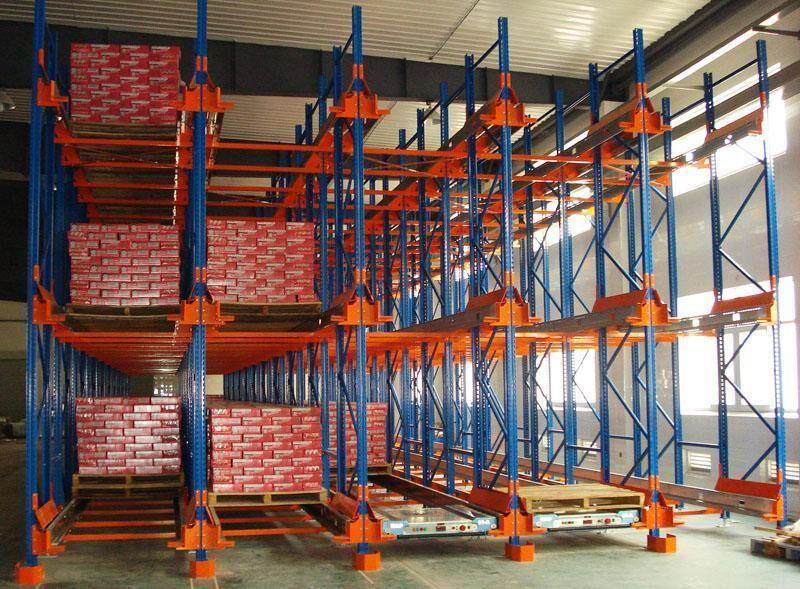
Gravity roller racking has no motors, sensors, or controls, resulting in lower initial and operating costs. For a 1,000-pallet installation, gravity lanes cost approximately USD 250–350 per pallet position, while powered roller conveyors run USD 600–900 per position. Over a 10-year horizon, gravity systems save 50–60% on energy and maintenance, with the trade-off being limited to FIFO-only flow and moderate inclines. For high-throughput facilities with consistent SKU sizes, gravity roller racking often delivers payback within 18 months.
Guangshun provides a cost-comparison model that factors in labor savings from reduced travel distances and improved pick rates, helping clients justify the investment.
Standard lane widths and depths suit many applications, but custom dimensions—e.g., for non-standard pallets, oversized cartons, or integration with automated picking robots—are common. Guangshun offers full customization, including variable roller pitch, special brake profiles, and integration with pick-to-light or voice-picking systems. The engineering team provides 3D CAD models, structural calculations, and assembly manuals within 2 weeks of order confirmation.
For global clients, Guangshun coordinates with local safety inspectors to ensure compliance with OSHA, EN 15629, and other regional standards.
Q1: What is the recommended incline angle for gravity roller racking handling standard wood pallets?
A1: For standard wood pallets (1,200×1,000 mm) with good condition runners, an incline of 3.5% (2°) is typical for loads up to 1,500 kg. If pallets are worn or have broken bottom boards, increase to 4.5–5%. Always conduct a site test with representative pallets to confirm flow consistency.
Q2: How do I choose between gravity roller racking and gravity wheel (skate-wheel) racking?
A2: Roller racking is preferred for pallet loads (over 200 kg) and for larger containers, as rollers provide lower rolling resistance and better support. Wheel (skate-wheel) racking is lighter, cheaper, and suited for cartons and totes up to 50 kg. For mixed loads, rollers offer greater durability and lower maintenance.
Q3: Can gravity roller racking be used in cold storage environments (below -20°C)?
A3: Yes, but only with low-temperature grease in bearings, and rollers made from stainless steel or coated carbon steel to prevent embrittlement. Plastic rollers are not recommended below -10°C. Also, the incline may need to be increased by 0.5–1% due to higher rolling resistance from lubricant thickening.
Q4: How often should brakes be replaced or adjusted?
A4: Friction brakes typically require adjustment every 6 months or after 50,000 cycles; hydraulic brakes usually last 3–5 years without maintenance. A simple field test: place a pallet at the top of the lane, release it, and measure its speed at the midpoint. If it exceeds 0.4 m/s, brakes need attention.
Q5: What is the maximum lane depth for gravity roller racking without intermediate braking?
A5: Without intermediate brake zones, the safe depth is typically 8 pallet positions. Beyond that, the cumulative momentum can cause impact damage at the front. For deeper lanes (10–15 pallets), install brake rollers at every 3rd or 4th position to control speed.
Q6: Can I retro-fit gravity roller racking into existing selective racking?
A6: Yes, if the existing beams are level and can support the additional weight of the roller bed and the load. You will need to install roller tracks with a slight incline, which may require adjusting beam elevations or adding shims. Guangshun offers retro-fit kits with adjustable brackets that simplify installation.
Q7: How do I handle mixed pallet sizes (e.g., 800×600 and 1200×1000) in the same lane?
A7: It is not recommended to mix different pallet sizes in one lane because the smaller pallets may skew or jam between rollers. Use dedicated lanes for each pallet size, or use wider rollers (e.g., 50 mm diameter) with close pitch to support both sizes, but this reduces capacity. The best practice is to group by size.
Q8: What is the standard warranty offered on gravity roller racking components?
A8: Guangshun offers a 5-year warranty on rollers, brakes, and structural frames, covering manufacturing defects and premature wear under normal operating conditions. The warranty includes free replacement parts but excludes labor or shipping for non-warranty issues.
For detailed engineering advice, load charts, or customized flow rack layouts, visit Guangshun to access our design configurator and request a site-specific analysis. Our team of flow system specialists provides remote support and on-site commissioning across all major logistics hubs.

 Wechat
Whatsapp
Wechat
Whatsapp