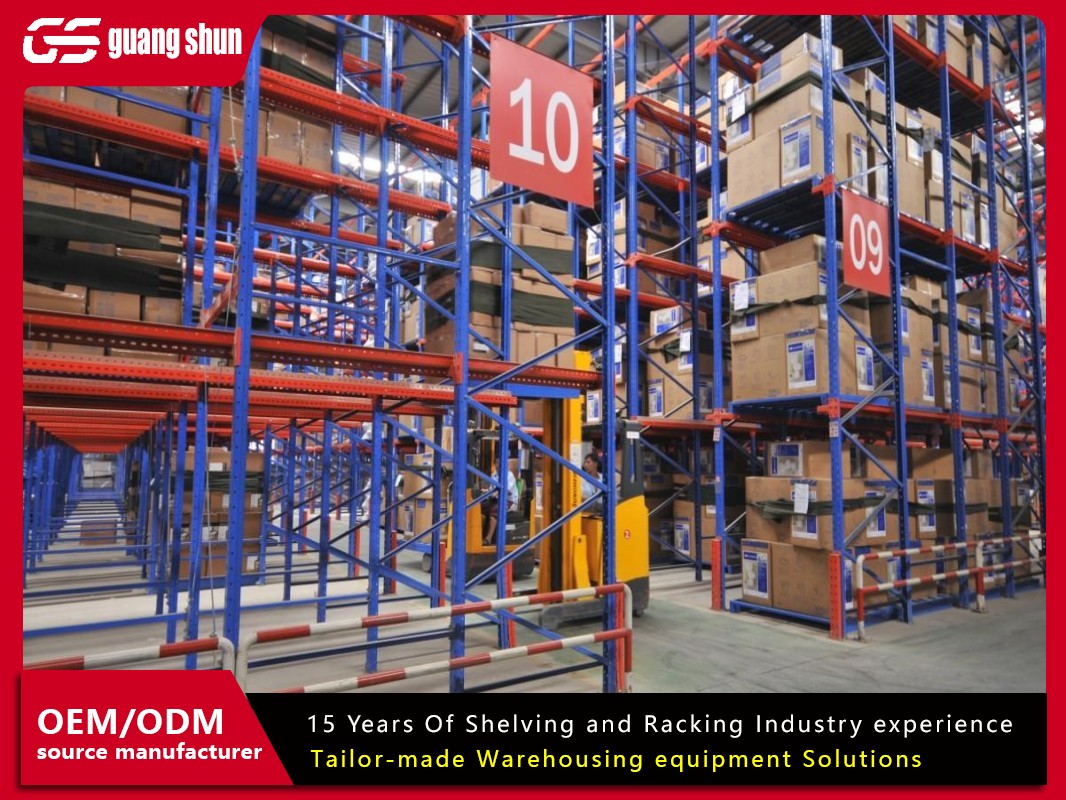
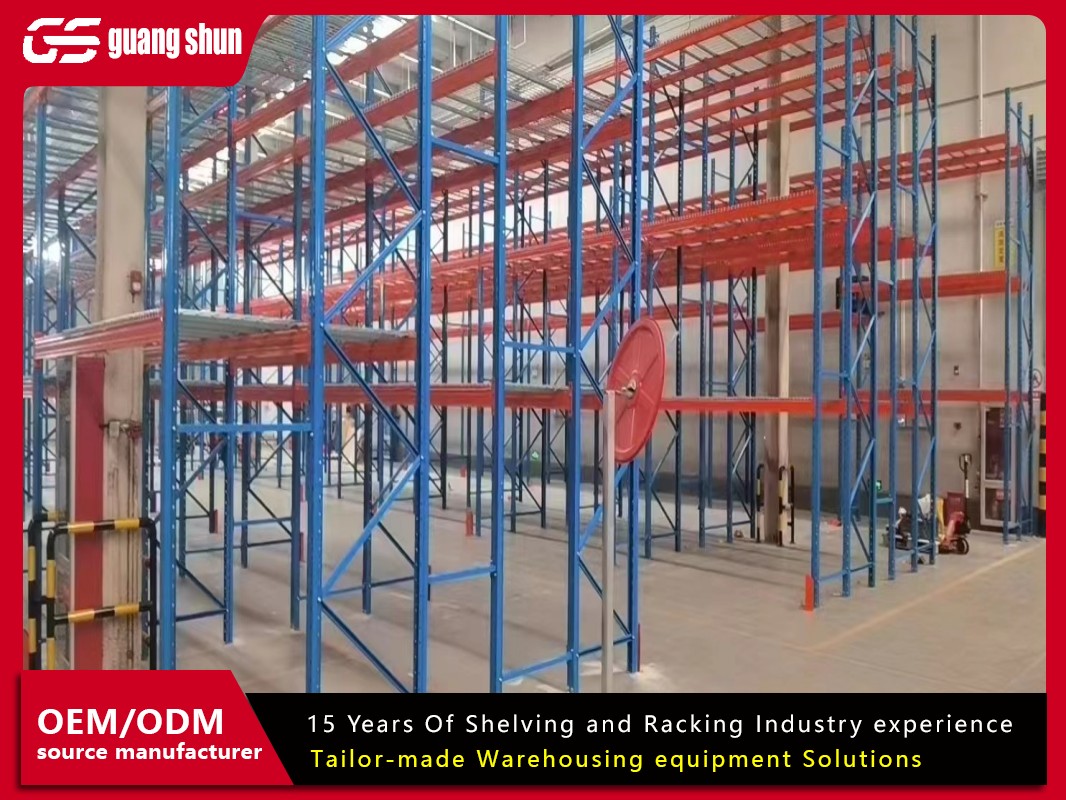
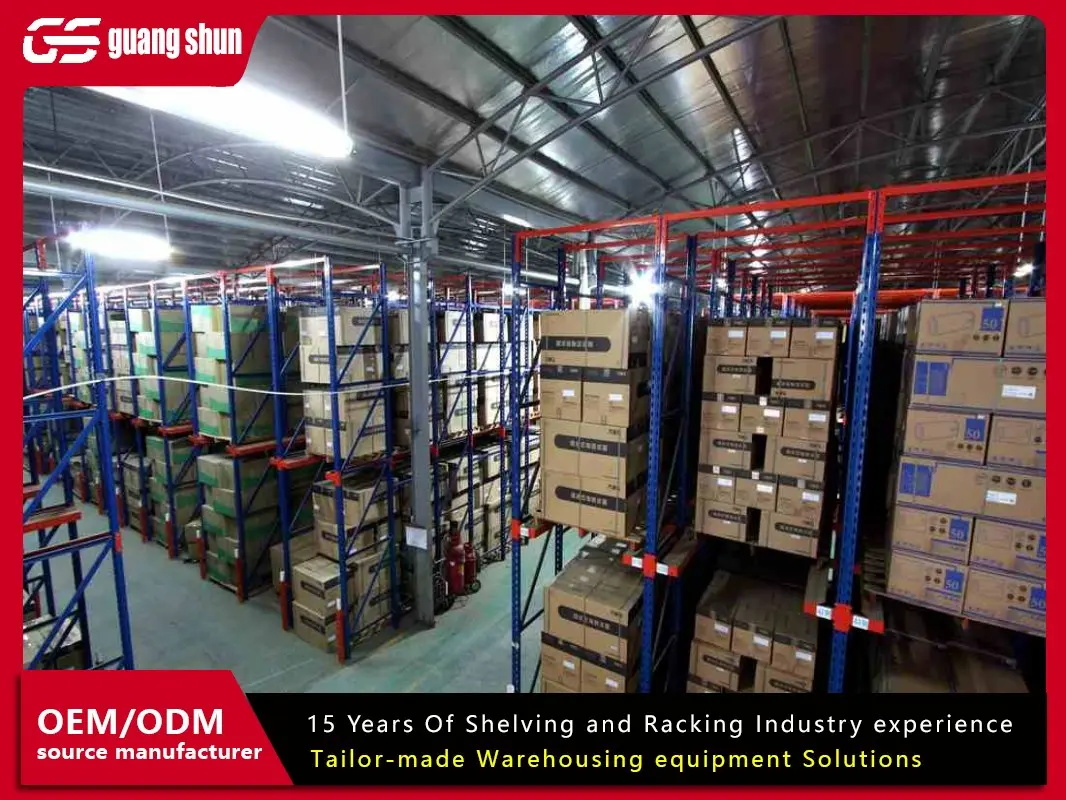
High-density warehousing environments operate under unrelenting physical demands. When square footage costs rise and inventory throughput accelerates, specifying modern heavy duty industrial shelving systems requires a rigorous balance of civil engineering, mechanical metallurgy, and operational workflow design. Far from being simple passive steel racks, these structural assemblies bear thousands of kilograms per square meter under cyclic stress, mechanical vibration, and dynamic forklift movement.
Material handling directors, logistics architects, and facility managers must evaluate load dynamics, cold-formed steel certifications, deflection thresholds, and seismic compliance before deployment. Inadequate structural calculations or substandard material selection lead directly to floor downtime, beam buckling, pallet dropping accidents, and severe regulatory non-compliance. This comprehensive technical guide details the structural parameters, selection matrices, and maintenance methodologies necessary to implement durable, high-capacity shelving frameworks within distribution hubs.
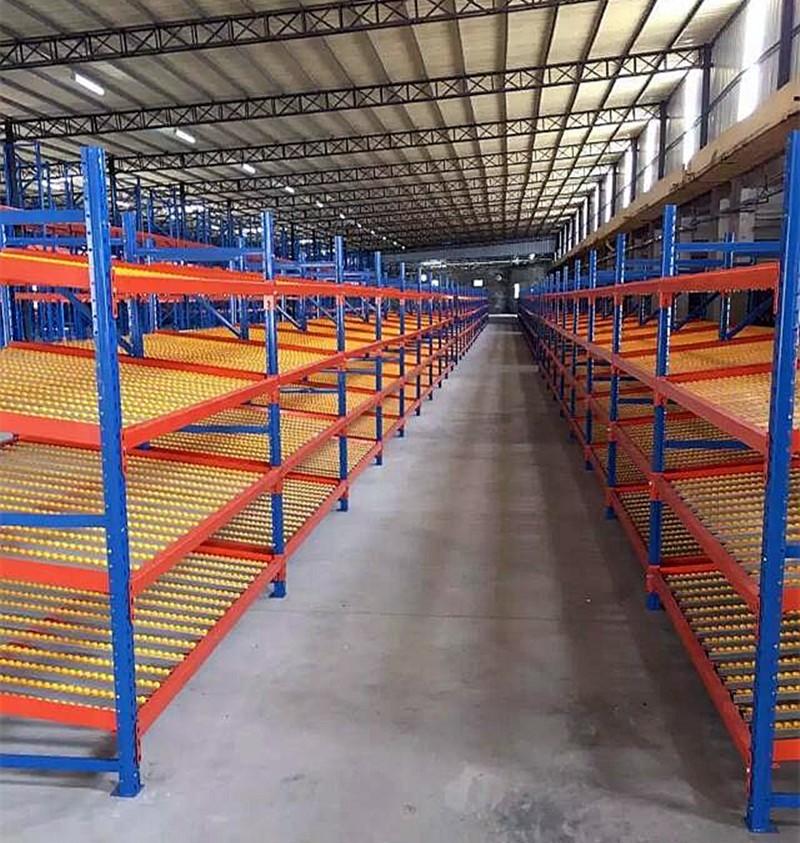
The structural integrity of industrial storage relies fundamentally on the mechanical properties of the structural steel from which it is manufactured. Heavy load applications cannot depend on mild generic metals; they demand high-tensile, cold-rolled structural steel grades such as ASTM A1011 or Q235B through Q355B equivalents. These alloys provide the required yield strength (typically between 235 and 355 MPa) and elongation percentages to withstand dynamic loading without experiencing brittle fractures.
Upright frame assemblies must be designed to resist axial compression and torsional buckling. Uprights feature continuous cold-roll-formed profiles with return flanges that stiffen the open side of the channel. The geometric profile directly dictates the moment of inertia ($I_x$ and $I_y$), which establishes the upright's resistance to bending along both axes. Manufacturers like Guangshun utilize structural cold-forming technology to produce closed or reinforced open-section uprights with optimized thickness-to-depth ratios, providing the necessary load-bearing capacity without excessive structural self-weight.
Upright Columns: Formed with multi-bend profiles to distribute vertical stresses and prevent localized web crippling. Punching patterns—whether teardrop, slotted, or keyhole configurations—must be calculated using finite element analysis (FEA) to ensure that metal removal does not compromise the vertical shear axis.
Cross and Diagonal Bracing: Bolted or welded diagonal bracing lattice patterns connect two upright columns to create a rigid truss. The triangulation angle (ideally between 35° and 55°) neutralizes lateral shear stresses generated by asymmetric picking or uneven rack loading.
Load Beams: Typically engineered as twin-roll-formed step beams or structural box tubes. The interlocking step interface accommodates steel wire decking, bar grating, or drop-in solid shelf panels, keeping loads centered along the structural centerline.
End-Plate Connectors: Multi-prong high-tensile steel brackets welded onto the beam terminals provide mechanical grip into the upright column perforations. A reliable mechanical locking pin with minimum shear capacity (often specified at over 1,000 kg shear load) prevents accidental dislodgement from lift-truck snagging.
When engineering heavy duty industrial shelving systems, structural engineers evaluate three distinct load classifications: uniformly distributed static loads, concentrated dynamic loads, and sudden impact vectors. Structural failures frequently occur when procurement teams conflate static dead weight with dynamic operation.
The baseline calculation for shelf beam load ratings follows the Uniformly Distributed Load (UDL) standard. Under UDL conditions, product mass spreads evenly across the entire surface area of the horizontal beams. The fundamental engineering metric governing beam safety is the deflection limit, universally defined by the Rack Manufacturers Institute (RMI) MH16.1 specification and the European FEM 10.2.02 standard as:
Maximum Beam Deflection = L / 200 (or L / 180 depending on jurisdiction)
Where L represents the clear span distance between uprights. For a standard 2,700 mm beam span, the maximum allowable vertical sag under full rated capacity cannot exceed 13.5 mm. If deflection exceeds this threshold, the beam transitions from elastic deformation into plastic deformation, resulting in permanent structural fatigue and eventual joint shear failure.
However, real-world warehouses rarely present textbook UDL conditions. Off-center point loads—such as dense machinery castings, metal stamping tooling, or unevenly stacked drums—generate localized concentrated stresses. If point loads rest near the mid-span of a shelf beam, the bending moment increases significantly compared to an equivalent weight spread across the beam length. Engineers must calculate section modulus requirements based on worst-case point loading, factoring in dynamic coefficients that account for the acceleration and deceleration of automated picking mechanisms or manual deposit.
Heavy-duty industrial storage does not follow a single structural mold. Depending on material flow, pallet integration, and access methods, warehouses select specific configurations:
Longspan frameworks cater to bulky, dense items handled manually or via pedestrian stackers. Built with wide bays (ranging from 1,800 mm to 3,000 mm) and beam profiles capable of carrying between 500 kg and 1,800 kg per shelf tier, longspan setups use heavy wire mesh decking or zinc-plated steel panels. They are common in automotive parts distribution, aerospace maintenance hangars, and hardware supply depots.
Bridging the gap between manual shelving and selective pallet racking, wide-span modular systems support integrated intermediate catwalks and multi-tier mezzanine floors. By transferring structural loads through extended vertical uprights to the slab foundation, these multi-tier installations expand storage volume vertically without requiring additional footprint expansion.
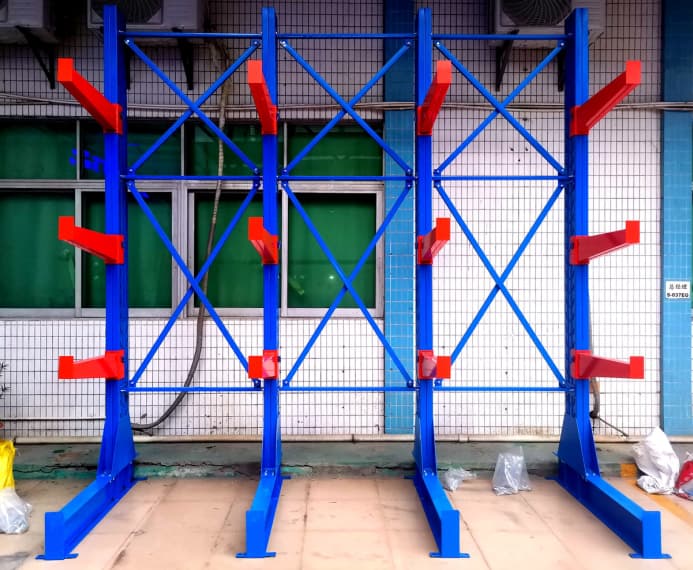
For storage of pipes, structural timber, steel bars, and extrusions, conventional front-column shelving creates access obstacles. Cantilever configurations replace the front columns with heavy base chasses and rigid structural steel central towers, from which structural arms project horizontally. Arm capacities scale up to 3,000 kg per arm, engineered with slight upward cambers (1° to 2°) to counteract load deflection.
Building codes mandate that heavy duty industrial shelving systems comply with stringent regional standards to protect personnel and inventory. The design of steel storage structures requires adherence to explicit structural engineering frameworks:
RMI MH16.1 (United States): Standard for the Design, Testing, and Utilization of Industrial Steel Storage Racks. Dictates testing methods for beam-to-column connections, base plate anchoring tolerances, and allowable stress design (ASD) versus load and resistance factor design (LRFD).
EN 15512 / EN 15620 / EN 15635 (European Union): Define structural tolerances, beam deflections, maximum out-of-plumb deviations, and operational maintenance procedures. EN 15512 mandates sophisticated second-order structural analysis taking system sway and connection semi-rigidity into account.
Seismic Zone Engineering: Facilities located in earthquake-prone regions (such as California, Japan, or portions of Southern Europe and the Pacific Rim) must account for seismic acceleration coefficients ($S_s$ and $S_1$). In seismic design, baseplates require oversized surface dimensions, double anchoring bolts with high shear strength, and dynamic structural stiffening to withstand ground acceleration without tipping or beam dislodgement.
Slab engineering is equally paramount. The concrete slab acts as the ultimate recipient of all vertical and moment loads. Industrial shelving uprights exert concentrated point pressures on the slab floor. A base plate measuring 150 mm x 150 mm carrying an upright load of 10,000 kg exerts substantial pressure directly beneath the steel plate. Facility managers must verify slab thickness, concrete compressive strength (minimum 25–30 MPa), rebar placement, and sub-base compaction to prevent foundation punching shear or concrete cracking.
In operating distribution environments, the most severe hazard to structural shelving is mechanical collision from material handling equipment (counterbalance forklifts, reach trucks, and order pickers). A forklift moving at just 8 km/h delivers an immense dynamic impact vector if it collides with an upright column.
Because structural columns are engineered primarily for axial compression, side-impact forces cause rapid cross-sectional deformation. Once an upright column sustains a dent deeper than 3 mm along its major axis or 5 mm along its minor axis, its axial load-bearing capacity degrades sharply, creating a risk of structural collapse.
Tier-one equipment manufacturers, including Guangshun, integrate factory-punched anchor footplates and supply heavy-gauge impact protection accessories to isolate structural members from daily warehouse traffic:
Wrap-Around Column Protectors: Fabricated from thick cold-formed steel (4 mm to 6 mm) or high-impact polymer buffers, bolted independently to the floor to absorb vehicle energy without transferring stress to the vertical rack column.
End-of-Aisle Heavy Bollards and Barriers: Structural steel tubes or C-channel profiles installed at the ends of double-entry rack rows where turning radius collisions occur most frequently.
Guide Rail Channels: Solid steel floor angles that steer very narrow aisle (VNA) forklifts securely down long corridors, preventing lateral sway into the shelving frames.
Annual structural inspections must be codified into facility operations. Certified safety inspectors must systematically assess three non-negotiable health parameters: upright plumbness (out-of-plumb ratio must not exceed 1/200), beam permanent deformation (residual bow when unloaded must not exceed 20% of maximum deflection), and anchor bolt integrity (torque testing to verify that slab anchors have not worked loose under vibration).
The procurement of heavy duty industrial shelving systems often represents a major capital expenditure. Selecting systems solely on the lowest initial per-shelf cost frequently generates substantial long-term expenses through premature failure, operational downtime, and costly structural retrofits. A complete engineering TCO assessment evaluates several structural variables:
Steel Grade Consistency: Certified mills supply traceability documentation for every batch of steel, verifying carbon content, tensile limits, and anti-corrosion properties. Low-grade non-certified steel can display internal voids, variable thickness, and low yield performance, resulting in system degradation under cyclic load stresses.
Surface Finishing Technology: Industrial atmospheres challenge metal surfaces. Standard warehouse installations benefit from electrostatic thermoset powder coatings cured at 180°C to 200°C, providing superior scratch, impact, and chemical resistance. Conversely, outdoor, unheated, or cold-storage environments mandate pre-galvanized or hot-dip galvanized steel (ISO 1461 standard) to prevent subsurface rust oxidation that corrodes steel joints.
Modular Scalability: Facilities evolve. High-quality systems feature consistent punched vertical profiles that allow reconfiguring shelf levels in 50 mm or 75 mm increments without hot-work cutting or field welding, which would void structural certifications.
Partnering with specialized manufacturers like Guangshun ensures that all load metrics are backed by mechanical load testing, mill test certificates, and precision fabrication standards. This rigorous manufacturing baseline supports predictable operational lifecycles spanning decades under peak industrial throughput.
Industrial warehousing operations cannot afford structural weaknesses. Storage infrastructure forms the physical backbone of the modern supply chain. System selection demands deep attention to steel metallurgy, beam deflection coefficients, seismic compliance, and dynamic impact protection.
Investing in robust heavy duty industrial shelving systems provides distribution centers with the mechanical stability required to maximize volumetric storage, safeguard human personnel, and maintain continuous material flow. Treating heavy-duty storage as an engineered, mission-critical structural asset secures your facility's long-term operational resilience and return on capital investment.
Q1: What is the standard deflection limit for industrial shelf beams under full load?
A1: Under international design standards like RMI MH16.1 and EN 15512, the standard allowable deflection limit for horizontal load beams is L/200, where L is the clear span length between upright columns (or L/180 in specific applications). For example, a 2,000 mm beam is permitted a maximum vertical deflection of 10 mm when loaded to rated capacity. Deflection exceeding this ratio indicates overloading or material fatigue and requires immediate load reduction and engineering inspection.
Q2: How does heavy-duty longspan shelving differ from standard pallet racking?
A2: While both utilize structural uprights and horizontal beams, heavy-duty longspan shelving is optimized for hand-loaded, medium-to-heavy items, cartons, or containers, featuring solid shelf inserts (steel, wood, or wire decking) with typical bay capacities ranging from 500 kg to 1,800 kg. Standard pallet racking is engineered primarily for unitized wooden or plastic pallets moved by forklifts, handling significantly higher tier loads (typically 1,000 kg to over 4,000 kg per level) with deeper frame dimensions and distinct pallet support profiles.
Q3: How are seismic forces factored into industrial shelving design?
A3: Seismic design incorporates regional spectral acceleration factors ($S_s$ and $S_1$), site soil classification, and building occupancy categories. Engineers calculate dynamic horizontal shear and overturning moments caused by ground acceleration. In high-risk seismic zones, shelving requires widened and thickened baseplates, heavy-duty mechanical or chemical chemical-capsule floor anchors, heavier upright profiles, and specialized diagonal back-bracing or portal ties to prevent structural sway or catastrophic collapse.
Q4: Which surface treatment is recommended for refrigerated or high-humidity facilities?
A4: For damp, refrigerated, or cold-storage facilities, hot-dip galvanization (conforming to ISO 1461) or continuous pre-galvanized steel construction is strongly recommended. Hot-dip galvanization bonds a durable zinc-iron alloy coating directly to the steel, providing sacrificial cathodic protection that prevents moisture from initiating rust beneath the surface. Standard powder coatings can chip or blister over time in constant condensation, leading to hidden internal corrosion.
Q5: What is the maximum acceptable out-of-plumb tolerance for loaded shelving uprights?
A5: According to both RMI and EN 15635 standards, the maximum out-of-plumb ratio for installed, loaded upright columns is 1/200 (0.5% of total upright height). For an upright standing 6 meters tall, the top of the column cannot deviate more than 30 mm from absolute vertical plumbness. Any frame exceeding this deviation must be unloaded, inspected for structural damage or baseplate shifting, and mechanically re-shimmed and re-anchored.
Q6: Can beams and uprights from different manufacturers be safely combined?
A6: Intermixing structural components from different manufacturers is strongly discouraged and often voids system load certifications and regulatory compliance. Even if hook tabs or teardrop shapes appear physically compatible, subtle variations in steel gauge, bend radius, hook-to-slot fit tolerances, and yield strength alter load distribution and connection stiffness. Any mixed installation must be certified by a licensed structural engineer via comprehensive physical load testing.

 Wechat
Whatsapp
Wechat
Whatsapp