An industrial storage cage rarely appears at the centre of a warehouse layout drawing, yet it turns up in every zone of the operation — receiving, kitting, line-side feeding, picking, buffer storage and outbound staging. It is a welded steel mesh container that carries loose parts and finished goods as a unit load, rather than as a pile that has to be re-handled at every step. Buyers usually start paying attention to mesh container specifications only after a pallet fails, a stack leans, or a picking face turns into a wall of unlabelled boxes. Specified properly, a wire mesh container spreads its cost across several hundred trips and keeps inventory visible from the aisle. This guide breaks down the engineering variables, load calculations and deployment rules that let warehouse teams specify containers on data rather than on brochure claims.
The category covers welded wire containers, collapsible cage pallets, mesh stillages and rigid steel mesh bins. They share a common architecture: a welded mesh body, a reinforced base, stacking feet at the corners, and one or more access gates. What separates a container that survives five years of forklift handling from one that deforms in six months is almost entirely in the details of that architecture.
Mesh body — welded steel wire grid forming four sides and, in some designs, a removable lid
Base frame — channel or angle steel understructure that carries the load and accepts forklift tines or pallet truck forks
Stacking feet — corner posts that locate into the feet of the container above, preventing lateral shift in a stack
Gate — half-drop, full-drop or swing gate for order picking without dismantling the stack
Surface finish — powder coating, zinc plating or hot-dip galvanising, selected against the operating environment
Wire diameter typically runs from 4 mm to 8 mm on general-purpose containers, with heavy-duty units going thicker. Mesh aperture — commonly 50 × 50 mm, 50 × 100 mm or 25 × 25 mm — controls two things: how much small product escapes through the grid, and how much the side wall deflects under load. A 50 × 50 mm aperture in 6 mm wire is the workhorse specification for cartons and bagged parts. Fine mesh at 25 × 25 mm costs more per unit but eliminates the need for inner liners when handling small hardware, fasteners or loose components.
Reducing wire diameter to save cost has a compounding effect. Thinner wire deflects further under the same load, which reduces the effective stack height and increases the risk of a lower container being crushed by the weight above it. Buyers comparing quotations should compare wire diameter and aperture side by side, not just the headline load figure.
The base is where most load failures begin. A container rated at 800 kg static may only carry 500 kg when moved by forklift, because dynamic loading concentrates stress at the tine entry points. Reinforced channel bases with welded cross members distribute that stress better than a simple perimeter frame. Corner feet should be formed from pressed steel rather than folded sheet, and they should seat positively into the container above — a loose fit allows a stack to walk during forklift contact.
Gate configuration is an ergonomics decision as much as a structural one. A half-drop gate allows a picker to reach the lower half of the container without releasing the upper section. A full-drop gate speeds up unloading at the line but introduces a hinge point that needs regular inspection. For containers that will be tipped or emptied by machine, a swing gate with a positive latch is usually the better choice.
Most containers are fabricated from Q235 low-carbon steel or an equivalent structural grade, selected for weldability and cost. The finish determines service life far more than the steel grade in most applications.
| Finish | Corrosion Resistance | Typical Environment | Relative Cost |
|---|---|---|---|
| Powder coating | Moderate | Dry ambient warehousing, retail distribution | Low |
| Zinc plating | Good | General manufacturing, light humidity | Medium |
| Hot-dip galvanising | High | Cold chain, food processing, outdoor yards | High |
Powder coating gives the widest colour choice and clean edges, which matters when containers double as customer-facing display or line-side kanban bins. Hot-dip galvanising adds significant upfront cost but is difficult to argue against in wash-down environments, where a coated container will start rusting at weld seams and scratches within a season.
Load figures are only meaningful when the loading condition is stated. A single container may carry three different ratings, and confusing them is the most common specification error in this category.
Static load — the mass the container holds when resting on a level floor, unstacked
Dynamic load — the reduced mass permitted when the container is moved by forklift or pallet truck, accounting for shock and tine deflection
Stacked load — the combined mass of containers above that the bottom unit can support, including the self-weight of each container
A practical rule for a standard 1200 × 1000 mm container in 6 mm wire is 800 kg static, 500 kg dynamic and four-high stacking at up to 1,200 kg total superimposed load — but those numbers assume evenly distributed contents and a level floor. Point loads from a single heavy casting will deform a mesh base long before the nominal rating is reached. Where mixed-weight parts share a container, a steel plate or plywood liner under the load spreads the force across several mesh cells and extends service life considerably.
Standard collapsible cage — folds flat for return transport, the default choice for closed-loop supply chains
Rigid mesh stillage — heavier frame and base, used for long-term storage where folding offers no benefit
Castor-mounted container — swivel castors allow manual movement in picking and assembly areas without a forklift
Half-drop gate container — order picking and line-side presentation
Lidded security container — high-value parts, controlled substances, tools
Custom footprint — non-standard dimensions to match existing racking bays or vehicle loading envelopes
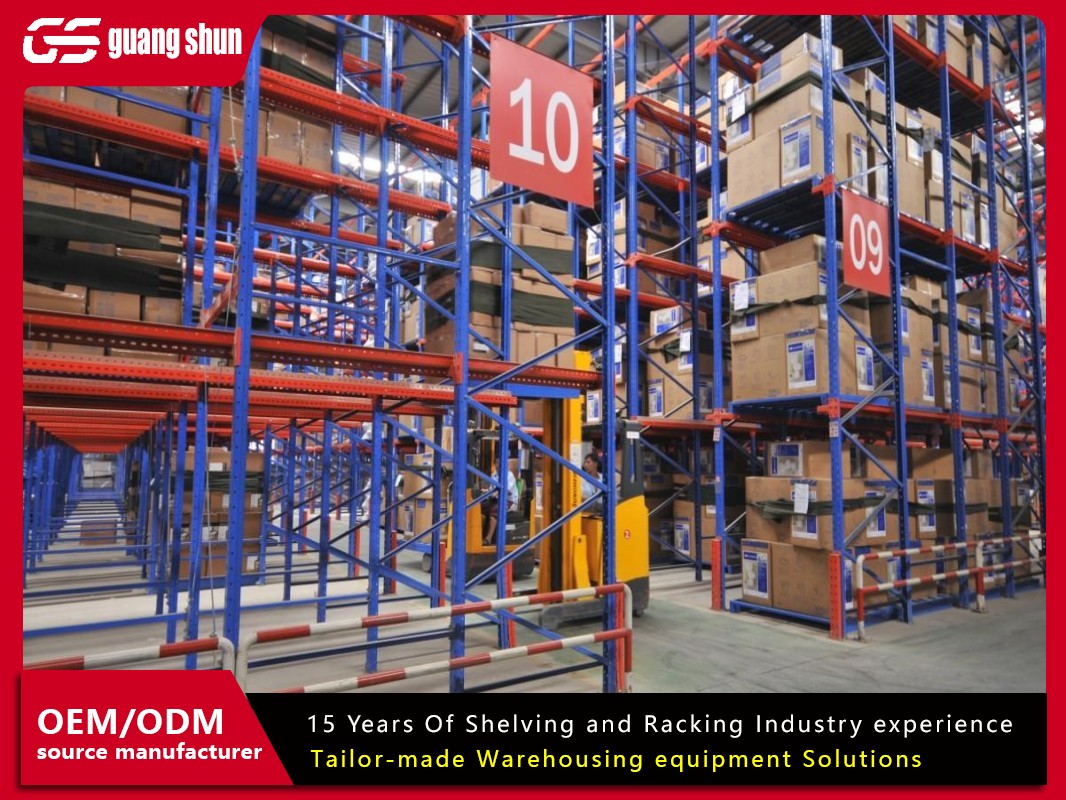
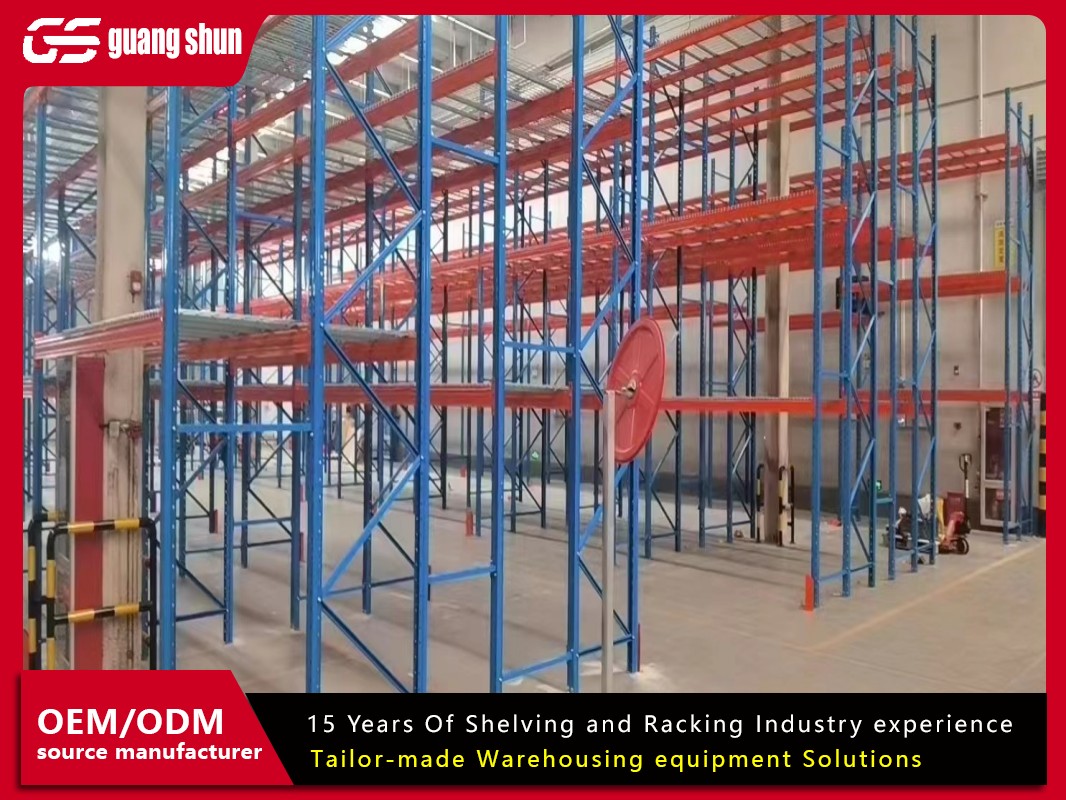
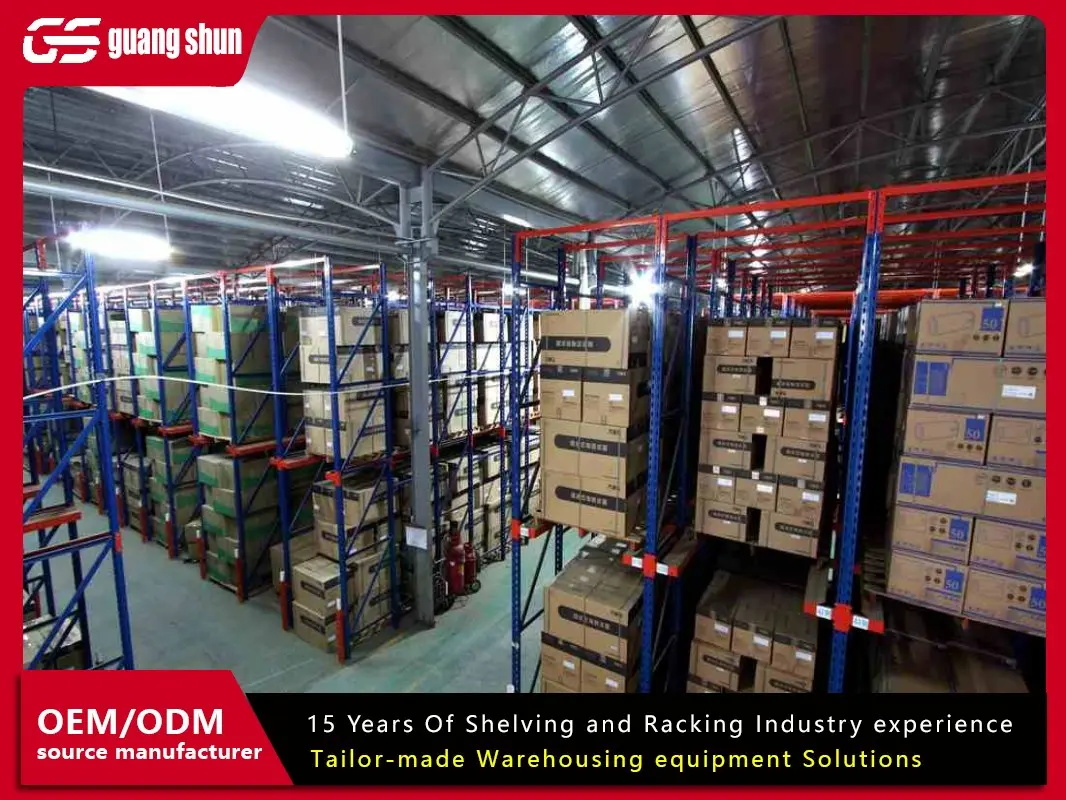
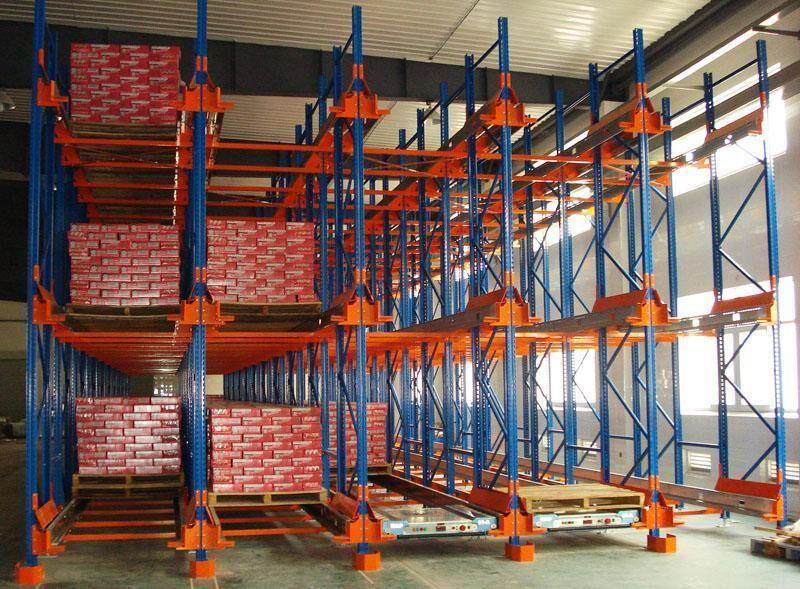
A mesh container is not a substitute for racking — it is a complement to it. Placing containers on pallet racking beams turns a static storage bay into a flexible, re-configurable location that can hold four separate SKUs instead of one palletised load. Drive-in and double-deep racking suit denser container storage where throughput per SKU is low. Mezzanine structures use containers as the transfer unit between levels.
The interface points to verify are beam pitch, bay width and clear entry height. A 1200 × 1000 mm container needs a bay opening of at least 1,300 mm to allow forklift positioning tolerance, and the beam level must clear the tallest stacked configuration. For operations running high-density storage, Guangshun manufactures racking and container systems on the same dimensional standards, which removes the mismatch that occurs when containers from one supplier are loaded into racking from another. Any industrial storage cage deployed on racking should be checked for beam seating — the base frame must sit fully on the beam face, not on the beam edge.
Line-side feeding of castings, brackets and sub-assemblies, with containers moving on a fixed kanban loop between the warehouse and the production cell. Dynamic load ratings and base reinforcement matter most here because containers are handled several times per shift.
Batch picking into containers, then consolidating to outbound. Half-drop gates reduce picker reach time, and collapsible units recover floor space when not in use — a real benefit in operations with seasonal volume swings.
Hot-dip galvanised containers withstand wash-down and condensation. Open mesh allows airflow around chilled product and makes cleaning between loads straightforward, which is difficult with solid-sided bins.
Containers act as mobile WIP buffers between machining, welding and finishing stages. Castor-mounted versions let operators move work without waiting for a forklift, which shortens the queue between operations.
Stack collapse from mismatched containers. Fix: standardise on one footprint and stacking foot profile across the site.
Unidentified contents. Fix: weld a label holder or rivet a card pocket to the gate side, and use colour-coded frames by product family.
High return transport cost. Fix: specify collapsible containers and negotiate a folding ratio of at least 3:1 for backhauls.
Manual handling injuries. Fix: cap container fill weight at a level operators can move safely, and use castor units below that threshold.
Base deformation at tine entries. Fix: reinforced channel bases, plus operator training on full tine insertion.
Inventory invisibility in stacks. Fix: keep the top two levels for fast movers and store slow movers at the base of the stack.
Confirm external dimensions against existing racking bays, vehicle loading envelopes and lift equipment.
State static, dynamic and stacked load requirements separately, with the content profile described.
Choose mesh aperture based on the smallest item the container will hold.
Select the finish against humidity, wash-down frequency and expected service life.
Decide gate type from the picking method, not from price.
Confirm stacking foot compatibility with containers already on site.
Request the folding ratio and folded height for return logistics planning.
Verify whether a industrial storage cage will be lifted by crane, forklift or pallet truck, and specify lifting points accordingly.
Mesh containers are load-bearing equipment and should be treated as such. A written inspection schedule — visual checks at every use, detailed inspection quarterly, and weld inspection annually — catches the deformation and cracked welds that precede failure. Containers with bent stacking feet, cracked corner welds or mesh deflection beyond roughly 10 mm on a side wall should be withdrawn from stacking duty and either repaired or downgraded to floor-level use.
Where containers are used in food or pharmaceutical supply chains, the finish and cleaning regime should be documented against the relevant hygiene standard. For units used in lifting applications, load testing and certification records should be retained per unit or per batch.
The purchase price of a container is the smallest part of its cost profile. The meaningful comparison is cost per trip. A container that costs four times a wooden crate but completes 200 trips works out cheaper per movement by a wide margin, before accounting for the reduced product damage, the elimination of disposable packaging and the labour saved by not re-packing at each stage. Add the floor space recovered by collapsing empty containers and the case for a properly specified mesh container set is usually straightforward.
Teams evaluating a first deployment should model three variables: trips per year, damage rate with the current packaging, and floor space value per square metre. Those three numbers will settle most specification arguments faster than any brochure.
Off-the-shelf containers cover a large share of requirements, but non-standard footprints, custom gate positions and specific finish specifications frequently deliver better results. Guangshun produces warehouse racking, storage racking, pallet racking, mezzanine racking, drive-in racking and matched container systems, which means dimensions and load interfaces can be coordinated at the design stage rather than corrected on site. Engaging the manufacturer early on the container-to-racking interface avoids the most expensive category of retrofit work.
Q1: How does an industrial storage cage compare with a pallet and
shrink wrap?
A1: A pallet and wrap is cheaper per unit but is
typically single-trip for the packaging, offers no stacking stability without
racking, and hides contents from view. A mesh container is a returnable asset
with a defined stacking system, visible contents and a service life measured in
years. The crossover point usually falls at around 30 to 40 trips per year.
Q2: Can mesh containers be stored on standard pallet
racking?
A2: Yes, provided the container base is fully supported
across the beam faces and the bay width allows forklift positioning tolerance. A
typical 1200 × 1000 mm container needs an opening of roughly 1,300 mm. Beam load
capacity must be checked against the stacked container weight, not the container
weight alone.
Q3: When should I choose hot-dip galvanising over powder
coating?
A3: Choose galvanising where the container will be washed
down, stored in humid or chilled conditions, or used outdoors. Choose powder
coating where the container stays dry, colour coding supports visual management,
and upfront cost is the deciding factor.
Q4: How do I calculate the correct stacking load?
A4:
Multiply the maximum content weight per container by the number of containers in
the stack, then add the self-weight of every container above the bottom unit.
Confirm the resulting figure against the manufacturer's stacked load rating, and
reduce it if contents are not evenly distributed.
Q5: What folding ratio should I expect from a collapsible
container?
A5: Most well-designed collapsible units fold to between
one-third and one-quarter of their erected height. A ratio better than 4:1
usually indicates thinner wire or a lighter base frame, which will reduce the
dynamic load rating.
Q6: Can containers be fitted with barcodes or RFID
tags?
A6: Yes. Weld-on label holders, riveted card pockets and
encapsulated RFID tags are all available. Tag placement should avoid areas
subject to impact from forklift tines, typically the upper third of a side panel
rather than the base frame.
Q7: What inspection regime keeps a container fleet
safe?
A7: A three-tier approach works well: a visual check by the
operator at each use, a documented quarterly inspection of welds, feet and base
frames, and an annual detailed inspection with load testing for any unit used in
lifting applications.
Container specification is a small decision with a long tail. Wire diameter, base construction, finish and stacking foot profile determine whether a fleet lasts three years or ten, and whether the storage system it feeds operates smoothly or generates daily exceptions. Starting from load data, environmental conditions and the racking interface — rather than from unit price — produces a container fleet that pays for itself in reduced handling, less product damage and recovered floor space. For operations planning a full storage build-out, coordinating the industrial storage cage specification with the racking design is the step that prevents most of the costly interface problems that appear after installation.

 Wechat
Whatsapp
Wechat
Whatsapp