Managing industrial inventory that is long, heavy, or irregularly shaped presents distinct spatial challenges. Traditional storage systems often fail to accommodate items such as structural steel columns, aluminum extrusions, timber packs, and heavy industrial piping without sacrificing valuable floor space. As warehouse footprint costs rise globally, industrial facility managers require systems that combine high density with direct selectivity.
Implementing a high-density mobile cantilever rack system addresses these spatial challenges. By mounting heavy-duty cantilever structures onto motorized mobile bases that travel along floor-embedded rails, facilities can eliminate underutilized aisles. Leading international storage equipment manufacturers, such as Guangshun, engineer these systems to provide high structural stability, optimal safety, and maximum operational efficiency for long load logistics.
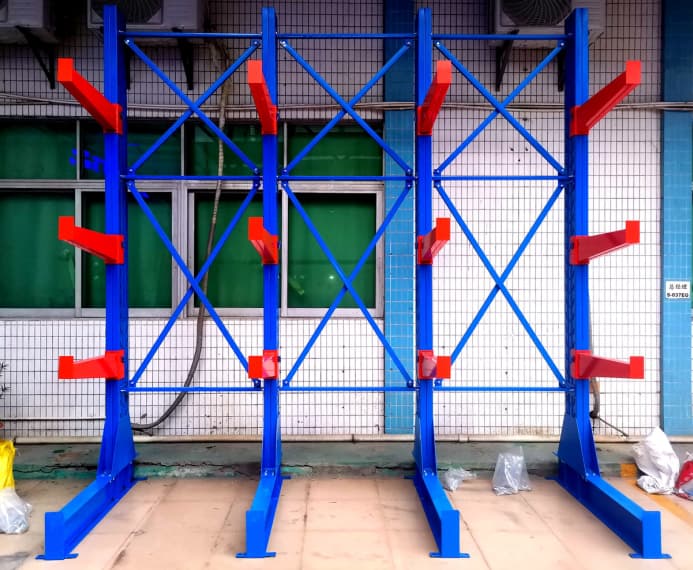
The primary operational benefit of dynamic racking is the dramatic reduction of dedicated aisle space. In a conventional warehouse layout, every cantilever rack row requires an adjacent aisle for forklift access. This static configuration means that up to 60% of the warehouse floor area is dedicated to access paths rather than actual material storage.
A mobile system consolidates these multiple aisles into a single, movable aisle. When an operator needs to retrieve a specific bundle of pipes or lumber, the mobile bases shift laterally on their tracks to open the required aisle. This configuration offers distinct spatial improvements:
Increased Storage Capacity: Reclaiming idle aisle space allows facilities to increase their storage capacity by up to 100% within the same physical footprint.
Reduced Footprint for New Builds: Companies planning new construction projects can reduce the planned building size by up to 45% while maintaining their target pallet and load capacity, leading to substantial savings on land acquisition and construction costs.
Concentrated Operations: Higher storage density minimizes travel distances for material handlers, optimizing overall operational throughput.
The mechanical layout of a mobile cantilever rack involves complex engineering. Unlike static systems, the mobile base must support the dynamic forces generated during movement, acceleration, and deceleration of multi-ton loads.
The structure consists of heavy-duty cold-rolled or hot-rolled steel upright columns, braced vertically and horizontally to prevent twisting under uneven loads. The cantilever arms extend outward from these columns, featuring adjustable pitch configurations to handle varying heights of stored materials.
To ensure safe movement under full capacity, structural engineers analyze dynamic load distribution. When the motorized mobile bases initiate movement, inertial forces act upon the columns and arms. To mitigate this stress, the drive control systems employ variable frequency drives (VFDs) that provide smooth acceleration and soft braking curves. This prevents load shifting and minimizes the structural wear of the steel frames over long-term operational cycles.
Safety is a fundamental priority in any high-density warehouse environment, particularly when handling heavy steel profiles or industrial tubing. Modern mobile racking systems incorporate multi-tiered active and passive safety mechanisms to protect personnel, materials, and material handling equipment.
When designing a custom mobile cantilever rack, structural engineers must integrate advanced safety systems directly into the electrical control panel and the mechanical bases. The primary safety technologies include:
Photoelectric Light Barriers: Installed along the base of each mobile carriage, these sensors detect obstacles in the aisle path. If a foreign object or a pedestrian enters an opening aisle, the movement stops instantly.
Emergency Stop Buttons: Positioned at the end of each mobile carriage, these manual overrides allow operators to halt all movement immediately during an unexpected event.
Distance Sensors and Anti-Collision Panels: Laser-ranging devices monitor the distance between adjacent moving carriages, preventing structural impacts and ensuring synchronized movement.
Aisle Safety Lockouts: Physical or electronic locks prevent the system from closing an aisle while a forklift operator is inside retrieving inventory.
The precise structural design criteria followed by Guangshun prioritize these safety features, ensuring full compliance with international safety standards, such as FEM 10.2.14 and EN 15095.
The operational reliability of a mobile racking system depends on the quality of its ground rails and carriage assemblies. The floor rails must be installed with precise levelness tolerances to prevent uneven wheel wear or structural misalignment during travel.
Embedded Floor Rails: Usually made of high-tensile steel, these rails are cast into the warehouse concrete slab during construction or retrofitted by cutting precise channels into existing concrete floors.
Polyurethane and Steel Wheels: Heavy-duty, double-flanged steel wheels bear the weight of the structure, while polyurethane guide wheels maintain linear alignment along the guide rails.
Synchronized Multi-Motor Drives: Each mobile carriage is driven by multiple synchronized geared motors. This decentralized driving force ensures that long carriages (which can exceed 30 meters in length) move uniformly without skewing.
The structural tolerance of the floor levelness must comply with stringent international standards (such as DIN 18202). Any significant deviation in the concrete floor plane can introduce secondary bending stresses in the cantilever columns, emphasizing the importance of qualified site evaluation before installation.
While some high-density storage solutions (such as drive-in or push-back racks) operate on a First-In, Last-Out (FILO) basis, mobile cantilever storage maintains 100% direct selectivity. Once the target aisle is open, every stored item is immediately accessible to the material handling equipment.
This direct access is highly beneficial for facilities managing diverse stock-keeping units (SKUs) of varying lengths and weights. It eliminates the need to relocate blocking stock to reach desired materials, significantly reducing handling damage and time.
Furthermore, integrating a mobile cantilever rack into an existing facility requires no specialized material handling fleet. Standard reach trucks, side-loaders, and multi-directional forklifts can operate within the open aisles, making the transition from static to dynamic storage straightforward for warehouse staff.
When specifying a dynamic cantilever storage system, engineering teams analyze several design parameters to ensure structural integrity and long-term durability. The table below outlines standard technical parameters typically evaluated during the project planning phase:
| Parameter Description | Standard Engineering Value / Range | Compliance Standards |
|---|---|---|
| Maximum Column Height | Up to 12,000 mm | EN 15620 / FEM 10.2.09 |
| Arm Load Capacity | 500 kg to 3,500 kg per arm | RMI / ANSI MH16.1 |
| Carriage Travel Speed | 4.0 to 8.0 meters per minute | EN 15095 (Safety of Power Racks) |
| Motor Drive System | Variable Frequency Drive (VFD) Controls | IEC 60034 Standard |
| Aisle Opening Width | Customized based on forklift turn radius | Manufacturer Standards |
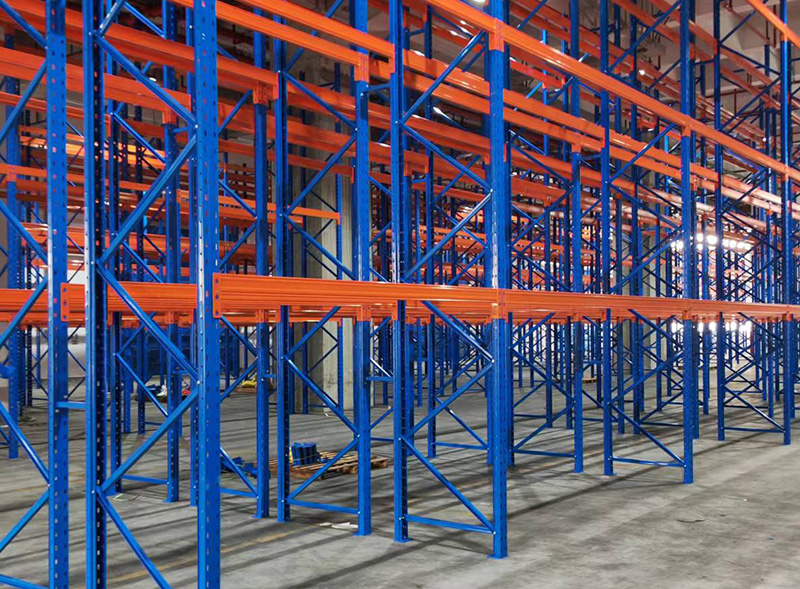
Implementing dynamic warehousing solutions is a logical step for companies facing high property costs and complex inventory profiles. By transforming multiple access aisles into a single, high-efficiency pathway, industrial enterprises can double their storage capacity, improve workplace safety, and maintain complete selectivity over their products.
Choosing a high-performance mobile cantilever rack ensures that heavy materials such as tubes, bars, and timber are stored in a safe, organized, and highly accessible manner. Consulting with engineering experts at Guangshun can ensure that your specific floor load capacities, seismic conditions, and inventory requirements are carefully integrated into a customized, high-density storage solution that yields measurable long-term returns on investment.
Q1: What are the main maintenance requirements for a mobile cantilever rack?
A1: Routine maintenance focus areas include inspecting the floor-embedded guide rails for debris, verifying the alignment of the safety photo-sensors, checking the oil levels in the gear motors, and conducting structural inspections of the cantilever arms for deflection or physical impact damage from forklifts.
Q2: Can a mobile cantilever system be installed in seismic zones?
A2: Yes. The structural design must incorporate local seismic acceleration factors. Engineering teams adjust the steel grade, column thickness, base plate anchoring, and integrated anti-tip devices on the mobile carriages to meet specific regional building codes and seismic standards.
Q3: How does the system handle power outages?
A3: In the event of a power failure, most industrial mobile bases feature a manual release clutch that allows the carriages to be moved using low-torque manual drives or specialized towing equipment. Additionally, systems can be integrated with emergency backup generators to maintain continuous automated operation.
Q4: Is it possible to retrofit mobile carriages under existing static cantilever columns?
A4: Yes, retrofitting is possible if the existing columns are in sound structural condition and meet the load requirements. The process involves dismantling the static racks, installing floor tracks, assembling the mobile carriages, and re-mounting the columns onto the motorized bases.
Q5: What is the estimated lifespan of a high-density mobile racking system?
A5: With regular structural inspections and preventative mechanical maintenance, a high-quality system designed with industrial-grade steel and robust motor drives can achieve an operational lifespan exceeding 15 to 20 years.

 Wechat
Whatsapp
Wechat
Whatsapp