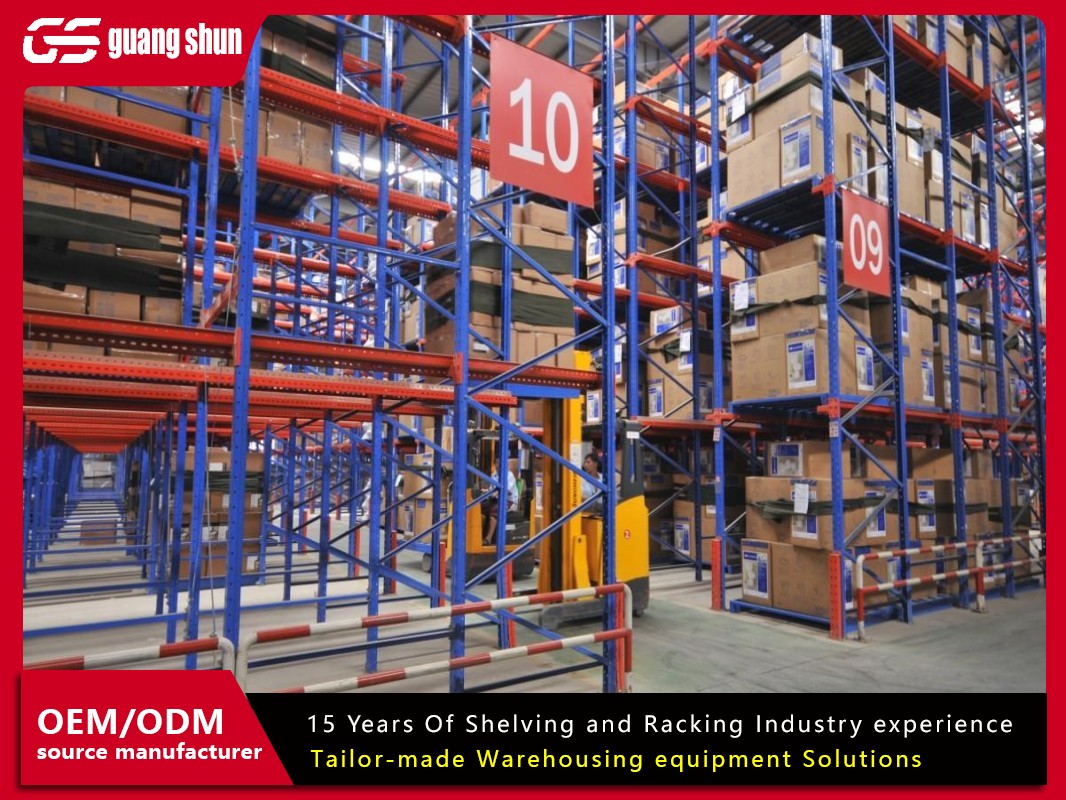
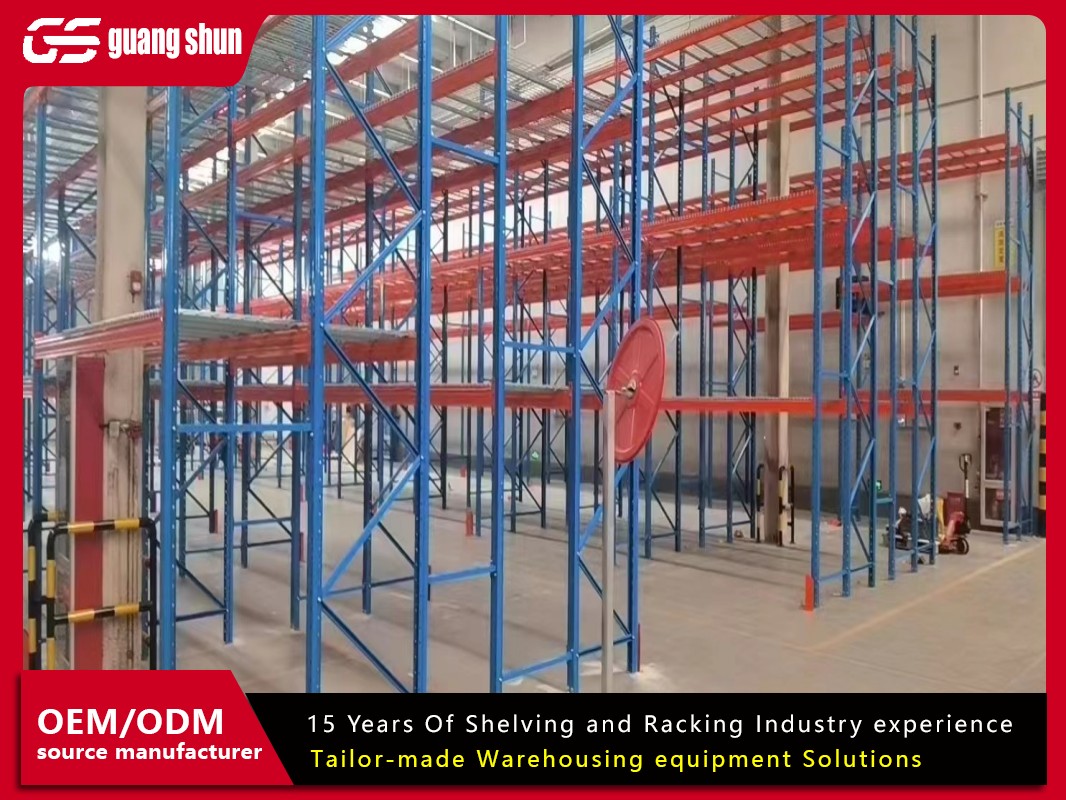
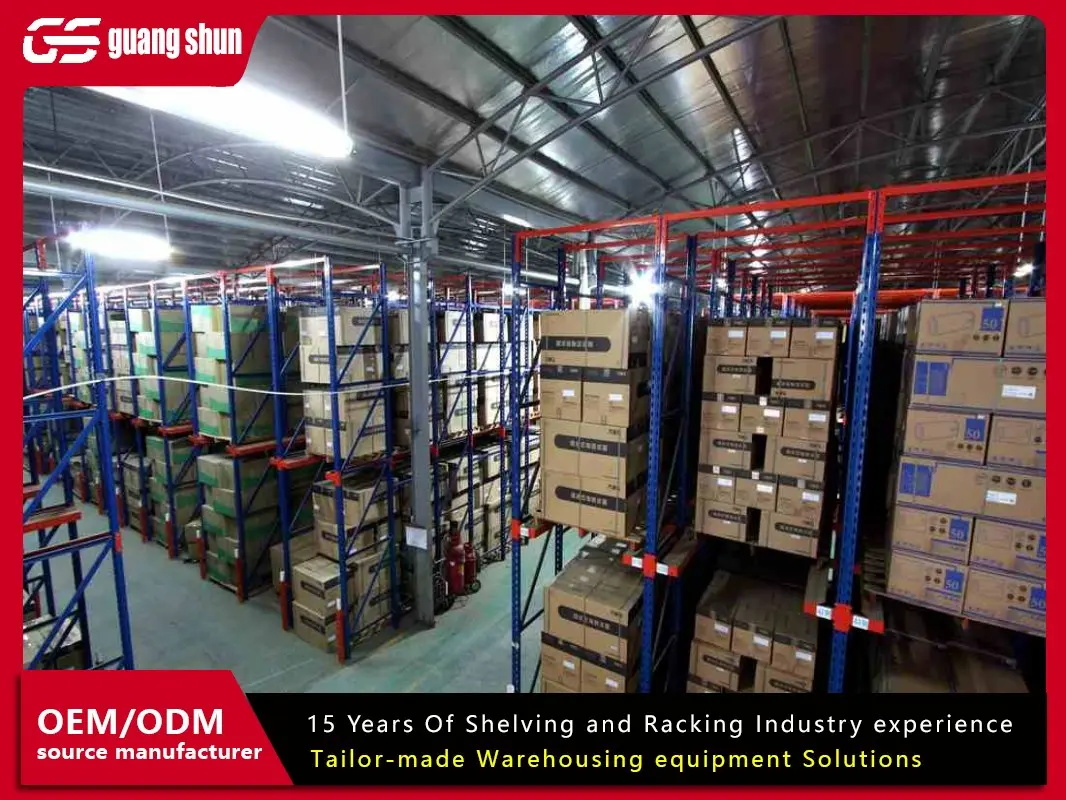
Selecting appropriate industrial pallet shelves requires more than comparing beam lengths and frame colors. These structures must resist static pallet weights, dynamic braking forces from forklifts, seismic lateral loads, and long‑term fatigue. This article provides quantitative methods for engineers and facility managers to specify, validate, and maintain steel shelving systems. We analyze load path integrity, failure modes, and cost‑effective retrofit strategies, using field data and RMI/ANSI standards.
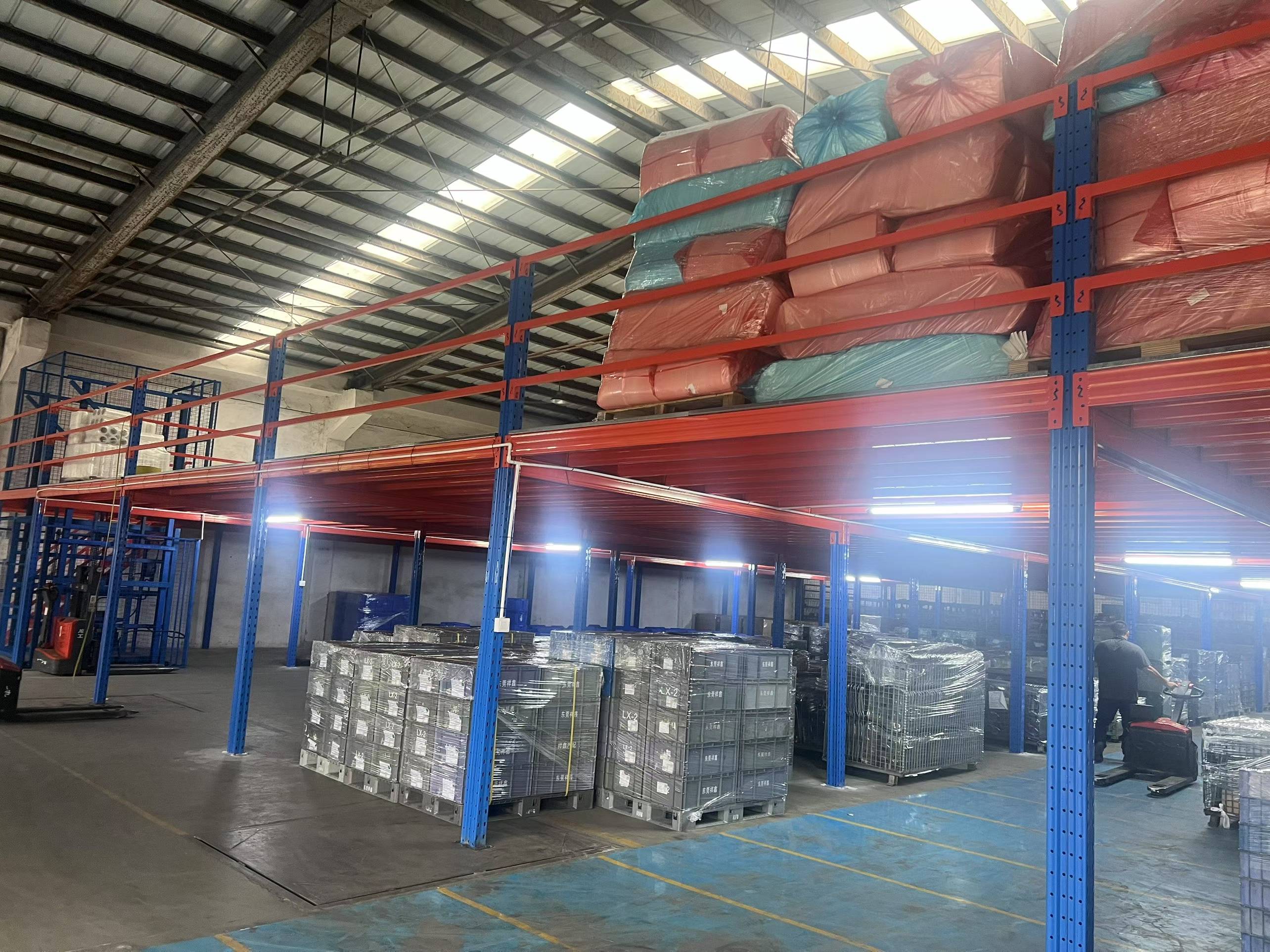
A reliable set of industrial pallet shelves consists of four interdependent components. Each must be rated for the maximum intended load plus a safety factor of 1.67 (per RMI MH16.1‑2020).
Upright frames – vertical columns with punched holes. Typical depths: 3″ to 6″. Steel grade Q235B or Q355B (minimum yield 36 ksi).
Beams (horizontal load bars) – step‑adjustable, with integral safety locks. Standard beam steps: 2″ or 3″ increments.
Base plates & anchors – transfer column loads to concrete floor. Anchor bolt diameter 5/8″ to 3/4″.
Bracing (horizontal and diagonal) – prevents side sway. X‑bracing or K‑bracing patterns.
Failure in any component cascades. A 2021 analysis of 200 warehouse incidents found that 68% of collapses originated from anchor bolt pull‑out or beam connector disengagement, not from overloading the uprights. Therefore, specifying industrial pallet shelves must include verified anchor torque and connector preload.
Static load is the pallet weight at rest. Dynamic loads occur during forklift placement or retrieval. For a forklift braking at 0.2 g (typical deceleration), the horizontal force on a beam is 0.2 × (pallet weight). For a 2,500 lb pallet, this adds 500 lbs of lateral force. Over time, this causes beam connector fatigue. RMI standards require a dynamic load factor of 1.3 for normal operation and 1.6 for seismic or high‑impact zones. When designing industrial pallet shelves for frequent forklift traffic, specify beams with anti‑lift tabs and preload indicators.
The allowable axial load for an upright is governed by Euler buckling: Pcr = π²EI / (KL)². Perforations (hole punching for beam connectors) reduce the net section area and moment of inertia. Typical reduction factor φ = 0.85 for hole patterns covering 15% of the column face. For a standard 4″×2.5″ upright (I = 3.2 in⁴) of 20 ft height with unbraced length 48″, the theoretical capacity is 14,200 lbs. After perforation reduction and safety factor, published load tables show 8,000‑9,000 lbs per upright. Always request the actual test certificate – never rely on generic “max load” claims.
Beam‑to‑upright connections are the most common failure point in industrial pallet shelves. Three connector types dominate:
Tab‑and‑slot (boltless) – quick assembly but prone to loosening under vibration. Acceptable for static storage with low fork traffic.
Keyhole‑and‑stud with anti‑lift tab – improved design. The tab prevents upward movement when a forklift lifts a pallet from the beam.
Bolted connectors (grade 8.8) – highest reliability. Torque to 150 ft‑lbs with re‑torque after 30 days. Required for seismic zones or AS/RS integration.
A 2023 study of 500 beam connections in active warehouses found that bolted connectors maintained preload for 2.5 years, while tab‑and‑slot connectors required adjustment every 9 months. For high‑throughput facilities ( >1,000 cycles per day), specify bolted connections and include quarterly torque checks in maintenance contracts.
Standard selective racks are only one type of industrial pallet shelves. Four other configurations address specific operational needs.
Two pallets deep per aisle, increasing density by 30‑40% over selective. Requires reach trucks with extended forks (48‑60″). Upright spacing increases to 10‑12 ft. Beam capacity must be derated by 15% due to longer spans. A mid‑west auto parts distributor installed double‑deep industrial pallet shelves and reduced floor space by 38% while maintaining 92% accessibility.
Forklift enters the lane. Uprights are spaced 8‑9 ft apart, with vertical guides. Load per position typically 2,200‑3,500 lbs. The critical failure mode is rail bracket fatigue. Specify full‑penetration welds and annual dye‑penetrant inspection of bracket welds. For lanes deeper than 5 positions, add lateral tie bars between uprights to prevent progressive collapse.
Uses rollers or wheels on a slope (3‑5%). The structural frame must resist dynamic impact from pallets advancing to the front stop. End stops must absorb kinetic energy E = 0.5 × m × v². For a 2,200 lb pallet moving at 0.5 ft/s, E ≈ 190 ft‑lbs. Specify hydraulic dampers for lanes deeper than 8 positions.
For long goods (lumber, pipes). Arms extend from a single column row. The moment at the column base is arm length × load × number of arms. A 48″ arm with 1,000 lbs generates 4,000 ft‑lbs moment. Standard base plates (6″×6″) are insufficient; use 12″×12″ plates with four 1″ anchors. Guangshun provides engineered cantilever designs with FEA‑validated base plate stiffness.
For warehouses in seismic zones D/E, standard industrial pallet shelves require modification. RMI/ANSI MH16.1‑2020 specifies allowable inter‑story drift ≤ 2% of height under design basis earthquake (DBE). For a 25‑ft tall rack, this is 6″. Without seismic bracing, drift often exceeds 4% because standard X‑bracing buckles. Solutions include:
K‑bracing with gusset plates – increases energy dissipation by 25%.
Slotted base plates with friction dampers – allow controlled sliding, reducing column forces.
Viscous dampers – added between uprights, limiting drift to 1.2% of height.
Anchor bolts must be designed for combined tension and shear. For a typical upright with 4,000 lbs uplift and 2,000 lbs shear, use 3/4″ diameter epoxy anchors with embedment 7″ into 4,000 psi concrete. Guangshun provides seismic anchorage calculations per ACI 318‑19, including cracked concrete factors.
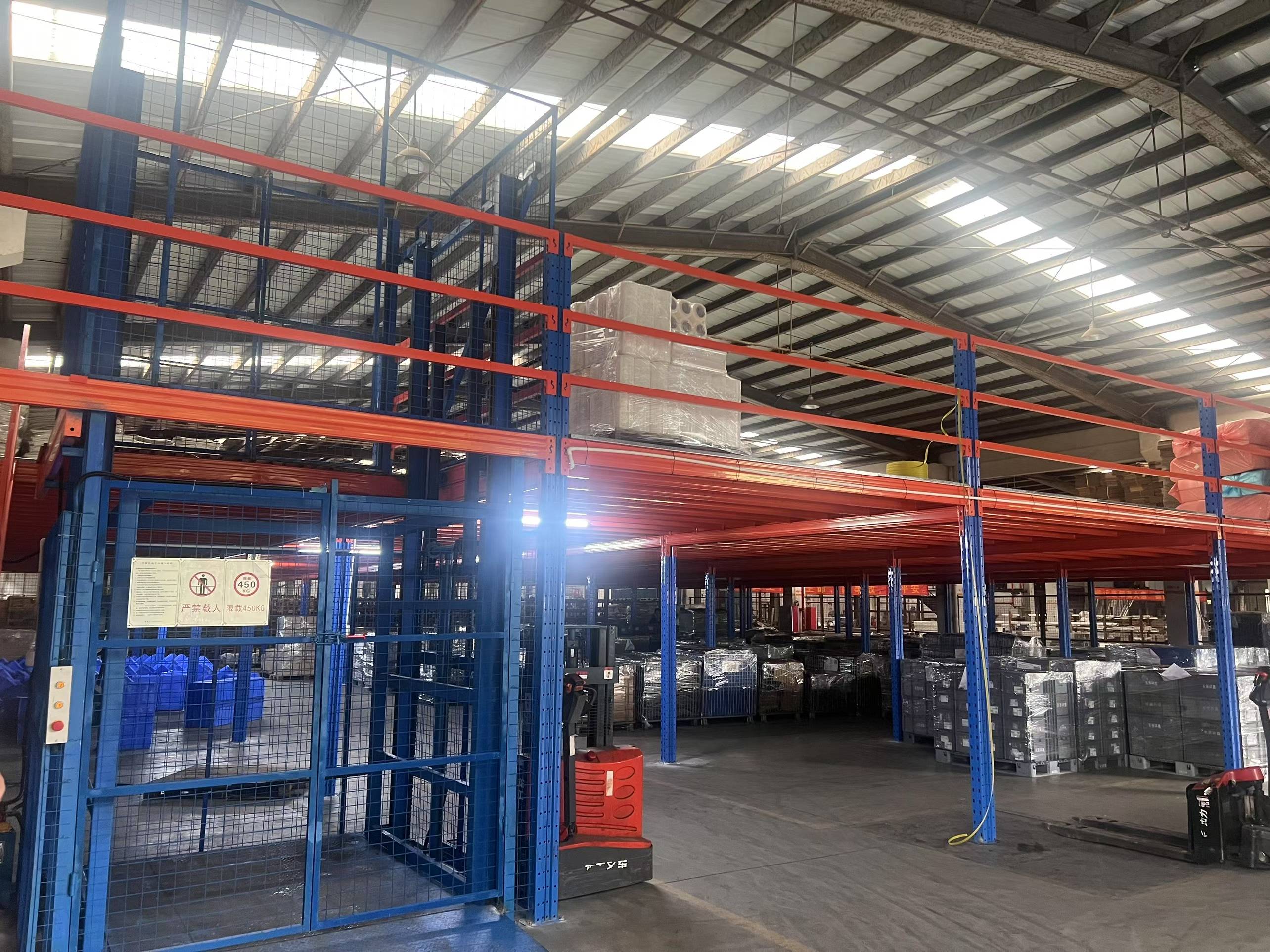
Forklift impacts cause most damage to industrial pallet shelves. Field data from 120 warehouses shows that 73% of uprights with dents deeper than 1/2″ failed within 18 months if not repaired. Repair methods based on damage severity:
Dent < 1/4″ depth – cold straightening allowed, followed by magnetic particle inspection (MPI). No capacity reduction.
Dent 1/4″ – 1/2″ – bolt‑on column sleeve (12″ long, same gauge) with eight grade 8.8 bolts. Restores 85% of original capacity.
Dent > 1/2″ or visible buckling – full column replacement using load transfer posts. The rack must be unloaded in the affected bay.
Annual laser alignment surveys detect hidden deformations. A 0.5° lean in a 20‑ft upright reduces capacity by 32% due to P‑delta effects. Facilities using quarterly alignment checks report 68% fewer collapse incidents.
Comparing standard vs. engineered industrial pallet shelves over 15 years for a 5,000‑pallet facility:
Standard (off‑the‑shelf) – $68,000 initial, $28,000 annual repairs (impact damage), $12,000 downtime, $4,500 inspection → TCO $68k + 15×($44.5k) = $735,500.
Engineered (RHS uprights, bolted connectors, seismic bracing) – $105,000 initial, $7,500 annual repairs, $3,200 downtime, $3,800 inspection → TCO $105k + 15×($14.5k) = $322,500.
Savings of $413,000 over 15 years, plus 18% higher storage density from 50 mm beam steps. Payback period for the engineered premium: 1.9 years. Many operators overlook this analysis and pay far more over time.
Q1: What is the maximum height for industrial pallet shelves without
additional lateral support?
A1: Per RMI/ANSI
MH16.1‑2020, maximum unbraced height depends on the upright section’s radius of
gyration (ry). For a typical 4″×2.5″ open section (ry =
1.2″) and allowable KL/r = 200, unbraced length = 200 × 1.2″ / 12 = 20 ft. With
horizontal braces every 8 ft, total height can exceed 40 ft. For closed RHS
sections (ry ≈ 2.1″), unbraced height reaches 35 ft. Always perform
column buckling analysis per AISC 360‑16 Chapter E.
Q2: How do I verify the load capacity of existing industrial pallet
shelves without original documentation?
A2: You can
perform a proof load test per RMI‑2018: load beams to 125% of desired rated
capacity for 15 minutes, measuring deflection. Acceptable deflection = L/180
(beam length/180). Also, measure upright thickness with ultrasonic gauge –
compare to original coil thickness (stamped on column). For missing data, many
third‑party engineers can reverse‑engineer capacity using FEA. However,
insurance companies may still require full replacement if documentation is lost.
Guangshun offers field
certification services for legacy racks.
Q3: Can industrial pallet shelves be used
outdoors?
A3: Yes, but with corrosion protection.
Standard powder coating (60‑80 µm) fails within 12‑18 months outdoors due to UV
degradation and moisture. Specify hot‑dip galvanizing per ISO 1461 (minimum
85 µm zinc) plus a top coat of polyester paint. For coastal environments (high
salt), use stainless steel uprights (grade 304) or apply a sacrificial zinc
spray annually. Also, outdoor racks require wind load calculations per ASCE 7‑22
– typically an additional 20‑30% capacity reduction.
Q4: What fire rating do industrial pallet shelves provide without
additional coating?
A4: Bare steel loses 50% of
yield strength at 1,000°F (538°C). In a standard time‑temperature fire curve
(ASTM E119), a 2.5 mm thick upright reaches critical temperature after 12‑15
minutes. For facilities requiring 2‑hour fire resistance, intumescent coatings
(minimum DFT 1.5 mm) or concrete‑filled columns are necessary. Note that
perforated holes reduce coating effectiveness – specify pre‑coating of hole
edges. NFPA 13 also mandates in‑rack sprinklers when storage height exceeds 12
ft for Class III commodities.
Q5: How often should I replace beam connectors on industrial pallet
shelves?
A5: For bolted connectors (grade 8.8),
replace after 10 years or 500,000 cycles (whichever comes first). For
tab‑and‑slot connectors, replace every 5 years or 250,000 cycles. Visual signs
of wear: elongated holes, cracks near the keyhole, or a loose fit when engaged.
A 2022 study found that 34% of connectors older than 8 years had hidden fatigue
cracks detectable only by magnetic particle inspection. Include connector
replacement in your 10‑year capital plan.
Q6: What is the correct procedure for anchoring industrial pallet
shelves to a post‑tensioned concrete slab?
A6: Post‑tensioned (PT) slabs contain stressed cables. Drilling into a cable can
cause slab failure. First, obtain the PT tendon layout drawing. Use a
ground‑penetrating radar (GPR) scan to mark cable locations. Then drill only
into zones without cables. Use epoxy anchors (not mechanical expansion anchors)
to avoid stressing the concrete. Maximum anchor depth = 70% of slab thickness.
For a 6″ PT slab, embedment ≤ 4.2″. Guangshun provides PT‑safe anchoring kits
with pre‑scan service.
Specifying industrial pallet shelves requires rigorous attention to load paths, connector integrity, seismic anchorage, and damage repair protocols. Engineered solutions with closed‑section uprights, bolted connectors, and seismic bracing deliver lower total cost of ownership and higher safety margins. Work with a manufacturer like Guangshun to obtain certified load tables, FEA reports, and installation protocols that meet RMI/ANSI standards and local building codes.

 Wechat
Whatsapp
Wechat
Whatsapp