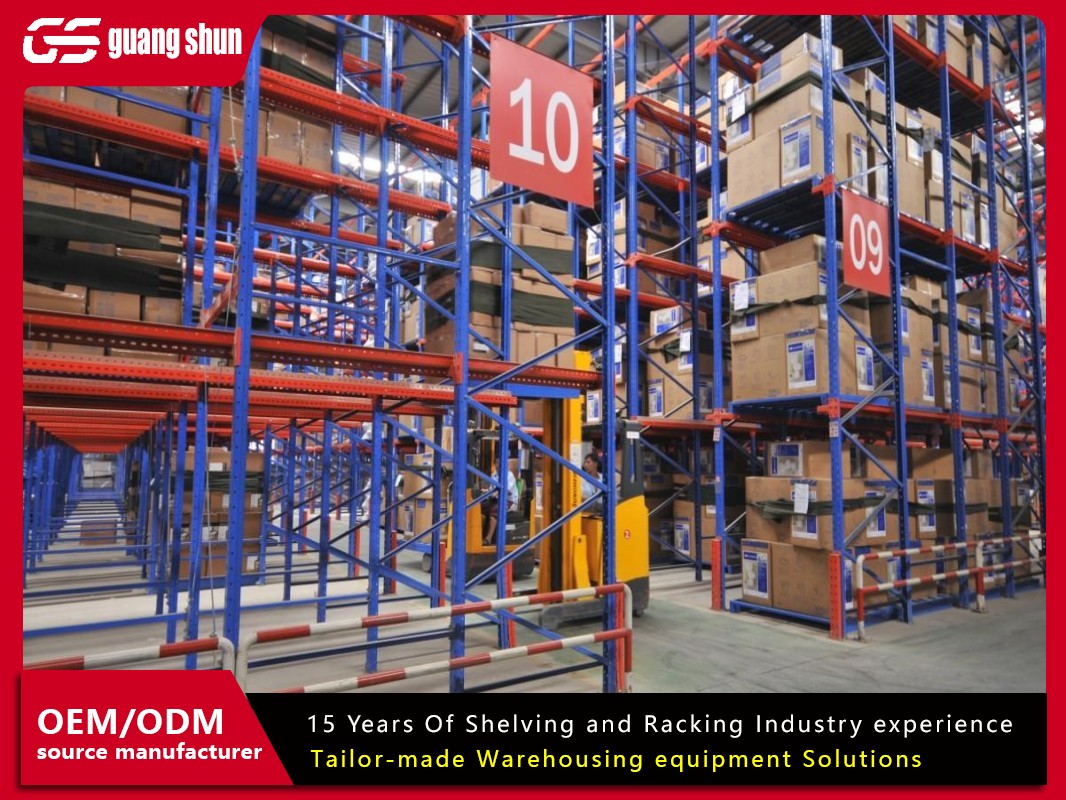
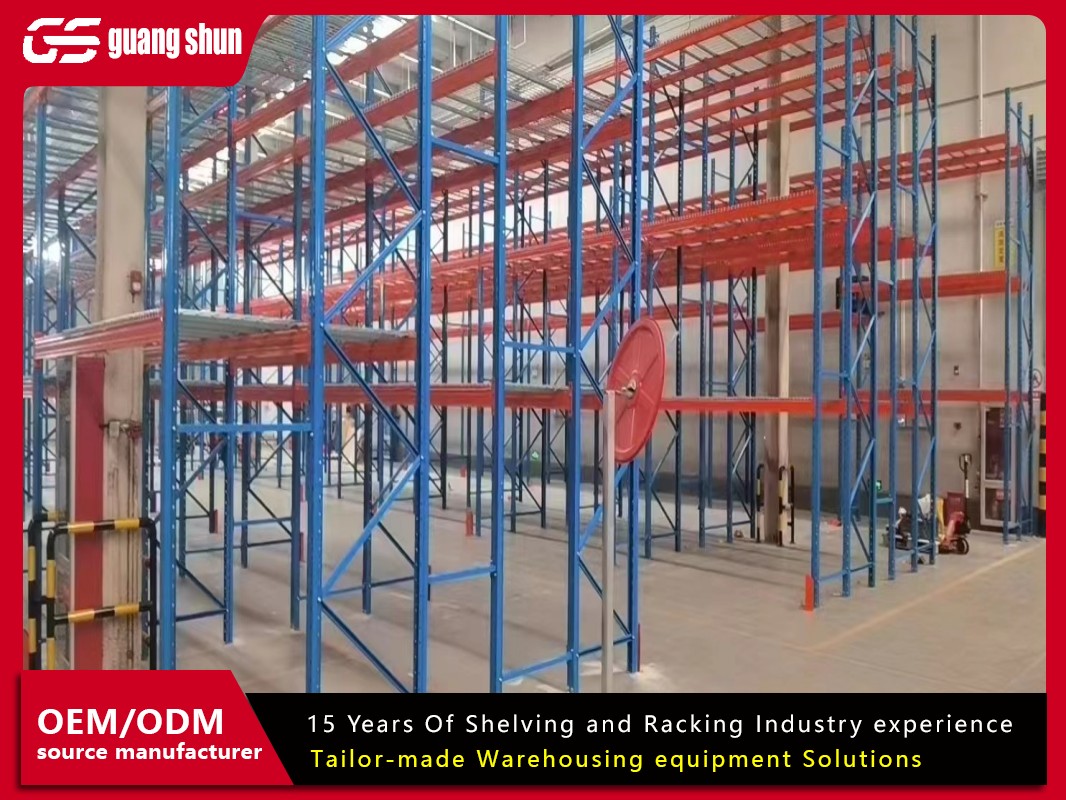
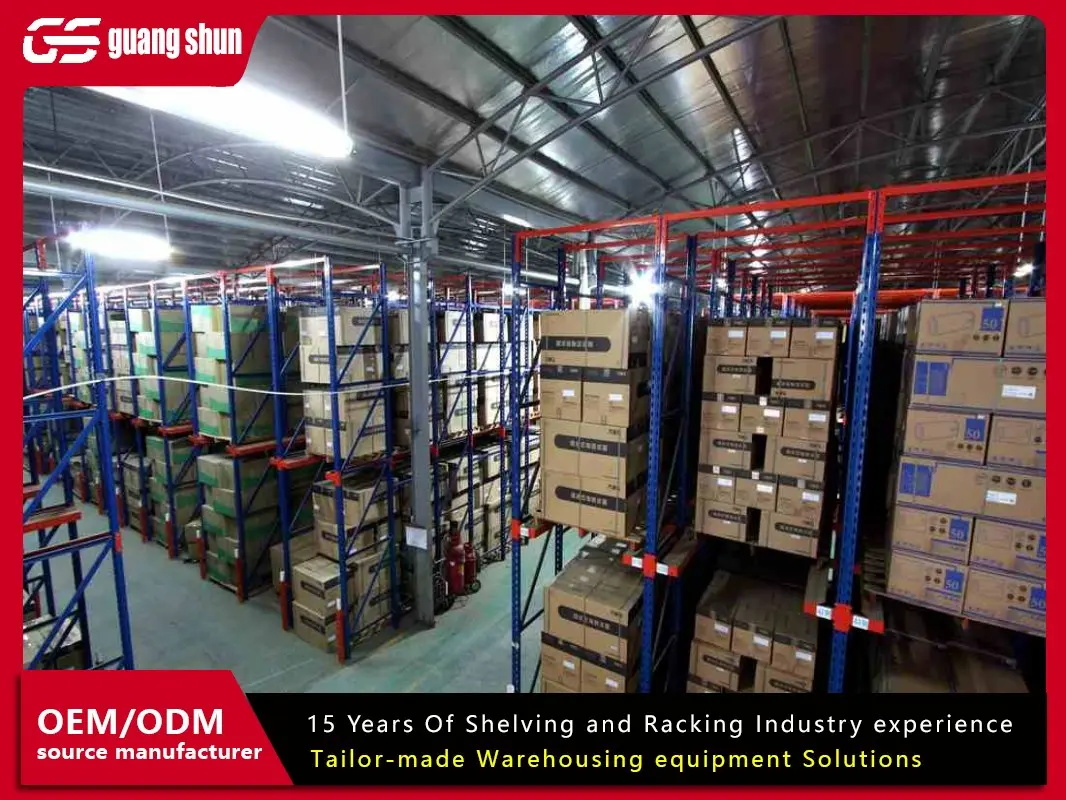
For warehouses needing high-density storage with multiple SKUs per lane, a push racking system offers a distinct mechanical solution. Unlike drive‑in racks where forklifts enter the lane, push racks use a series of nested carts on inclined rails. Each new pallet loaded from the front pushes the previous pallets back. When the front pallet is removed, gravity moves the next pallet forward. This article provides quantitative design criteria for cart bearings, slope optimization, lane depth limits, and seismic restraint, based on field data and RMI/FEM standards.
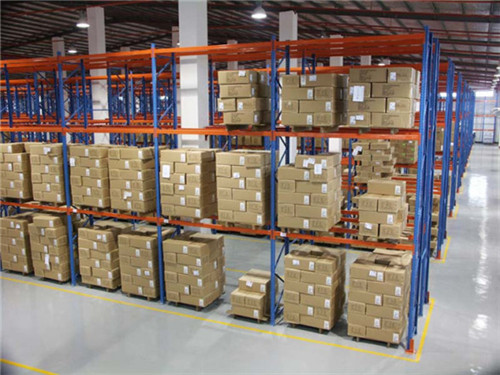
A push racking system consists of three primary subsystems:
Upright frames and rails – heavy‑duty columns (100‑120 mm depth) supporting inclined steel rails (typically 3‑5% slope).
Nested carts – each lane contains 2‑6 carts, one per pallet position. Carts ride on wheels or rollers with sealed bearings.
End stops and bumpers – front and rear stops to retain carts and absorb impact.
When a forklift places a pallet onto the front cart, the cart pushes the entire train backward against the slope. After the front pallet is removed, gravity advances the next cart forward. This LIFO (last‑in, first‑out) pattern is ideal for products without expiration dates. A typical push racking system achieves 60‑75% density compared to drive‑in, but with better SKU separation and lower pallet damage.
The minimum slope required to overcome rolling resistance and bearing friction is given by tan(θ) = μr + (a/g), where μr is rolling resistance coefficient. For steel wheels on steel rails with sealed ball bearings, μr ≈ 0.008‑0.012. Adding a safety margin, practical slopes range from 2.5% to 3.5% (1.4°‑2.0°). Over‑sloping (above 4%) causes carts to accelerate excessively, leading to high impact forces at the front stop. Under‑sloping results in carts that stall or move erratically. Field tests show that a 3% slope provides optimal performance for pallet loads between 1,000 and 2,500 lbs.
Each cart supports a pallet plus the weight of carts above it. For a 4‑cart lane (maximum depth), the bottom cart bears up to 4 pallet loads. Bearings must be rated for dynamic load capacity (C) and static load (C0). Using ISO 281:2007, bearing life L10 (hours) = (C/P)^3 × 1,000,000 / (60 × RPM). For a typical 1.5″ diameter wheel with C = 2,200 lbs and P = 1,500 lbs, L10 ≈ 15,000 hours at 10 RPM (one cycle per 2 minutes). In high‑throughput environments (500 cycles/day), replace bearings every 2‑3 years. Sealed bearings (2RS) with lithium grease are mandatory to prevent contamination.
Maximum lane depth in a push racking system is typically 4 pallets (5 carts including the front load position). Deeper lanes (5‑6 carts) require steeper slopes (4‑5%) and stronger end stops, but the incremental density gain is offset by higher maintenance costs. For lanes deeper than 4, a “cascade” design with secondary rails is sometimes used, but most engineers prefer drive‑in racks beyond 5 positions. The table below shows recommended configurations:
2‑deep (3 carts) – slope 2.5%, max load 3,000 lbs per cart, suitable for light‑medium duty.
3‑deep (4 carts) – slope 3.0%, max load 2,500 lbs, standard configuration.
4‑deep (5 carts) – slope 3.5%, max load 2,000 lbs, heavy‑duty rails required.
Cart synchronization is achieved via mechanical interlocks or simple gravity. Misalignment occurs when carts have uneven bearing wear – solution: replace all carts in a lane simultaneously.
Three operational profiles benefit most from push racking.
Drive‑in racks suffer from ice buildup on floor rails, blocking forklift entry. Push racks eliminate floor‑level rails – carts ride on elevated rails, avoiding ice. A frozen vegetable processor installed 120 lanes of push racking system with stainless steel carts and synthetic low‑temperature grease (‑40°C rating). After 18 months, they reported 0 rail‑related jams, compared to weekly blockages in their previous drive‑in racks. The system also reduced product damage by 22% because forklifts never enter the lane.
USDA and EU hygiene regulations demand easy cleaning. Push racks have fewer horizontal surfaces than drive‑in, reducing bacterial growth. Open rail design allows pressure washing. A midwest meat plant replaced their drive‑in lanes with a push racking system, cutting sanitation labor hours by 35% and passing every swab test. The carts are removed quarterly for autoclave cleaning.
Returned items often require LIFO because newer returns are processed first (higher restock value). Push racks provide dense storage for irregular cartons. A European e‑commerce hub uses 3‑deep push lanes for returned apparel. The system handles 1,200 pallets per day with 99.8% inventory accuracy. Compared to selective racks, floor space usage dropped by 52%.
Reliable push racking depends on five material choices:
Rails – hot‑rolled steel channel (C3×4.1 or equivalent) with a wear‑resistant surface. Hardness >200 HB.
Cart frames – welded steel tube (2″×2″×11ga) with cross members to support pallet.
Wheels – nylon or polyurethane on steel hubs. Nylon has lower rolling resistance; polyurethane grips better on slopes.
Bearings – sealed deep‑groove ball bearings (6202 or 6203) with C3 clearance.
End stops – shock‑absorbing urethane bumpers (90 durometer) bolted to channel stops.
For seismic zones, add horizontal bracing between uprights every 4 ft and secure rails with anti‑lift clips. Guangshun provides FEA validation for push rack configurations in seismic D/E zones, including base plate stiffeners and anchor bolt pullout calculations per ACI 318.
Precision installation is mandatory for push rack performance. Rail slope must be consistent across all lanes within ±0.1% measured with a digital inclinometer. Rail straightness: deviation ≤1/16″ over 10 ft. Cart wheel alignment: all wheels must contact rails simultaneously – use a feeler gauge (0.010″ max gap).
Monthly maintenance checklist:
Inspect all carts for free movement – push a cart to the rear; it should return to front stop within 3‑5 seconds.
Listen for grinding bearings – replace any cart with audible noise.
Check end stop urethane for cracking – replace if more than 20% of bumper is deformed.
Lubricate rails with dry film lubricant (graphite or PTFE spray) – do not use wet oils that attract dust.
Annual recertification per RMI/ANSI MH16.1 includes dynamic load testing: place rated load on front cart, release from 6″ above stop, measure impact deceleration (<2g).
For a facility storing 2,500 pallets of non‑perishable goods (turnover 4× per year), we modeled 10‑year total cost of ownership (TCO):
Selective racking – $180,000 initial, $95,000 annual labor (picking and putaway), $8,000 maintenance → TCO $180k + 10×($103k) = $1.21M.
Drive‑in racking – $220,000 initial, $68,000 annual labor (forklift entry slower), $22,000 annual damage repairs (pallet and rack) → TCO $220k + 10×($90k) = $1.12M.
Push racking system – $260,000 initial, $52,000 annual labor (faster front‑face access), $9,000 maintenance (cart bearing replacement), $4,000 damage repairs → TCO $260k + 10×($65k) = $910k.
Push racking provides the lowest TCO over 10 years, with payback vs. selective racking at 2.1 years. The higher upfront cost is offset by reduced labor and damage. Many warehouse operators overlook this because they focus only on initial price.
Three frequent issues in push racking systems:
Cart skewing (wedging) – caused by uneven rail wear or bent cart frames. Solution: install rail guides (vertical rollers) on both sides of carts. Retrofit kits cost $150 per lane.
Bearing seizure – from dust or moisture ingress. Upgrade to sealed stainless steel bearings (440C) and add rail covers. Also schedule quarterly cleaning with compressed air.
End stop failure – repeated high‑speed impacts. Install speed controllers (centrifugal brakes) on the front cart axle. Brakes limit velocity to 0.5 ft/s, extending stop life by 5‑7 years.
For facilities with frequent overloading (pallet weight > 2,500 lbs), upgrade to heavy‑duty carts with 2.5″ diameter wheels and double bearings per wheel.
Q1: What is the maximum pallet weight per position in a push racking
system?
A1: Standard designs accommodate
1,000‑2,500 lbs per pallet. For loads up to 3,500 lbs, specify heavy‑duty rails
(C4×5.4 channel) and carts with 2.5″ wheels and tapered roller bearings. Loads
above 3,500 lbs are not recommended because the required slope (>4.5%)
creates excessive impact energy. Always refer to the manufacturer’s load table –
never exceed the static capacity of the lowest component. Guangshun provides
certified load tests for each cart configuration.
Q2: Can push racking be used in a freezer with frequent defrost
cycles?
A2: Yes, but with specific materials.
Carbon steel rails and wheels corrode rapidly due to condensation. Use stainless
steel rails (grade 304) and nylon wheels with sealed stainless bearings. The
slope must be increased by 0.5% to compensate for ice film. Also, install rail
heaters (low‑wattage resistance wires) if defrost cycles occur more than twice
daily. A Canadian frozen food warehouse uses heated rails and reports 99.8%
uptime over three winters.
Q3: How do I convert an existing selective rack to a push racking
system?
A3: Conversion is possible if the upright
frames are heavy‑duty (minimum 100 mm depth, 2.5 mm thickness). You replace the
beam levels with inclined rails and add carts. However, the original floor
anchors may not withstand the dynamic forces from cart impacts. A structural
engineer must verify anchor pullout capacity. Typically, only 30‑40% of
selective racks are suitable for conversion; others require new uprights. Guangshun offers
retrofit kits with pre‑calculated anchor loads.
Q4: What is the typical lead time for a custom push racking
system?
A4: For a 500‑lane system, engineering and
FEA take 2‑3 weeks, fabrication of rails and carts 4‑5 weeks (if using standard
components), galvanizing/powder coating 1 week, and installation 2‑3 weeks.
Total typical lead time is 9‑12 weeks. Expedited projects with existing
certified drawings can be reduced to 6 weeks. Always order spare carts (5‑10% of
total) to minimize downtime during bearing replacements.
Q5: How do I calculate the required number of carts per
lane?
A5: Number of carts = lane depth (pallet
positions) + 1. For a 3‑deep lane, you need 4 carts. The extra cart (front load
position) always holds the pallet being picked. The formula ensures that when
the front pallet is removed, the next cart advances fully to the stop. Never
reduce cart count – it causes unsafe gaps. Some suppliers offer “compact”
designs with shared carts, but these have higher jam rates and are not
RMI‑approved.
Q6: What fire safety measures are required for push racking
systems?
A6: Per NFPA 13, push racks create
horizontal flues (open spaces between pallets) that accelerate fire spread.
In‑rack sprinklers are required if storage height exceeds 12 ft. Additionally,
each lane must have a vertical barrier (solid steel sheet) every 20 ft to
prevent horizontal fire travel. Carts themselves must be made of non‑combustible
materials – nylon wheels are acceptable if they have a UL 94 V‑0 rating. A fire
protection engineer should model the specific configuration using CFD (e.g.,
FDS) to determine sprinkler spacing and water density.
Selecting a push racking system requires rigorous attention to slope accuracy, bearing life, lane depth, and seismic restraint. When properly engineered, these LIFO systems deliver higher density than selective racks with lower damage rates than drive‑in racks. The total cost of ownership often beats alternatives for non‑perishable goods with moderate turnover. Work with an experienced manufacturer like Guangshun to obtain certified cart load ratings, FEA reports, and installation protocols that meet RMI/ANSI standards and local building codes.

 Wechat
Whatsapp
Wechat
Whatsapp